Exploring the UK's cities
A city is a busy settlement where people live and work. They are located all over the UK but what makes a city… a city?
Watch: Find out more about cities in the UK
Discover the difference between cities and towns in the UK.
Bore da. That's good morning in Welsh!
My name is Seren and today I'm in the capital city of Wales - Cardiff. But what makes a city a city and why's it all here in the first place? It's time to do some exploring.
A city is a big town, but not all big towns are cities. City is a title given to a town by a king or queen. These days governments usually decide. To become a city, a town has to be special in someway.
It used to be because the town had a university or cathedral, but these days it might be because a town has a large population - that's the number of people living there - or because it has an interesting history or culture. Cardiff has it all!
Cardiff is in the south-east of Wales where the River Taff and the River Severn pour out into the Bristol Channel between Wales and England.
Thousands of years ago, people came here to live so they could use the River Taff as a water supply and they used both rivers as an easy way to travel. King William I of England started work on the castle here in 1081 so he could keep an eye on Welsh people and the town grew around it.
Then about 200 years ago, Cardiff became really well known as a port shipping coal from the mines in South Wales to harbours all over the world. A canal was dug and a railway was built, more and more people came here to work and the town grew bigger and richer.
Because of this, in 1905, Cardiff was made a city and in 1955 it became the capital city of Wales and now about half a million people live here. But no coal has left the port since the 1960s.
The Senedd building, which is where the Welsh Parliament meets, was built right on the docks where the ships used to be loaded. These days, Cardiff is known as a business centre with TV and film companies, financial services, retail and many other businesses.
Big business is common in other cities too such as Birmingham, which is right in the middle of England in an area called the Midlands. Easy to remember isn't it?
Birmingham is a really big city with a population of over a million people. It started as a successful market town where people would come to shop. Then in the 1700s, the Industrial Revolution began, and it became known for making and building things in workshops and factories.
What city is nearest to you? Or maybe you live in one? Maybe you could visit a museum and find out how it all began?Bye for now. Hywl am nawr.
What is a city?
A city is a type of settlement, which has been awarded the city status by the A ruler such as a king or queen.. Historically, a settlement had to have a cathedral to be made a city, which is why smaller settlements, such as Wells, Ely and Salisbury are still cities today. However this is no longer a requirement.
Generally, it is large and has a The number of people living in an area. of over 100,000. There are usually, but not always:
- houses
- shopping centres and retail parks
- places of worship
- banks, post offices
- entertainment venues such as theatres or cinemas
- tall buildings used for offices
- factories on the outskirts
- transport links
In a city centre, businesses are very There is a lot of them in a small area.. There are usually banks, offices, large shops, and also restaurants, bars and hotels close together. As land is very expensive in the centre of cities, there are usually lots of tall buildings there. Some cities can have more than one centre. This can happen when two or more towns grow until they connect and form one city, such as Stoke-on-Trent.
The UK's smallest city, St. Davids in Wales, has a population of only 1,600 people.
Cities of the UK
There are 76 cities in the UK and most of these are in England. There could be several reasons why:
- With its great rivers and fertile lands, settlements were formed more easily in England than in mountainous Scotland and Wales.
- England is the closest country to mainland Europe, only separated from France by the English Channel. This meant that it was much easier to establish trade links with the southeast coast than with remote parts of the United Kingdom.
The capital and largest city of the UK is London in England. A village that was expanded by the Romans and served as a trade centre and a place to cross the River Thames has grown into a centre of business and culture.
Activity
Tap and find: UK cities
Comparing two cities
Case Study: Cardiff
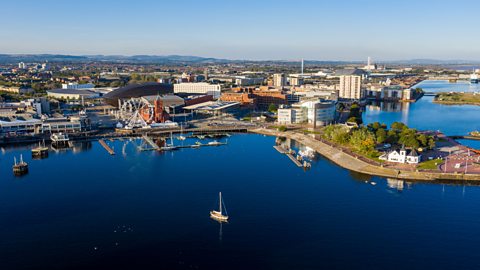
Cardiff is the capital city of Wales.
It is in the south part of Wales at the mouth of the River Severn. The River Taff runs through Cardiff.
Population
Cardiff has around 370,000 inhabitants.
Importance
Before the 19th century, Cardiff was just a small town, then coal mining in Wales turned Cardiff into an important port for trading coal.
Today, Cardiff is the centre of business in Wales, home to the Welsh parliament and a popular place for tourists. It has three universities and a stadium for the Welsh national rugby union and football teams.
Landmarks
- Cardiff Castle
- Cardiff Bay
- Llandaff Cathedral
- National Museum
Land use
The centre of Cardiff has shops and restaurants, and is next to a park with Cardiff Castle. People's homes surround the city centre. The industrial buildings on the waterfront have been redeveloped as offices and entertainment venues.
Case study: Birmingham
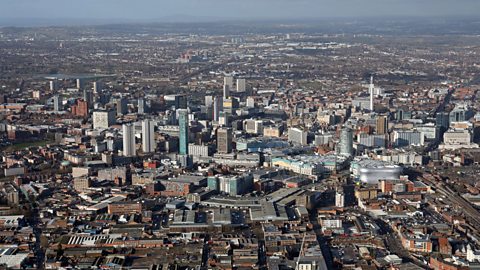
Birmingham is a city in the West Midlands in England. It is the second largest city in the UK.
There are no major rivers going through Birmingham. However, there is a large canal system, which was used as a waterway to transport coal and goods before railways and roads were developed.
Population
Birmingham's population is currently around 1,140,500 people.
Importance
Birmingham was an important market town until the 18th century because of its central location in the country. With the Important change which started in England in the 18th century and changed how things are made. Instead of making everything by hand, things were made by machines ran by steam-powered engines in factories. and the invention of the improved Engine used to power machines. It would use steam to create movement and needed coal as fuel. the city became the centre ofThe process of making a large number of products using machines and people. and Using maths and sciences to design and build machines and buildings.. Today many companies have their offices in Birmingham. It is home to five universities and two football clubs.
Landmarks
- The Bullring shopping centre
- Birmingham Town Hall
- St Philip's Cathedral
Land use
Birmingham's city centre is an important travel hub with shops, large shopping centres and universities. On the outskirts, there are houses, parks and hospitals.
Activity
Quiz: Exploring cities

Race Across the Continents game - new update! game
Help this team of adventurers race their way to victory. Explore the globe in this exciting game update to discover new audio voiced by Ade Adepitan and fun animations. Challenge yourself with brand-new achievements and become a high-flyer!

More on Geography of the UK
Find out more by working through a topic
- count10 of 17
- count11 of 17
- count12 of 17
- count13 of 17