How much food was there during World War One?
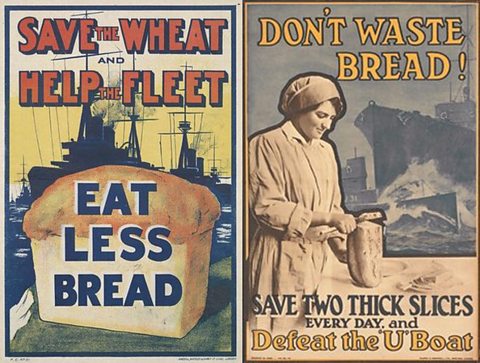
Fresh fruit, vegetables, meat and bread were hard to find.
- There were long queues outside shops.
- Lots of food was sent away to feed soldiers fighting in the war.
- There was less food arriving, as ships carrying supplies were attacked by German submarines.
- In 1918 the Government brought in rationing.
Watch: What was rationing?
Watch our video to find out more about rationing during World War One.
JACK: Potatoes, chocolate. Two of my favourite foods. What do you get if you put them together? So far, a disgusting mess!
But if I was a boy in World War One, I might have cooked this.
WARTIME BOY: Yes, chocolate potato pudding sounds great to me because during the war, we couldn’t be fussy about our food.
Before the war started, a lot of our food was brought by sea from other countries.
Without these supplies there wouldn’t be enough food to go around.
As the war went on, Germany decided if they saw a ship supplying food to Britain their warships or submarines would sink it.
So soon there was more and more of our food at the bottom of the ocean and less and less on people’s plates.
If they could find any free land, people started trying to grow their own vegetables on it.
And we began trying to save bread because the wheat we needed to make the bread wasn’t arriving on the ships anymore.
Posters told us how we could help, and recipe books and leaflets taught us how to cook with whatever food we had.
I can make soup with scraps, stuffed onions with leftover meat, and cook fish sausages.
And, because there wasn’t much wheat, we use potatoes in our biscuits and cakes instead.
That’s why I’m making a chocolate pudding with potatoes.
But food prices were still going up and the quantities were going down.
Some days I didn’t get very much dinner.
For poorer families life was getting very, very hard.
Empty shops and empty stomachs – it was horrible.
Finally, rationing was introduced to make sure that Britain’s food could be shared out fairly among everyone.
A ration book allows us to have a certain amount of some foods like meat, sugar and butter.
And that’s it. We have to make it last for a whole week.
Rationing is followed by absolutely everyone. Even the King and Queen are on a diet.
And some poorer families are able to eat meat for the first time.
Rationing has helped to stop people starving. And during the war we’ve learnt not to waste any food.
Chocolate potato pudding – delicious!
JACK: And I’m not going to waste my chocolate potato pudding either.
Bleurgh! Maybe I’ll finish it tomorrow.
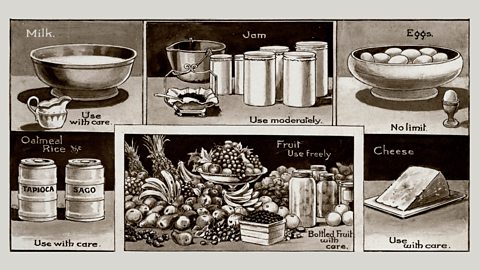
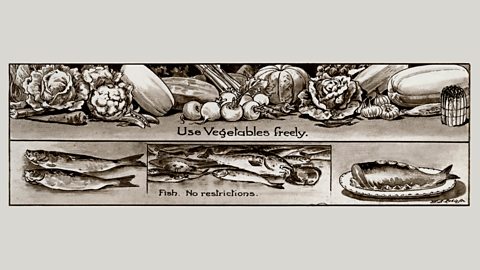
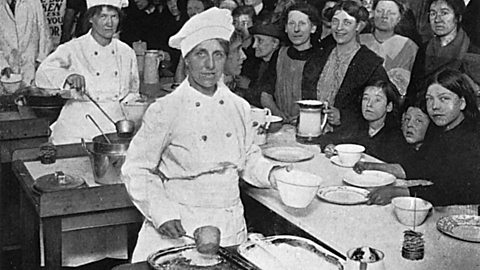
Which foods were rationed?
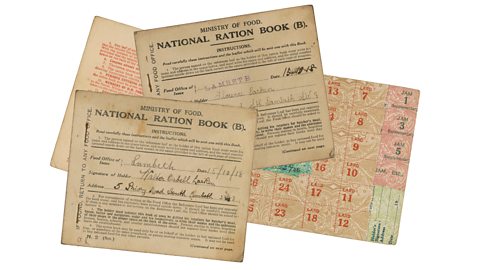
Image caption, Ration cards could only be used at certain shops
Families had to say which butcher, baker and grocer they would buy their food from.

1 of 6
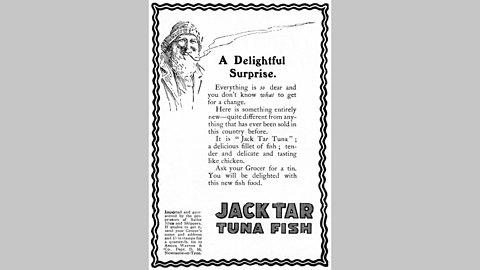
What did shop owners sell?
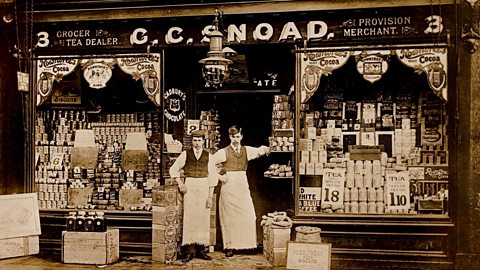
Image caption, The grocer sold shoppers many of the everyday things they needed
Their packed window displays were a common sight. Among the things they sold are a few brands we still have today.
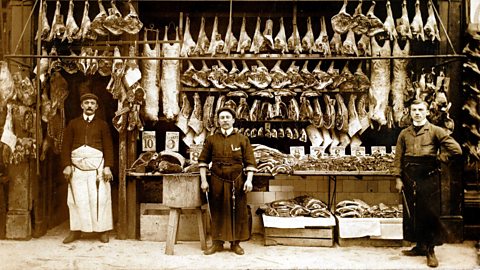
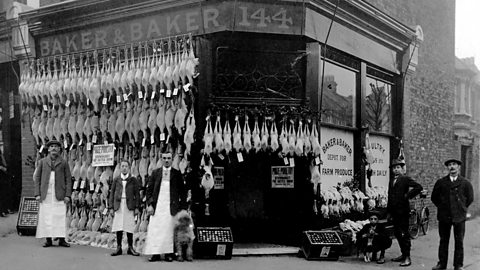
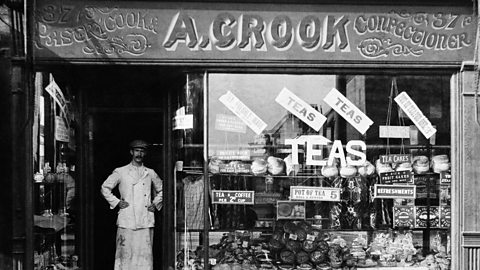
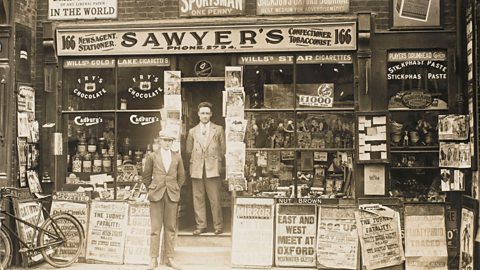
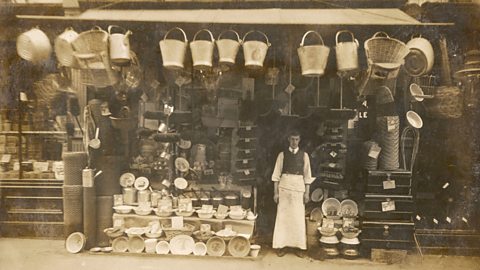
1 of 6
What were school dinners like?
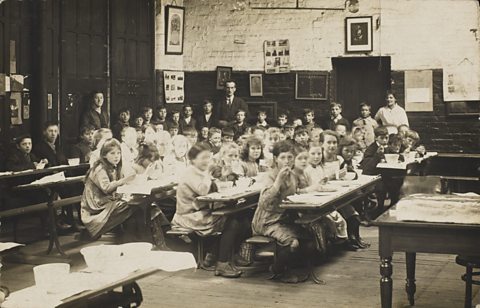
From 1906, many pupils got a school meal such as:
- Bean soup and bread, followed by treacle pudding.
- Toad-in-the-hole (sausages in batter) and potatoes.
- Mutton stew and suet pudding.
- Fish and potato pie, then baked raisin pudding.
In the war, schools also had food shortages and had to cut back.
Some families ate only one meal a day. They got by on tea, bread and jam. They may have had only one meal a week with meat, usually on a Sunday.
What were sweet shops like?
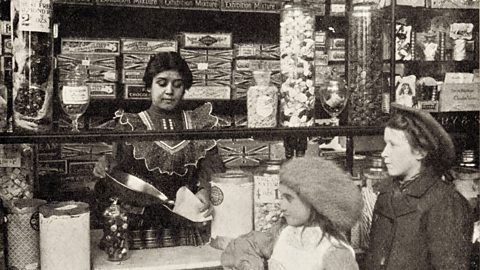
Sweetshops in the early 1900s sold hard-boiled sweets such as:
- humbugs
- peppermints
- pear drops
Sweets were kept in big glass jars. The shopkeeper would weigh them out and hand them to customers in a paper bag.
Activities
Activity 1: What shops were on the high street?
During World War One shops looked very different from today.
There were no supermarkets or shopping centres. Shops were smaller and many were named after the families who owned them.
Explore our interactive high street and click on different people to find out more about them.
There are ten different people to find. You can use the question mark button to highlight them all.
Activity 2: Quiz – Rationing during World War One
Activity 3: History Explorer game
Play this game to test your knowledge and learn even more facts about World War One.
History Explorer: Secrets through time
History Explorer: Secrets through time: KS2 History
Horrible Histories: Raid and Trade game! game
Play Horrible Histories: Raid and Trade KS2 History
More on World War One
Find out more by working through a topic
- count42 of 43
- count43 of 43
- count1 of 43