Why are flowering plants important?
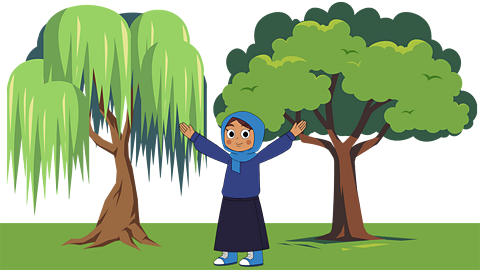
Plants are very important living things.
They have lots of jobs, such as providing animals with food and releasing oxygen into the air.
Plants can be divided into two groups, those that produce flowers, called flowering plants, and those that don’t.
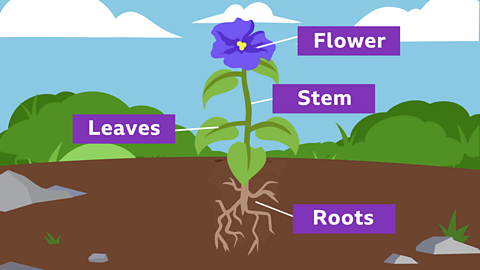
Flowering plants all have the same four important parts, with each part doing something different to help the plant carry out all its jobs:
- Flower
- Stem
- Leaves
- Roots
The parts of a flowering plant
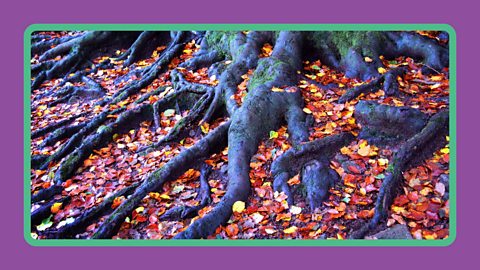
Image caption, Roots
A plant gathers water through its roots which grow underground.
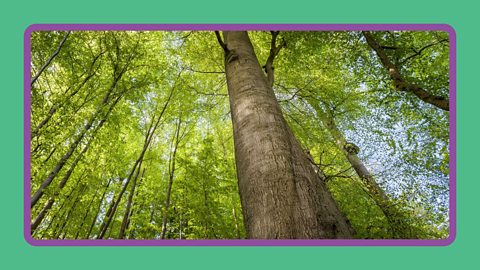
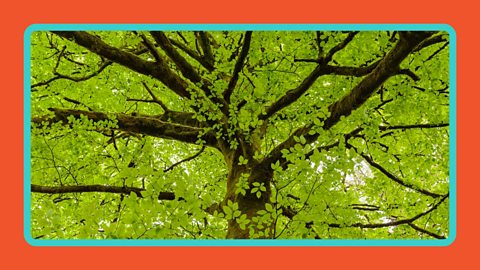
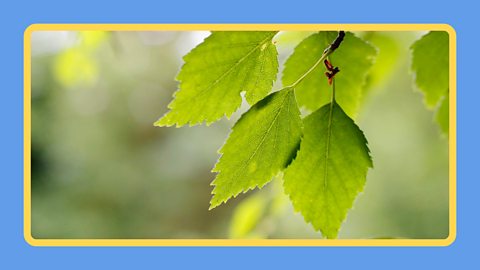
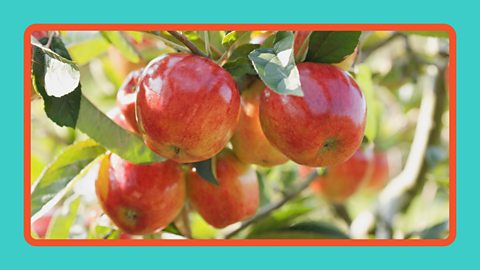
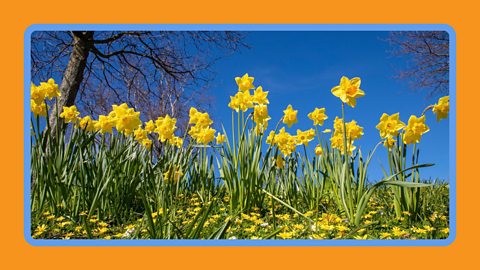
1 of 6
Fascinating flowering facts
Flowers can be used as natural dyes. For example, madder produces a deep red colour.
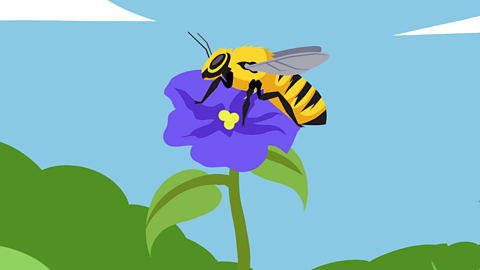
Flowers are an essential food source for pollinators like bees, butterflies, and hummingbirds.
Some flowers are carnivorous and have evolved to trap and eat insects and other small animals for nutrients.
Watch: What are the parts of a plant?
Ivy: I'm busy!
Posey: Aunt Ivy I've brought you another…
Posey: Stop!
Posey: What ARE you doing?
Ivy: I'm getting rid of all the ugly bits I don't need. These hands don't have any fingers; you can't even see these little toes they're hidden in the ground, and this neck scoffs is way too long.
Posey: No. You can't just keep all the pretty bits. It's like, ummmm, a human body. All the bits are needed and have their own function.
Posey: That means the job that they do. If you didn't have bones, you wouldn't be able to hold your head up; if you didn't have a stomach, you wouldn't be able to digest food; if you didn't have lungs, you wouldn't be able to breath.
Ivy: Holds breath That's not true. ExhalesWell I've never seen a plant breath, or eat, and they definitely don't have bones… I don't think.
Posey: Their parts all have functions. What do you think a stem does?
Ivy: That's easy, it's to see above the rest of the flowers of course.
Posey: No. The stem supports the plant and transports water and nutrients.
Ivy: Nutrients?
Posey: Food.
Ivy: Ah, gotcha.
Posey: All around the plant, ok?
Ivy: Mhmm.
Posey: What about the leaves?
Ivy: That's easy, they're for waving at its friends.
Posey: No, the leaves help the plant make food for itself.
Ivy: Greedy.
Posey: And the roots?
Ivy: Oh they don't do anything, they just make a mess.
Posey: The roots keep the plant in the ground and absorb water and nutrients. They're like straws, they suck up all the bits they need from the soil.
Ivy: But, the flower's the only bit I like, because it's got pretty colours and it smells nice.
Posey: Finally, you got close, but there's much more to it than that.
Ivy: Well, why does the flower have to look pretty?
Posey: The flower has to look pretty and smells nice so bees will come and visit them,
Ivy: Aw, thanks for explaining that to me
Posey: So, here's the plant I was bringing you.
Ivy: Thank you. I promise I will take much better care of it.
Each part of the plant has a different job, and they all work together to keep the plant alive and healthy. Let’s find out what they do!
| Roots | Take up water and nutrients from the soil. The roots also keep the plant steady and upright in the soil. |
| Stem | Carries water and nutrients to different parts of the plant. The stem of a tree is called its trunk. This often divides into smaller branches. |
| Leaves | Use light from the Sun, along with carbion dioxide from the air and water to make food for the plant. This process is called photosynthesis. |
| Flowers | Are involved in plant reproduction and produce seeds from which new plants grow. |

Did you know?
All flowering plants produce fruit.
Sometimes it looks like the fruits that we know and can eat, like apples, plums and blackberries, and in other plants it doesn’t look like a fruit we know at all.
The job of the fruit is to protect the seeds of the plant and to help them to be spread.
Watch: The structure of a plant
Take a closer look at the structure of plants.
Sally: I’m Sally Forth. I’m going to introduce you to a fantastic little plant found deep in uncharted territory. Wooooh!
Firstly see how its roots bury themselves in the soil. It needs a strong stem to hold up its impressive green leaves.
Seeds contain a store of food enabling a new plant to grow.
And look at this striking flower… Attracting insects to it with vibrant colours and intoxicating smells.
Girl: Sally!I hope you’ve remembered to water the hanging baskets.

Did you know?
Flowering plants from all over the world which live in different climates and habitats, all have the same structure, even if they look very different to each other.
A tree's stem is called its trunk.
There are some plants which live underwater. Some aquatic plants like seaweed live in the sea.
Important words
Carbon dioxide – Carbon dioxide is a gas, absorbed by plants from the air to make food.
Leaves – A plant's leaves use light from the Sun, along with water and carbon dioxide to make food for the plant as part of the process of photosynthesis.
Nutrients – Nutrients are the substances that nourish a plant.
Photosynthesis – The process in which plants use sunlight, water and carbon dioxide to create their own food and oxygen.
Roots – Roots take up water and nutrients from the soil, the roots also keep the plant steady and upright .
Stem – The stem carries water and nutrients to different parts of the plant.
Wilt – When a plant becomes weak from too much heat or not enough water.
Activities
Activity 1 – Find the parts of a plant
Activity 2 – Take the quiz
Activity 3 – Identifying and describing plants
Next time you are in your garden, local park or playing field:
- Identify as many different plants as you can.
- Draw a picture of each plant that you see.
- Explain how they are similar and note the differences that they have.
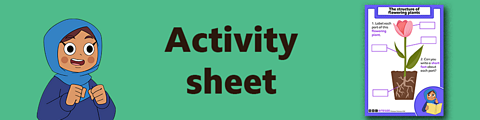
Activity 4 - Label the structures of a flowering plant
New game! Horrible Science: Stinky Space. game
Join Pipette on her epic mission and learn some revolting facts about space along the way.

More on Plants
Find out more by working through a topic
- count2 of 5
- count3 of 5
- count4 of 5
- count5 of 5