How to describe 2D shapes
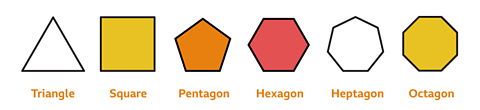
2D shapes can be described by their sides, their angles and their symmetry.
The sides might be equal in length and some might be parallel.
The angles could be right angles, but sometimes they are greater than or less than a right angle.
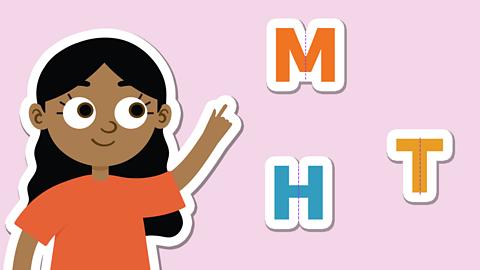
A 2D shape could have line symmetry or rotation symmetry, or both!
How to describe 3D shapes
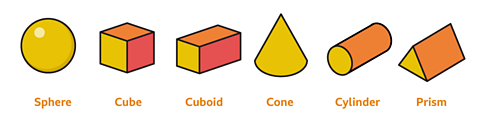
3D shapes are described by their faces, edges and vertices.
The faces can be the same shape or different, and a 3D shape could have a curved surface as well as flat faces.
Example 1
Dawn describes a 2D shape as having 4 right angles. What shape could it be?
A square has 4 right angles and 4 equal sides.
A rectangle has 4 right angles, but not equal sides.
Dawn’s shape could be a square or a rectangle.


Example 2
Bruce draws this quadrilateral. How can we describe it?
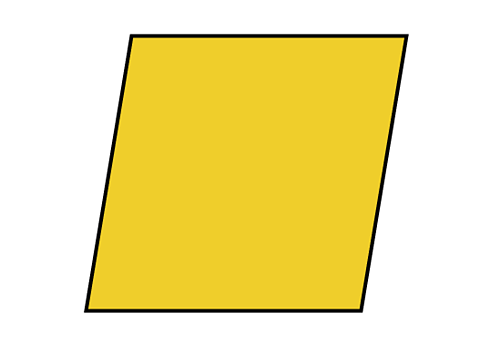
- It has 4 equal sides, and the opposite sides are parallel.
- It has 4 angles but none are right angles.
- The opposite angles are equal.
It is a rhombus.
Example 3
Sophie draws this triangle. How can we describe it?
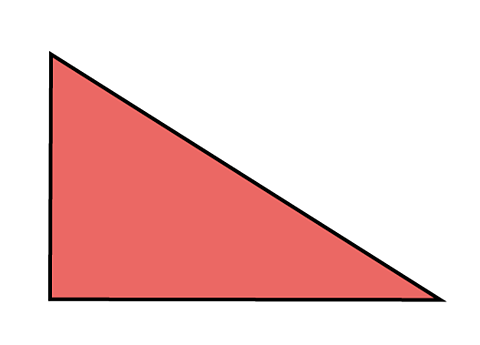
- It has 3 sides that are all different lengths.
- It has 1 right angle.
It is a right-angled scalene triangle.
Example 4
Mika draws a shape with 5 equal sides and 5 equal angles. What is her shape?
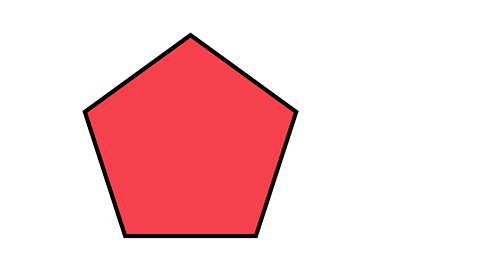
A shape with 5 equal sides and 5 equal angles is a pentagon.
Example 5
Chloe notices that her 3D shape has 5 flat faces. 4 of the faces are triangles.
She also counts that it has 8 edges and 5 vertices. What is her shape?
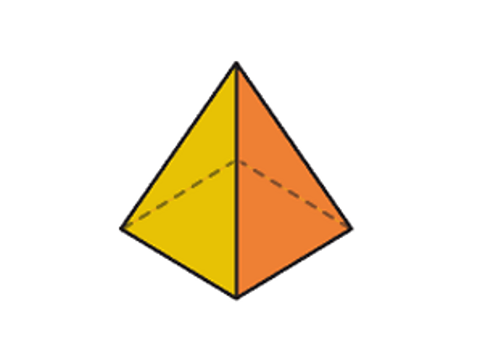
Chloe’s shape is a square-based pyramid.
Quiz
Play our fun maths game Guardians: Defenders of Mathematica. game
Use your times tables and more maths skills to defeat monsters and reclaim the Kingdom of Mathematica
More on Shapes and movement
Find out more by working through a topic
- count2 of 2