Key points
Natural selection is known as ‘the survival of the fittest’. The best adapted organisms are able to survive.
The most desirable characteristics get passed down from parents to their offspring.
Scientists have used fossils to look at how organisms have evolved over time.
Video
A research fellow at Oxford University explains what natural selection is
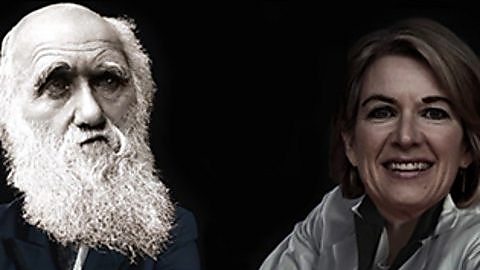
LAUREN: In 1859, Charles Darwin published his On The Origin of Species, which sets out the theory of natural selection.
I'm Lauren, I'm a research fellow here at the Oxford University Museum of Natural History. The basic principle of natural selection is what we call the survival of the fittest.
Those that are poorly adapted may well die out before they can reproduce, and those that are best adapted will go on to produce more offspring and pass their genetic material on.
In giraffes, there were some taller giraffes than others. And those taller giraffes would have been able to reach more food.
Everything you look at has been through a very long process of natural selection and evolution to be as it is now.
If you went and looked at anything that shows camouflage, or specialisation to eating a particular food, or attracting mates in a particular way — all of those are examples of natural selection.
Some of the examples we've got here include things like birds of prey. They've all evolved to have this very similar kind of colouration. They're quite well camouflaged. They all have very large eyes. They're very light, very fast flyers — all of these things are a result of being selected to be a good predator.
Humans exert a lot of influence. Cats and dogs have massively changed evolutionarily since humans started domesticating them.Dogs, for example, look very different from the wolves that they would have been related to.
The best thing about my job is that I have freedom to think about big questions. I get to work on all these incredible animals.I get to travel the world. I work with amazing people, and I get to share some of my research with people that come into the museum, which is amazing.
Natural selection
Natural selection is a process by which a species changes over time in response to changes in the environment, or competition between organisms, in order for the species to survive.
The members of the species with the most desirable characteristics are able to produce the best-adapted offspring. If a species is unable to adapt then it is at risk of becoming extinct.
Evolution
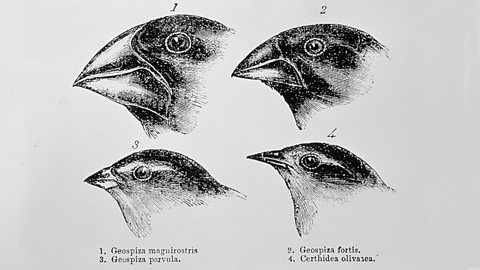
Charles Darwin’s theory of evolution suggested that different species have evolved from simpler life forms and that the organisms able to survive are those that have adapted best to their environment.
Evolution is a slow process that can take many thousands, even millions, of years to happen. Scientists have used fossil evidence to look at how organisms have adapted over millions of years and how their characteristics have changed.
If a species is unable to adapt quickly enough to its environment, then it is at risk of becoming extinct. This can happen for many reasons:
- New predators
- New diseases
- Destruction of habitats
- Changes to the environment
- Increased competition for resources
Test your knowledge
Play the Atomic Labs game! game
Try out practical experiments in this KS3 science game.
More on Inheritance and genetics
Find out more by working through a topic
- count7 of 11
- count8 of 11
- count9 of 11
- count10 of 11