Key information
We live on planet Earth which circles around the Sun, our source of heat and light.
In this Space article you will find out about:
- what the Earth, Sun and Moon are and how they are different from each other
- why we experience day and night
- what causes the different seasons
- the movement and shapes of the Moon
Watch
Watch this video to find out why we have day and night, and what causes the different seasons.
Up here on the International Space Station I don’t get affected by the seasons but on Earth the seasons are always changing: Spring, Summer, Autumn and Winter.
What causes the seasons to change?
Let’s take a look at this model.
The Sun is a star, a giant ball of burning gas. The heat and light that it gives off helps to keep everything on our planet alive. When we see the Sun moving across the sky during the day it’s because the Earth is spinning, not the Sun.
Let’s put a marker on Scotland. When this part of the Earth is facing the Sun it’s day time, when it’s facing away from the Sun that's night time.
One spin of the Earth is how we measure one full day.
While the Earth is spinning to give us day and night, it is also moving around the Sun. This movement is called an orbit.
One orbit of the Earth around the Sun is how we measure one year.
The Earth spins three hundred and sixty five times in one year. That’s why we have three hundred and sixty five days in a year.
The line around which something spins is called an axis. The Earth's axis is tilted at an angle. The Earth’s tilt is the reason for the changing seasons.
The top half of the Earth we call the northern hemisphere, and the bottom half we call the southern hemisphere.
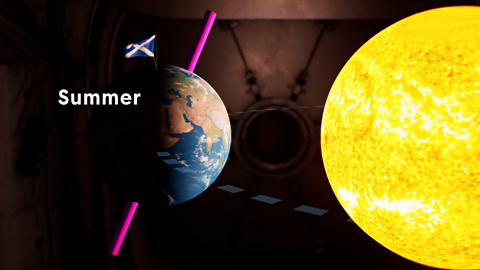
At this point in the orbit, the Earth’s tilt means that the southern hemisphere is facing more towards the Sun. This means that the light and heat from the Sun is more direct and stronger. The days are the longest in the year and the nights, the shortest. This is summer in the southern hemisphere.
Meanwhile, the northern hemisphere is tilted away from the Sun. The light and heat from the Sun is less direct, and it is spread over a wider area so it brings less warmth. The tilt means that nights are longer, days are shorter. This is winter in the northern hemisphere.
In Scotland we experience winter at the beginning of the year. Six months later the Earth hastravelled halfway around its orbit. The southern hemisphere is now tilted away from the Sun so it is winter.At the same time it is summer in the northern hemisphere because it is now tilted more towards the Sun.
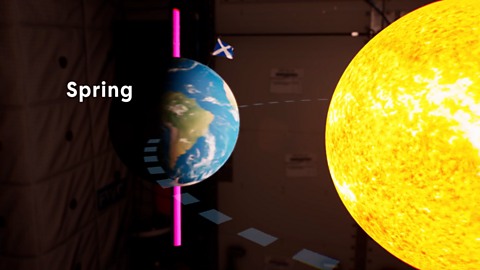
The Earth’s tilt means we experience four seasons as we orbit the Sun. So, starting with winter in the northern hemisphere, the Earth moves round and the days get longer and warmer until it becomes spring.
The northern hemisphere continues to tilt more and more towards the Sun, until the longest summer days in June.
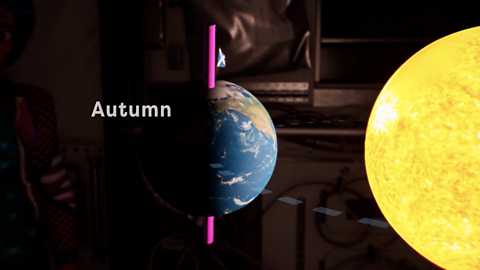
After summer it starts tilting away from the Sun again. The days get shorter and colder as we move into Autumn.
The days keep getting shorter and colder until the northern hemisphere is tilted the furthest from the Sun. This is winter once again. We’ve completed another orbit of the Sun and as a new year starts, the cycle of the seasons starts all over again.
What are the Earth, Sun and Moon?
We live on Earth. It is a A large, spherical object that orbits a star. Planets can be made up of solid material or gases. made of rock and metals.
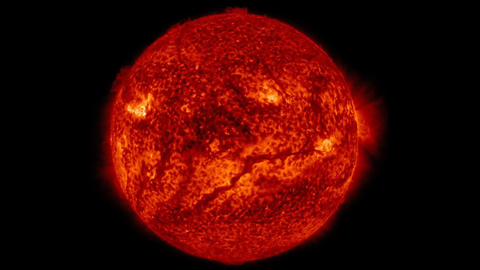
The Earth circles around the Sun in a path called an To orbit means to travel in a regular path around another object, for example a planet travelling around a star. Orbit is also the name for the path the object travels round.. The Sun is a A huge ball of burning and glowing gas that radiates light and heat. made of hot, glowing gases.
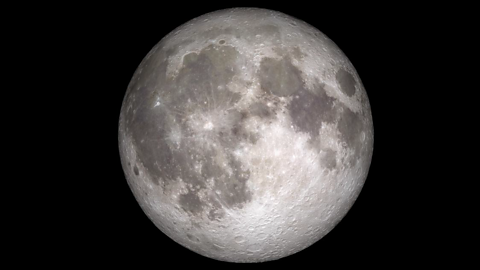
The Moon is a An object that orbits a planet or star. Satellites can be natural objects, for example moons, or made by people, for example weather satellites or the International Space Station. made of rock. Just like the Earth orbits the Sun, the Moon orbits the Earth.
- Image source, NASA
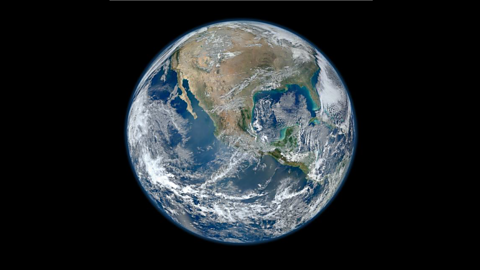
Image caption, This is what the Earth looks like from space.
The green and yellow are the countries, the blue is the sea and the white areas are clouds.
1 of 3
The Earth, Sun and Moon are all spheres – the shape of a ball. But they are very different sizes.
- The Sun is 109 times wider than Earth
- The Earth is more than three times the width of the Moon
How to make a scale model of the Earth and Sun
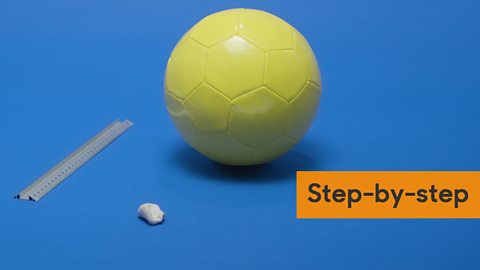
Image caption, Click to see a step-by-step slideshow

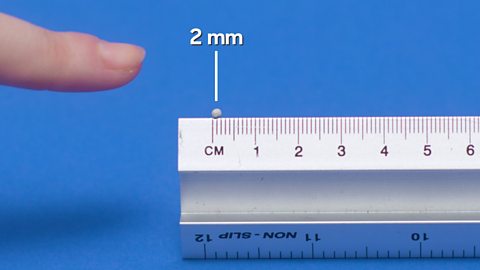

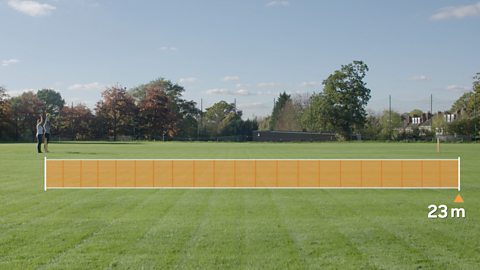
1 of 5
How do we get day and night?
The Earth is always spinning around on its A straight line around which an object spins (an imaginary line going through the Earth from the North Pole to the South Pole).
It takes the planet 24 hours to spin all the way round once. That's why one full day (including night) takes 24 hours.
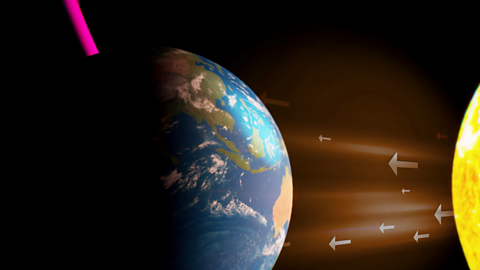
- when part of the Earth faces the Sun and gets lit up it is daytime.
- when part of the Earth faces away from the Sun it is in darkness. This is night.
Because the Earth is always slowly spinning, everywhere on Earth turns in and out of the light from the Sun, moving between day and night.
Quiz
Why do we have a year with seasons?
As well as the Earth spinning on its axis, at the same time it is also orbiting the Sun.
The Earth takes 365 and a quarter days to make one complete orbit of the Sun. This is why a year on Earth is 365 days long.
(The extra quarter day is the reason why we have a 366 day leap year every four years.)
Activity
Why do we have four seasons?
The Earth’s axis is slightly tilted. This tilt gives us our seasons.
The four seasons are spring, summer, autumn and winter.
Winter is when the northern hemisphere (where we live) is tilted away from the Sun. Sunlight hits the northern hemisphere at a shallow angle. This spreads sunlight over a wide area so it is weaker and less warm. Winter has the coldest weather and the longest nights of the year.
Spring is when the northern hemisphere begins to tilt towards the Sun. Longer days with stronger sunlight make the weather warmer and brighter. This helps plants to grow.
Summer is when the northern hemisphere is tilted towards the Sun - this gives us longer days and means the Sun's rays are more direct, stronger and warmer.
Autumn is when the northern hemisphere begin to tilt away from the Sun. Days become shorter and the Sun's light hits the northern hemisphere at a shallower angle. This makes it weaker and so the weather gets colder. The shorter days cause the leaves on trees to change colour.
Look at how the Earth's tilt changes how much sunlight the northern hemisphere receives.
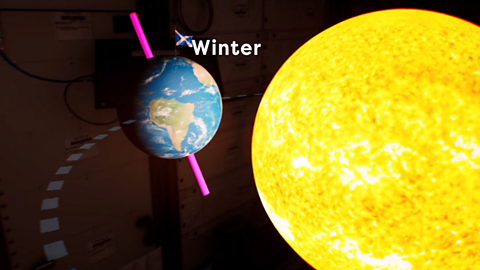
Image caption, Winter - the northern hemisphere tilts away from the Sun.
It is in darkness longer, so we have longer nights.
1 of 4
Why does the Moon change shape?
The Moon is always a sphere but you may have seen different shapes of Moon in the sky. These are called the Moon's phases.
The Moon does not make its own light like a star. The Moon appears bright because it reflects light from the Sun. Like the Earth, half of the Moon faces towards the Sun, and half faces away from it.
As the Moon orbits the Earth, we see it from different angles. We see different amounts of the lit and dark side, and this is what causes the phases of the Moon:
This diagram shows how the Moon appears to change shape as it orbits (circles) the Earth due to which part of it is facing the Sun.
- 🌕 Full Moon is when we can only see the side of the Moon that is lit up by the Sun.
- 🌑 New Moon is when we can only see the side of the Moon that is in shadow because it is facing away from the Sun.
- 🌗 Half Moon when we the Moon is side on, and we see half of the lit side and half of the side in shadow.
- 🌙 Crescent Moon is when we only see a small edge of the lit side and mostly see the part of the Moon that is in shadow.
- 🌔 Gibbous Moon is when we mostly see the lit side of the Moon but we can also see part that is in shadow.
When the lit area of the Moon we see is getting bigger each day, we say the Moon is waxing.When the lit area of the Moon we see is getting smaller, we say the Moon is waning.
It takes just over 27 days for the Moon to orbit (go around) the Earth.It takes a little longer, 29.5 days, for the Moon to go through all of its phases.
Quiz
Surface of the Moon
The Moon is made of rock. Its surface has different shapes and patterns on it.
Some markings are A bowl-shaped dent in the surface of an object. A crater can be caused by an explosion, or by the impact of a very fast object. caused by asteroids or meteors crashing into the Moon.
You might be able to see some craters just with your eyes.
If you can use binoculars or a telescope, you should be able to see craters more clearly.
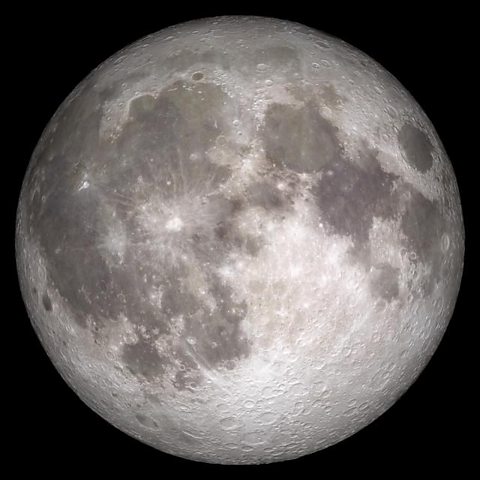 Image source, NASA
Making Moon craters
Here is an activity to investigate how the craters of the Moon are made.
What you need:
shallow metal pan or tray
flour
chocolate powder
marbles or different sized balls
Making craters
- Fill the pan about 2 cm deep with flour
- Lightly sprinkle drinking chocolate to cover the entire surface.
- Drop the marbles or balls into the pan.
- Notice how the marbles make craters in the pan. The white flour is brought to the surface.
- Try dropping different sizes and weights of balls from different heights and angles. See if the craters are deeper or different shapes.
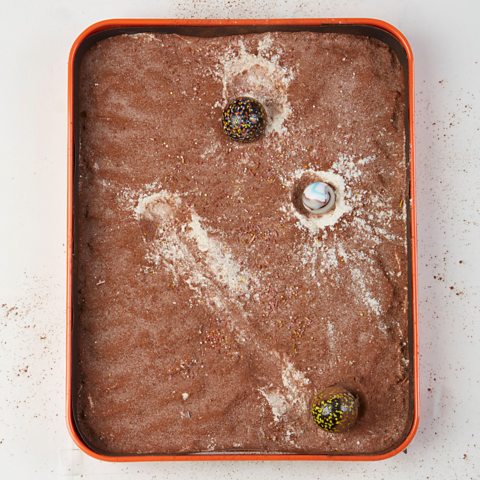
The marbles act as the A rocky object that orbits the Sun. Asteroids are smaller than planets and can be any shape and An object made of dust and ice that orbits the Sun. When close to the Sun, a comet releases gases and dust which are visible as a bright 'tail' crashing into the Moon's surface.
You should notice that it isn't just the size of the object that affects the size of crater. It's mass and the speed it hits the surface at also make a difference.
More on Earth and space
Find out more by working through a topic
- count2 of 6
- count3 of 6
- count4 of 6
- count5 of 6