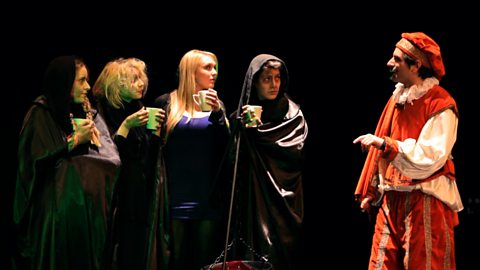
Language plays an important part in Shakespeare’s plays. He uses language in different ways to entertain the audience. Learn about the words he invented and why we still use them today.
Language and relevance
Childhood and family
Shakespeare was a very creative writer: he invented many new words and had a lasting influence on the English language. The plays contain more than 17,000 individual words, and about ten per cent of those were entirely new words. Some of them were not adopted by other speakers of English, but many were. 'Eyeball', 'puking' and 'hobnob' are all examples. You probably use words invented by Shakespeare every day.
Shakespeare is the most quoted writer in English of all time, and he is also the most translated. His plays have been translated into over 80 languages, including some into Klingon (the language spoken by the fictional Klingons in Star Trek)! Other writers have borrowed from Shakespeare ever since the plays were first published. There are many novels which draw their titles from his work, and modern film adaptations which are based on his plays are very common. It seems as if Shakespeare captured something in the way he wrote and told stories.
Find out how Shakespeare influenced the English language with his writing style.
FEMALE PERFORMERLove looks not with the eyes but with the mind and therefore itwinged Cupid painted blind.
FEMALE PRESENTERSo beautiful. There’s lots of lovely language in Shakespeare’splays, but people don’t speak the way that Shakespeare wrote,not in real life, so why is it…
WILLIAM SHAKESPEAREYeah they do. People are always using words and phrases I’vewritten.
FEMALE PRESENTERLike when?
WILLIAM SHAKESPEARELike constantly. You can’t help it, you’ll probably do it any minutenow.
FEMALE PRESENTERWell I’ll bet you I don’t. [CAPTION - “BET”]
WILLIAM SHAKESPEAREBet, that’s one of mine. Henry IV Part One.
MALE THEATREGOERShh!
WILLIAM SHAKESPEAREIt’s my play mate, I can talk if I want.
FEMALE PRESENTERSo whilst we may use some of Shakespeare’s words andphrases, we certainly don’t speak in blank or rhyming verse, butif we did, it might be quite revealing.
MALE THEATRE STAFFNo talking, those are the rules.William ShakespeareYeah, whatevs mate, you don’t run the show here.
FEMALE PRESENTERYou see blank verse is mostly left to nobles or royalty, or those inpositions of power.
MALE THEATRE STAFFI asked you once, I tried to be nice. Now stay away; I’m notgonna tell it twice.
FEMALE PRESENTERHold on. Rhyming verse is mostly left to the magical characterslike witches or fairies.Oh, that must be his day job.The young lovers Romeo and Juliet even speak in rhymingcouplets, rhyming each other’s sentences, to show just how inlove they are.
MALE THEATREGOERI reckon that this girl is stalking us.
FEMALE THEATREGOERI think you’re right, she’s weird. Let’s get the bus.
FEMALE PRESENTEROh, bless.
WILLIAM SHAKESPEAREI think he’s punching a bit above his weight there.
FEMALE PRESENTERWell, love is blind. [CAPTION - “LOVE IS BLIND”]And most of his characters speak in a rhythm called…
WILLIAM SHAKESPEAREIambic pentameter.
FEMALE PRESENTERYes, thank you. Ten syllables to a line with the stress on eachalternate syllable.
FEMALE CAFE CUSTOMEROh my gosh, guess what? Jo and Josh have split.
FEMALE CAFE CUSTOMERHe’s way too good for her and she’s a cheat.
FEMALE CAFE CUSTOMERThat’s true. But you’re the one he fancies now.
FEMALE CAFE CUSTOMERDon’t give me jokes, that boy is so bare fit.
WILLIAM SHAKESPEAREIf music be the food of love, play on. Oh she doth teach thetorches to burn bright. Now is the winter of our…
FEMALE PRESENTERYes, thank you, we get the point. A juicy bit of gossip there in iambic pentameter.But when a character is speaking in prose or ordinary speech,it might mean a number of things. They might be of a lower [CAPTION - “LOWER”] statusor it might mean that something chaotic and unusual is happening.
MALE PRODUCTION STAFFHi guys, I got your coffees. A macchiato and a latte with…
FEMALE PRESENTERWe’re filming.
MALE PRODUCTION STAFF…skimmed milk.
MEMBER OF FILM CREWCut. What the hell do you think you’re doing? We’re in themiddle of a take here you worthless [CAPTION - “WORTHLESS”]Cut, I said cut!
FEMALE PRESENTEROh, now that is an eyeball popping [CAPTION - “EYEBALL”] puke inducing [CAPTION“PUKE”] rant [CAPTION - “RANT”] of remorseless savagery. [CAPTION -“REMORSELESS” “SAVAGERY”]I’m surprised there wasn’t a scuffle. [CAPTION - “SCUFFLE”]
WILLIAM SHAKESPEARED’you think he’ll calm down?
FEMALE PRESENTERWell, it’ll take some groveling. [CAPTION - “GROVEL”]He’s very hot-blooded. [CAPTION - “HOT-BLOODED”]
WILLIAM SHAKESPEAREI’m sorry.
FEMALE PRESENTERNo, d’you know what? I’m quite impressed.Hob-nob? [CAPTION - “HOB-NOB”] You didn’t invent the hob-nob?!
WILLIAM SHAKESPEAREThe phrase, not the biscuit.
FEMALE PRESENTEROh. Right come on, let’s go before I catch a cold. [CAPTION - “CATCH A COLD”] Blimey,this isunreal. [CAPTION - “UNREAL”]
WILLIAM SHAKESPEAREMm.
Did you know?
Shakespeare invented many phrases that we still use today. These sayings all come from different Shakespeare plays – do you know what they mean?
- All that glitters is not gold [not everything that looks pretty is worth much] (The Merchant of Venice)
- As dead as a doornail [very dead] (Henry VI Part 2)
- Foul play [cheating or behaving badly to win] (Several, inc Macbeth)
- In the ‘mind’s eye’ [seeing something in your imagination ] (Hamlet)
- In the twinkling of an eye [very quickly] (Merchant of Venice, but also based on a phrase in the Bible)
- Salad days [youth – when you are young and green!] (Antony and Cleopatra)
- Wild goose chase [to go hunting after something you can’t catch, so to waste time] (Romeo and Juliet)
And one phrase more famously associated with Sherlock Holmes also comes from Shakespeare’s plays – 'the game is afoot'.
Rhythm
Most of Shakespeare’s plays are written in blank verse, which is a rhythmic verse form that does not rhyme. It echoes the patterns of natural speech, in a more patterned way. His blank verse is written in iambic pentameter. This is a name for a certain pattern of beats called ‘feet’. Pentameter means that each line is divided up into five feet. In each foot there is one stressed syllable. In iambic pentameter the rhythm goes ‘unstressed, stressed’. Sometimes this pattern changes, which can tell you something about the importance of the line.
Sometimes pairs of rhyming lines known as rhyming couplets are used – to mark an important occasion, or to finish a scene with a flourish. Occasionally a very noble character – like the Prince in Romeo and Juliet will speak entirely in rhyming couplets. Some characters use prose – not speaking in any kind of rhythm at all – they are usually the funny characters, for example Bottom in A Midsummer Night’s Dream.
Did you know?
- If you spot a noble character speaking in prose in Shakespeare or a lowborn character speaking in verse, it’s a clue that there is something unusual happening.
- Although Shakespeare is the author most associated with blank verse, it was also used by Christopher Marlowe, another Elizabethan playwright, and the poets John Keats and Alfred, Lord Tennyson.
On the page
Playscripts follow certain conventions. One of them is to have the speaker’s name in the left hand margin, next to the words they are due to speak. This helps keep track of who you need on stage.
The plays themselves are divided into scenes – a unit of action that takes place in one place at one time. Scenes are grouped into acts. Shakespeare followed Latin playwrights in using a five act structure, although this is made clearer in modern printed texts than it would have been on the Elizabethan stage.
Because Shakespeare wrote in blank verse, the plays are laid out on the page in verse rather than in prose. Each line is five feet or about ten syllables. Usually a single line will all be spoken by the same person.However, sometimes the rhythm of the line is split between more than one person, which is shown on the page like this:
Lady Macbeth is completing the rhythm of the line, so the playscript will make it clear that she is speaking the second half of the same line. If you see this it suggests very rapid banter between characters, or two very close characters.
Did you know?
Theatres wouldn’t put on a Lots of performances of one play. of the same play in Elizabethan times. In two weeks they might perform ten different plays. This meant the audience could come again the next night. It also made it hard for the actors to learn lines – they might need someone whispering their cues from the side!Actors didn't have individual copies of the script in case rival theatre companies stole them. Sometimes rival actors would attempt to memorise the play during a performance and write it down after – which probably made for very inaccurate copies.
More on About Shakespeare
Find out more by working through a topic
- count5 of 5