Problem 4 - Rods
Problem 4 is about using three lengths of rod to measure all sorts of lengths.
Maths teacher Chris Smith can show you how things add up.
The Maths Week Scotland Daily Challenges have been set by the Scottish Mathematical Council.
Chris Smith - This problem is all about measuring different lengths.
Now normally we would measure with a ruler or a metre stick but we're not going to do that today.
Instead I've got three rods of different lengths. 9, 3 and 1 unit long.
And we can use these in different combinations to measure different lengths.
For example, if I want to measure 10 units I can take the 9 units and put the 1 rod at the end. We know it makes a rod 9 + 1 = 10 units long.
If we want to measure 7 units, I can take that 10 then put the 3 unit rod next to it. 9 + 1 = 10. And 10 - 3 = 7.
Can you work out how to arrange the three rods to measure all the unit lengths from 1 to 13?
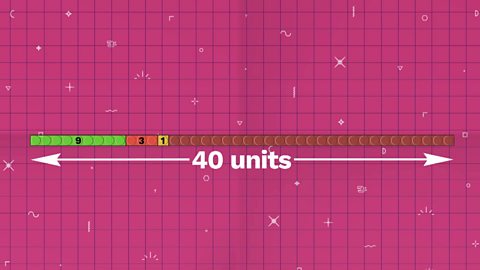
And for bonus points, you can add a fourth rod that will allow you to measure every unit length from 1 all the way up to 40 units. What length would that fourth rod need to be?
First of all, it’s important to remember that you don’t have to use all the rods for every length. You could use one rod, or you could use two, or you could use all three.
And remember you can use these in different combinations to allow you to add to make longer lengths or to subtract when we work out the difference.
You might even want to make your own rods, maybe using building blocks or cutting them out from card to help you to crack this problem.
Give it a go.
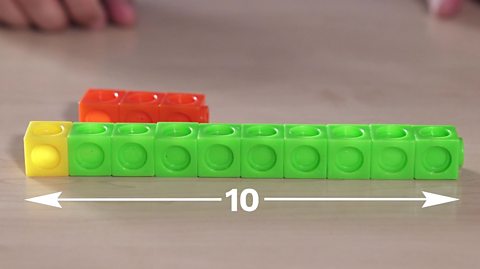
You are given three rods of lengths 1, 3 and 9 units. Using these rods you can measure different lengths.
For example, you can measure 10 units by placing the 9 and 1 rods end to end:
9 + 1 = 10
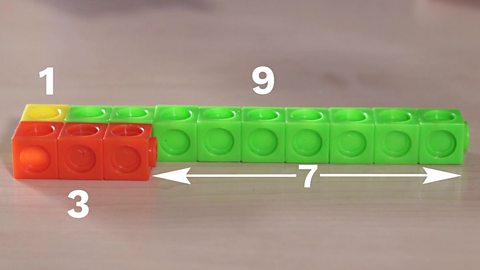
You could measure 7 units by placing the 9 and 1 rods together and then placing the 3 rod next to this. The difference leaves a length of 7 units:
9 + 1 - 3 = 7
There are two parts to this problem:
- a) Show how you could measure each whole number length up to 13 units using different combinations of the three rods.
- b) By adding a fourth rod, it is possible to measure all whole number lengths up to 40 units. What is the length of this extra rod?
Need a hint?
Remember that you don’t have to use all the rods for every length. You could use one rod, or you could use two, or you could use all three.
You can add rods together to make longer lengths.
You can place a short rod next to a longer one to measure the difference between them.
It might help to make your own rods, maybe using building blocks or cutting them out from card to help you to crack this problem.If you like working just with numbers you could try adding and subtracting the numbers 9, 3 and 1 to make all the numbers you need.
Solution
Worked out the answer? Here's how you can do it.
Chris Smith: Did you figure out how to arrange the rods to measure those different lengths?
It basically becomes a question of adding and subtracting.
Let's take a look at how I solved this one.
Length 1 is dead easy. There we go. We know that is 1 unit long.
If we bring in the 3 rod we can see the bit that's remaining is 2 units long.
3 - there we go. And to make 4 we just add in the 1.
To get 5 we'll put the 9 next to this 4. That means this bit here must be 5.
To make this section longer again we take away that 1 and so this section here is 9 take away 3 gives us 6.
To make 7, first of all make 10, take away 3. This section here is 7.
To get 8 what we do is take the 9 and we subtract the 1 and so what's left here must be 8.
To make 9 we just use the 9 rod.
10, we add in the 1, so that is now 10.
To make 11 we start with 3 and 9, which gives 12, and then we subtract 1, so this section here must be 11.
Take that 1 away, this is 12.
And how do we get 12? We combine all three rods and that gives us 13.
Did you work out how long the fourth rod would be to allow us to measure every unit length from 1 all the way up to 40?
We know the other three rods add up to 13. So there's just one possible answer if we can only add one rod that can take us up to a length of 40 units, You have to be able to add that rod onto the 13 to make 40.
So the rod must be 40 take away 13, which equals 27 units long.
And now we use a similar process to before. We already have all of the lengths from 1 to 13. And we can use these rod combinations with the 27. Either adding to 27 or subtracting from 27 to allow us to get every number from 1 all the way up to 40.
We already know how to form the number 13. We put the 9 and the 3 and the 1 together, and that's 13.
So if we line this up with the 27, if this bit's 13, this bit must be 14 because 27 - 13 = 14.
If we want to make 15 we just remove the 1, and then we've got 27 - 12 = 15.
And we can keep going through all of the numbers from 15, 16, 17 all the way up to 40, which is 1 plus 3 plus 9 plus 27.
Did you spot anything interesting about the lengths of the rods in this question? They were all powers of 3: 1, 3, 9 and 27. And that's no coincidence because you had three options for each rod. You could add them, you could subtract them or you could leave them out altogether.
So if you're dead keen you might want to go and find out more about base three numbers.
Part a)
For part a) of this problem, you needed to work out how to make the whole numbers 1 to 13 using one, two or three of the rods of length 1, 3 and 9.
You can do this by adding rods, subtracting rods, and just having rods on their own.
All the combinations are listed in this table and you can see how they rods were put together in this slideshow.
| length | rods |
|---|---|
| 1 | 1 |
| 2 | 3 - 1 |
| 3 | 3 |
| 4 | 3 + 1 |
| 5 | 9 - (3 + 1) |
| 6 | 9 - 3 |
| 7 | 9 + 1 - 3 |
| 8 | 9 - 1 |
| 9 | 9 |
| 10 | 9 + 1 |
| 11 | 9 + 3 -1 |
| 12 | 9 + 3 |
| 13 | 9 + 3 + 1 |
How to measure lengths 1 to 9
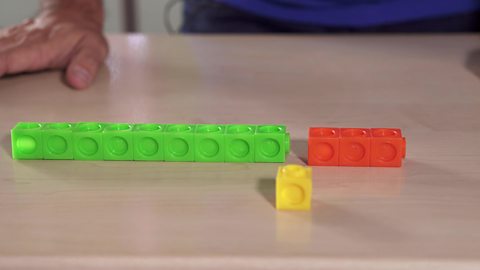
Image caption, 1
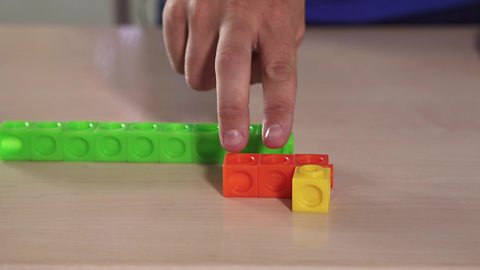
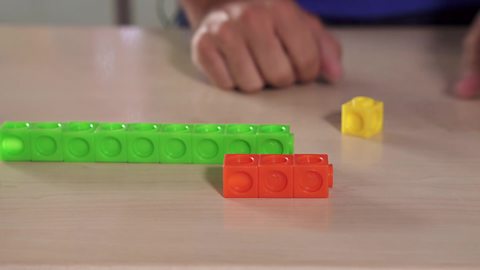
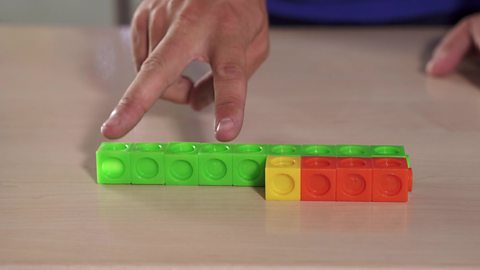
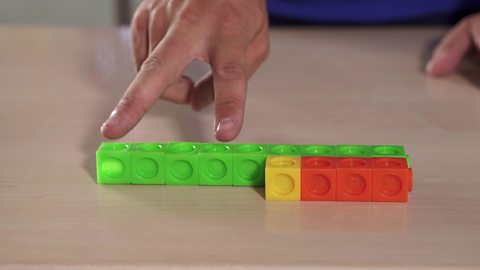
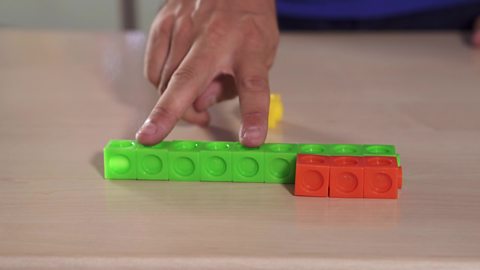
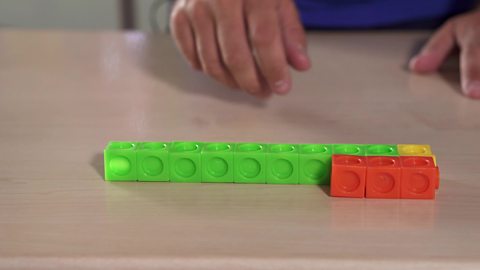
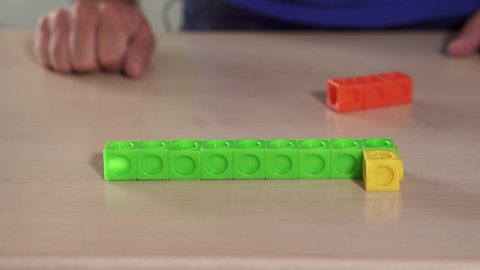
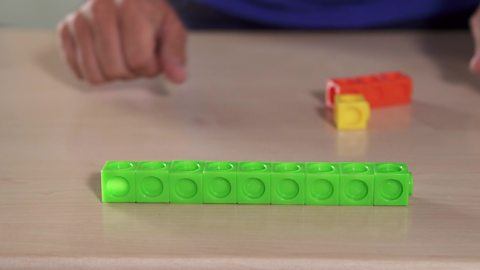
1 of 9
How to measure lengths 10 to 13
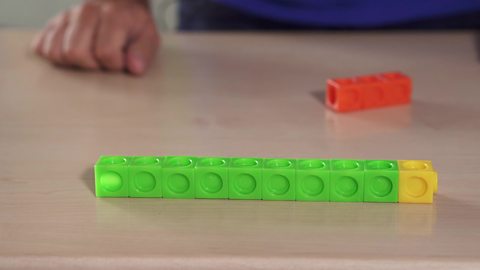
Image caption, 9 + 1 = 10
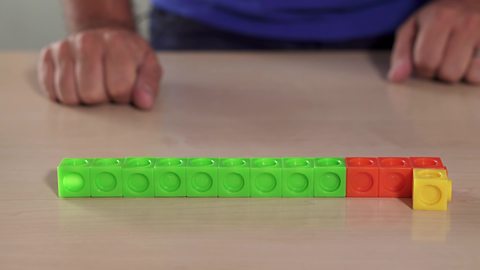
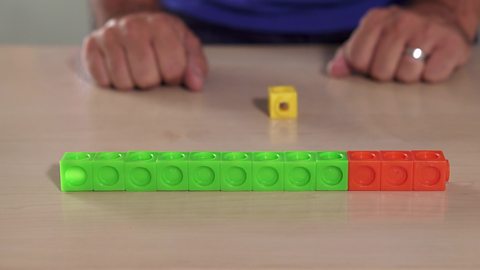
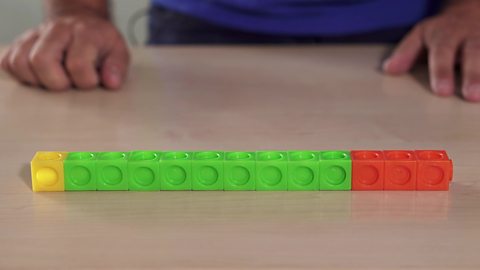
1 of 4
Part b)
You can only add one more rod to make the numbers up to 40. The three rods you already have add up to 13.
So that means the extra rod must equal 40 - 13 = 27. Any other rod would be too short.
You already know how to make numbers 1 to 13.
You can make all the numbers from 14 to 26 by taking these combinations away from 27.
| lengths 14 - 26 | rods |
|---|---|
| 14 | 27 - (9 + 3 + 1) |
| 15 | 27 - (9 + 3) |
| 16 | 27 + 1 - (9 + 3) |
| 17 | 27 - (9 + 1) |
| 18 | 27 - 9 |
| 19 | 27 + 1 - 9 |
| 20 | 27 + 3 - (9 + 1) |
| 21 | 27 + 3 - 9 |
| 22 | 27 + 3 + 1 - 9 |
| 23 | 27 - (3 + 1) |
| 24 | 27 - 3 |
| 25 | 27 + 1 - 3 |
| 26 | 27 - 1 |
And you can make all the numbers from 28 to 40 by adding these combinations to 27.
| lengths 28 - 40 | rods |
|---|---|
| 28 | 27 + 1 |
| 29 | 27 + 3 - 1 |
| 30 | 27 + 3 |
| 31 | 27 + 3 + 1 |
| 32 | 27 + 9 - (3 + 1) |
| 33 | 27 + 9 - 3 |
| 34 | 27 + 9 + 1 - 3 |
| 35 | 27 + 9 - 1 |
| 36 | 27 + 9 |
| 37 | 27 + 9 + 1 |
| 38 | 27 + 9 + 3 -1 |
| 39 | 27 + 9 + 3 |
| 40 | 27 + 9 + 3 + 1 |
More on Problem solving
Find out more by working through a topic
- count19 of 21

- count20 of 21

- count21 of 21
- count1 of 21