Problem 3 - Dice
Problem 3 is all about different A 2-D plan made up of the faces of a 3-D object. This can be folded to form the 3-D object. and working out which ones can fold into cubes or dice.
Maths teacher Chris Smith and pupils from Grange Academy are here to explain.
The Maths Week Scotland Daily Challenges have been set by the Scottish Mathematical Council.
CHRIS: This problem is all about dice.
A die is a cube and like all cubes, it has six square faces.
Any cube can be opened out into a net made up of six squares.
But which of these nets can fold up into a cube?
For those that don't, use the spots to explain why not. And for those that do with the given spots, which form a standard die?
Explain your answer.
Do you think you'd be able to build one of these so that it did fold up to give a cube?
PUPIL: Try cutting out the nets and see which folds into a cube.
PUPIL: Think about the sides on a die. Do you know which numbers are opposite each other?
CHRIS: Opposite faces. Yeah. Do any of them add up?
PUPIL: If you're stuck, find a die to compare the nets to.
CHRIS: So what shape have we formed?
PUPILS: A cube.
CHRIS: A cube, but not?
PUPILS: A die.
CHRIS: Not a die.
PUPIL: Good luck everyone.
So here's the challenge:
A die is a cube and like all cubes it has six square sides.
Any cube can be opened out into a net made up of six squares.
Which of these nets can fold up into a cube?
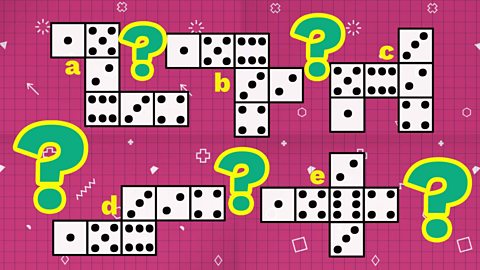
For those that don’t, use the spots to explain why not.
For those that do, with the given spots, which form a standard die?
Explain your answer.

Need a hint?
- Try cutting out the nets and seeing which fold into a cube.
- Think about the sides on a die. Do you know which numbers are opposite each other?
- If you are stuck, find a die to compare the nets to.
Solution
Worked out the answer? Here's how you can do it.
CHRIS: Did you work out which nets could fold up into a cube?
Let's look at each net and find out.
Net A.
This net has six squares but it cannot fold up into a cube. The faces with four and five dots overlap.
Okay, good.
PUPIL: Four and five overlap.
CHRIS: Net B.
Net B can't make a cube when it's folded up either. When we fold it up, the faces with one dot and four dots overlap. Let's see. Does it make a cube? Does it make a die? On you go.
**PUPIL:**One and four overlap.
CHRIS: Net C.
This net doesn't make a 3D cube as faces with one dot and four dots overlap.
**PUPIL:**It doesn't work.
CHRIS: Yours doesn't work?
**PUPIL:**One and four overlap.
CHRIS: Net D.
This net can fold up to make a cube. None of the faces overlap.
It works.
CHRIS: Net E.
And this net folds up into a cube, too.
It's got all six, you've checked that it's got a one, a two, a three, a four, a five and a six, yup. So they've got no sneaky sevens in there.
So we have two nets that make cubes but are they dice?
For a net to fold into a standard die, it needs to have the right numbers in the right positions. On a standard die, the opposite numbers add up to seven.
So one is opposite six. Two is opposite five and three is opposite four.
We know nets D and E both make cubes. But do they make standard dice?
Let's take a look at net D. Faces with one and six dots are opposite. Two and five are opposite and three and four are also opposites.
So, net D does make a standard die.
So we should have a one and a six. Yes? What else?
Two and a five and?
Four and a three, and we've gone all of those. Excellent.
What about Net E? This cube does not make a standard die as faces with two and three dots are opposites, so are four and five.So what shape have we formed?
PUPILS: A cube.
CHRIS: A cube. But not?
PUPILS: A die.
CHRIS: Not a die. We still can make sevens but not with opposite faces. So D and E will both make cubes. But only D will make a die.
Great job. If you solved this dicey challenge.

There are two parts to solving this problem.
Step one
First we need to check which nets can fold up into a cube.
To do this, all six faces need to come together to make the six faces of a cube. If they overlap or leave a gap, then they are not nets for a cube.
- net a is not a net for a cube. When folded up the faces with five and four dots overlap
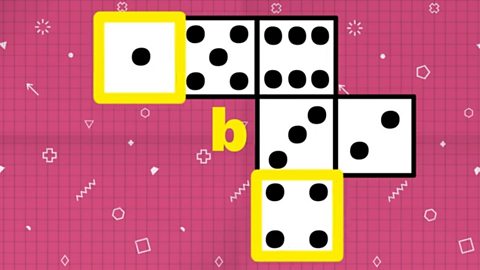
- net b is not a net for a cube. When folded up the faces with one dot and four dots overlap
- net c is not a net. When folded up the faces with one dot and four dots overlap

- net d is a net for a cube. No faces overlap
- net e is a net for a cube too. No faces overlap.
So only net d or net e could be dice.
Step two
Next we need to check if the faces are in the right position.
On a standard die, the dots on opposite sides add up to seven:
- one dot is opposite six dots
- two dots is opposite five dots
- three dots is opposite four dots

net d folds up so that all these sides are opposite.
net e does not fold up so that all these sides are opposite. Faces with two and three dots are opposite, so are four and five.
So although both net d and net e are both cubes, only net d makes a standard die.
Maths Week Scotland 2023. list
Try out all the daily challenges from Maths Week Scotland 2023.

Maths Week Scotland 2022. list
Try out all the daily challenges from Maths Week Scotland 2022.
Maths Week Scotland 2021. list
Want more maths challenges? Here are all the problems from 2021.

More on Problem solving
Find out more by working through a topic
- count4 of 21
- count5 of 21
- count6 of 21
- count7 of 21