Overview of characters
There are many characters in Shakespeare’s A Midsummer Night’s Dream. Take an in-depth look at the main ones identifying their key attributes and relationships and analysing their part in the play.
All of the characters come from Athens, Greece. The main characters in A Midsummer Night’s Dream can be put into three groups:
- The Fairies
- The Mechanicals
- The Mortals
The Fairies live in the woods and control most of the events in the story through their magic.
The Mechanicals are a group of workers who are trying to rehearse a play in the woods to celebrate Duke Theseus’s wedding. They are truly comic characters, a bit like clowns.
The Mortals are the human characters of the story. Within this group there are four young lovers who find their lives turned upside down by the fairy world in the middle of the night.
We are going to concentrate on the lovers because they are the characters that are involved in the confusion in the woods. Each of the characters has some kind of relationship problem. The play is funny because when the fairies try to fix these problems - the magic just makes things worse.
The lovers are:
- Hermia
- Lysander
- Demetrius
- Helena
Hermia
Hermia is the daughter of a powerful nobleman, Egeus. She has fallen in love with a boy called Lysander, but her dad wants her to marry a boy called Demetrius. She doesn’t like Demetrius at all. Under Athenian law, though, fathers can choose who their daughters marry. If their daughters don’t like that choice the alternative is to be put to death or sent away to become a nun.
Changes in character
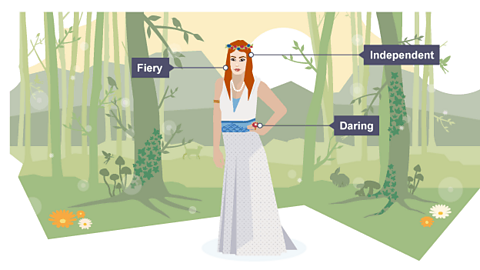
Image caption, Character attributes
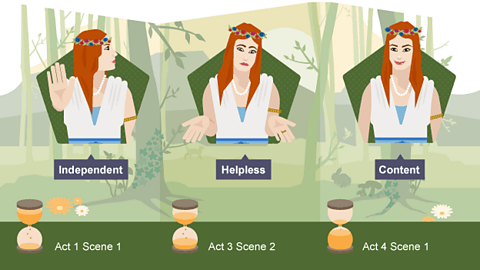
1 of 3
Character attributes
- Independent - she knows her own mind and defies her father. She stands up for herself when Duke Theseus suggests that she marries Demetrius.
- Daring - she runs away with Lysander even though the possible consequences are death or life as a nun.
- Virtuous - She makes sure that Lysander lays a little way apart from her when they fall asleep in the woods because they aren’t married yet.
- Fiery - she has a quick temper and Helena has been afraid of her since they were at school.
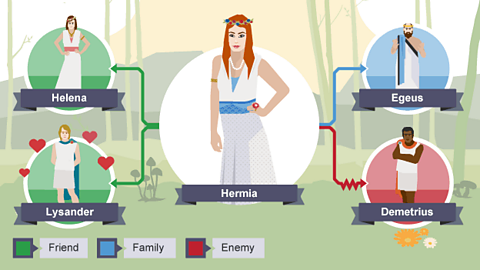
Friends and enemies
Hermia’s friends are:
- Helena - her best friend, but Helena betrays her by telling Demetrius that she is eloping with Lysander
- Lysander - her boyfriend, but he treats her badly when, under a spell, he falls in love with Helena
Her enemies are:
- Egeus - her father is prepared to have her put to death for disobeying him
- Demetrius - is her best friend’s ex-boyfriend and she’s not a bit interested in him
Changes in character
- Hermia starts out by being loved by both Lysander and Demetrius, but when they both fall in love with Helena because of the spell, she reacts badly and falls out with her best friend Helena.
- She is an independent girl at the beginning of the play who defies her father to run away with Lysander – and she keeps this independent streak, although during the spell she follows Lysander like a puppy.
- Hermia starts by having to leave home to be with her true love, but at the end of the play the Duke allows her to marry Lysander and she stays in Athens.
Character analysis
What causes Hermia so much frustration?
Hermia has an independent mind and is frustrated that she has no choice in her own marriage. She wishes that her father could see what she sees in Lysander, and what she objects to in Demetrius.
HERMIA
I would my father looked but with my eyes.
Act 1 Scene 1
How does Shakespeare show that Hermia is a daring and determined character?
Alone in the woods at night, she tells Lysander:
HERMIA
Nay, good Lysander, for my sake, my dear,
Lie further off yet; do not lie so near.
Act 2 Scene 2
She may have disobeyed her father by running away with a man he disapproves of, but she means to get married and not do anything more to ruin her reputation.
How does Hermia’s temperament differ from her sweet appearance?
Hermia has a temper and is more frightening than she looks. Helena complains:
HELENA
She was a vixen when she went to school,
And though she be but little, she is fierce.
Act 3 Scene 1
Appearances can be deceptive, as little as Hermia is, she can cause trouble with her strong personality and her anger. Helena also suggests that she can behave like a wild animal.
Listening task
In Act 3 Scene 2, Hermia discovers that both Lysander and Demetrius now love Helena and hate her. In a fit of confused jealousy, she decides that it’s all her friend’s fault.
HERMIA
O me, you juggler, you canker-blossom,You thief of love! What, have you come by nightAnd stol’n my love's heart from him?
HELENA
Fine, i'faith!Have you no modesty, no maiden shame,No touch of bashfulness? What, will you tearImpatient answers from my gentle tongue?Fie, fie you counterfeit, you puppet, you!
HERMIA
‘Puppet?’ Why so? - Ay, that way goes the game.Now I perceive that she hath made compareBetween our statures; she hath urged her height,And with her personage, her tall personage,Her height, forsooth, she hath prevailed with him.And are you grown so high in his esteemBecause I am so dwarfish and so low?How low am I, thou painted maypole? Speak!How low am I? I am not yet so lowBut that my nails can reach unto thine eyes.
HELENA
I pray you, though you mock me, gentlemen,Let her not hurt me. I was never curst;I have no gift at all in shrewishness.I am a right maid for my cowardice;Let her not strike me. You perhaps may thinkBecause she is something lower than myselfThat I can match her.
HERMIA
Lower? Hark, again!
What advice would you give to the actress playing Hermia?
Hermia is really angry and you can tell because she asks lots of questions but doesn’t wait for them to be answered. There is also lots of repetition for emphasis. Perhaps the actress should do lots of pointing as she accuses Helena of stealing her man. Don’t forget, Hermia is a lot shorter than Helena and her gestures could reflect how offended she is by the suggestion that Helena is making fun of her height. She also threatens to scratch Helena. She could launch herself at Helena, claws bared like a wild animal.
Lysander
Lysander is Hermia’s boyfriend. He is equal to Demetrius in Athenian society, but for some reason unknown to the audience, Hermia’s dad prefers Demetrius as a future son-in-law. Lysander persuades Hermia to defy her dad and run away with him. He promises to marry her when they reach his aunt’s house. When a love spell makes him fall in love with Helena, he treats Hermia very badly. This is all forgotten when everyone wakes up from the final spell.
Changes in character
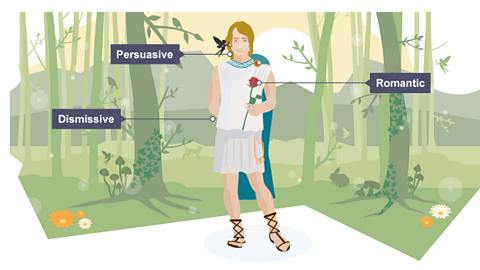
Image caption, Character attributes
1 of 3
Character attributes
- Romantic – he promises to marry Hermia in secret if she will run away with him. He offers to kill Demetrius for Helena if she wants him to.
- Persuasive – he easily persuades Hermia to run away. He tries to persuade her to sleep close to him.
- Dismissive – he is mean to Hermia when the potion makes him fall in love with Helena. He forgets her and leaves her in possible danger in the woods at midnight.
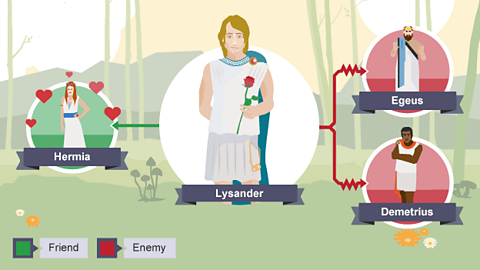
Friends and enemies
Lysander is friends with:
- Hermia - his girlfriend
His enemies are:
- Egeus - who won’t let him marry Hermia
- *Demetrius- - who is trying to steal his girl
Character changes
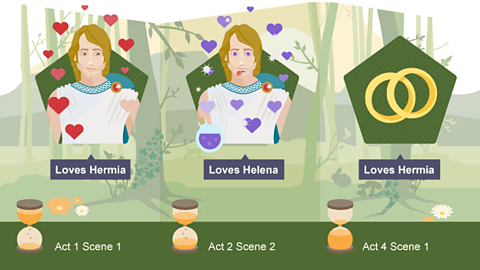
- Lysander changes from being so besotted with Hermia that he will risk everything for her, to being in love with Helena and hating Hermia.
- He is very considerate to Hermia at the beginning, agreeing to sleep a little way away from her in the forest, but under the spell he forgets about her and leaves her in danger.
- Finally he changes back to loving Hermia, forgetting everything that happened in the forest.
Character analysis
What causes Lysander’s frustrations at the beginning of the play?
Lysander is frustrated because he believes he has as much right to marry Hermia as Demetrius. He tells the Duke:
LYSANDER
I am, my lord, as well-derived as he,
As well-possessed: my love is more than his,
My fortunes every way as fairly ranked,
If not with vantage, as Demetrius’
Act 1 Scene 1
Lysander has as much money as Demetrius and comes from an equally important family. What’s more, he has Hermia’s love, unlike Demetrius.
How does Shakespeare show Lysander behaving in a persuasive way?
Lysander has a way with words, and has managed to get Hermia to run away with him.
Hermia also tells him:
HERMIA
Lysander riddles very prettily
Act 2 Scene 2
She is too clever to be persuaded to lie too close to him in the woods in the middle of the night – she can see he is talking in riddles.
How does Lysander show that there is a darker side to him?
Under a spell, Lysander shows a much darker side to his nature.
Helena says:
HELENA
I thought you lord of more true gentleness
Act 2 Scene 2
Helena means that she thinks he is teasing her by saying he loves her. Furthermore, the spell makes Lysander fall in love with Helena, but there’s no mention of the magic causing hatred. Lysander treats Hermia in a Insensitive or cruel and ungentlemanly way.
Listening task
Egeus, Hermia’s father, describes how Lysander won his daughter’s heart.
EGEUS
Stand forth, Lysander! – And, my gracious Duke,This man hath bewitched the bosom of my child.Thou, thou, Lysander, thou hast given her rhymes,And interchanged love-tokens with my child.Thou hast by moonlight at her window sungWith feigning voice verses of feigning love,And stolen the impression of her fantasy,With bracelets of thy hair, rings, gawds, conceits,Knacks, trifles, nosegays, sweetmeats - messengersOf strong prevailment in unhardened youth;With cunning hast thou filched my daughter's heart,Turned her obedience, which is due to me,To stubborn harshness.
What does Egeus say that shows us how romantic Lysander is?
Egeus tells us that Lysander has given Hermia poems and lots and lots of presents. He has also serenaded her at her window.
On the other hand, what does Egeus tell us that show us how persistent and persuasive Lysander can be?
Egeus suggests that the presents have been over the top and because his daughter is young, she has been easily won over by them. He also claims that Lysander’s love songs are insincere. He says that Lysander stole Hermia’s heart with cunning and he has turned her against her dad.
Demetrius
Hermia’s dad loves Demetrius and is keen for him to marry Hermia. Even though Demetrius knows that Hermia doesn’t love him back, he is determined to marry her. Hermia’s best friend, Helena is in love with him, but he uses her for information about Hermia, then treats her very badly. Duke Theseus mentions at the beginning that Demetrius might have been engaged to Helena in the past. At the end, Demetrius realises that Helena is his true love after all. But is this just the effects of the fairies’ magic?
Changes in character
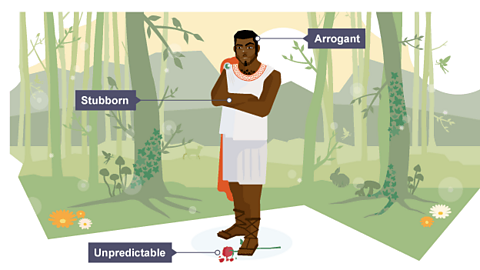
Image caption, Character attributes
1 of 3
Character attributes
- Arrogant – he wants to marry Hermia no matter what her opinions are on the matter.
- Stubborn – he searches throughout the night for Hermia in the dark woods.
- Unpredictable – long ago, he was in love with Helena. Then he fancied Hermia. Then he woke up and realised that he had been in love with Helena all along… with a little help from fairy magic.
Friends and enemies
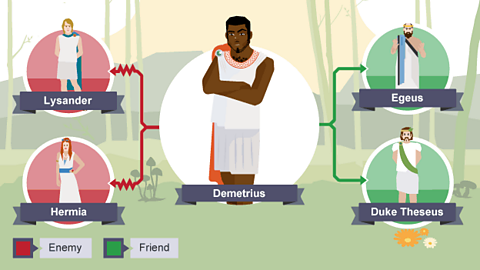
Demetrius’ friends are:
- Egeus – who wants him to marry Hermia
- Duke Theseus - the Duke of Athens
- Helena - his friend, even though at the beginning, he’d rather she wasn’t
He is enemies with:
- Lysander – his rival
- Hermia – she hates him, even though he loves her
- Helena - he hates her, even though she loves him
Character changes
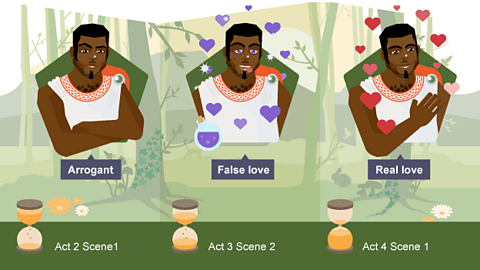
- In the beginning Demetrius is not a likeable character. He is arrogant and stubborn. However, he ends up as one of the main romantic characters in the play.
- In the middle Demetrius falls back in love with Helena, under the love spell, changing his mind about who he wants to marry.
- At the end Demetrius finally realises that he is actually in love with Helena. But he doesn’t remember the spell. He’s not even sure how he has reached that realisation.
Character analysis
How does Shakespeare show that Demetrius is stubborn and arrogant?
Demetrius doesn’t care that Hermia and Lysander are in love.
He says:
DEMETRIUS
Relent, sweet Hermia; and, Lysander, yield
Thy crazed title to my certain right.
Act 1 Scene 1
He sees it as his right to marry Hermia, even if it’s against her will. The addition of the adjective certain emphasises this even further.
Is Demetrius reliable in love?
No. Demetrius has broken his previous promises of love to Helena, in pursuing Hermia’s hand in marriage. Lysander calls him an inconstant man in Act 1 Scene 1.
The Duke mentions that Demetrius has been linked with Helena in the past. Helena tells us that he used to love her. Demetrius doesn’t really love Hermia. He admits it was just a passing fancy at the end of Act 4 Scene 1.
How does Hermia react to Demetrius’ constant advances?
She finds him annoying and tells him:
HERMIA
Out, dog! Out, cur! Thou driv’st me past the bounds
Of maiden's patience.
Act 3 Scene 2
He just won’t get the message that Hermia doesn’t want him. She is a respectable young lady, but his behaviour drives her to swear.
Listening task
In Act 4 Scene 1, Demetrius wakes up to find to his surprise that his love for Hermia was just a fancy. He is truly in love with Helena after all. He can’t remember the events of the night in the wood. He doesn’t know about the love potion.
DEMETRIUS
My lord, fair Helen told me of their stealth,
Of this their purpose hither to this wood;
And I in fury hither followed them,
Fair Helena in fancy following me.
But, my good lord, I wot not by what power
(But by some power it is),—my love to Hermia,
Melted as the snow, seems to me now
As the remembrance of an idle gaud
Which in my childhood I did dote upon;
And all the faith, the virtue of my heart,
The object and the pleasure of mine eye,
Is only Helena. To her, my lord,
Was I betrothed ere I saw Hermia;
But like in sickness, did I loathe this food.
But, as in health come to my natural taste,
Now I do wish it, love it, long for it,
And will for evermore be true to it.
What does Demetrius compare his love for Hermia and his love for Helena with?
Demetrius compares his love to Hermia with the love a child has for a toy that they soon grow out of. He compares his love for Helena with food that he went off for a while, but now has a healthy appetite for.
How do you think Hermia might react to what Demetrius says?
Perhaps Hermia doesn’t even notice what Demetrius says about her. She may just be glad that her friend has her man, and glad that Demetrius is out of her hair.
A modern Hermia might not be so keen to be compared to a toy, though. And Demetrius did have a good go at trying to ruin her life. A modern Hermia might good-naturedly cuff him round the ear at this comment.
Helena
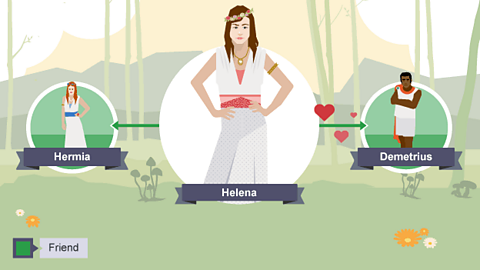
Helena is Hermia’s tall best friend. They have known each other since they were at school. Helena is totally in love with Demetrius, but he only has eyes for Hermia. In fact he tells Helena he hates her. Helena lets a man get in the way of her friendship with Hermia. She tells Demetrius about Hermia’s secret plan to run away. She allows Demetrius to make a fool of her and be cruel to her. She goes through a lot to get her man.
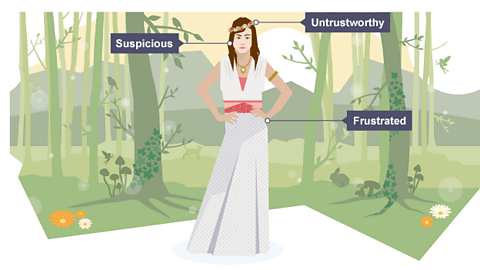
Image caption, Character attributes
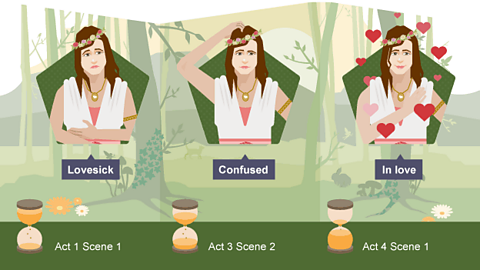
1 of 3
Character attributes
- Untrustworthy – Helena will do anything to make Demetrius like her, even giving away her best friend’s secrets.
- Frustrated – it’s hard to love someone so much and get nothing back. She wishes she could fight for love like a man.
- Suspicious - when Lysander and Demetrius tell her they love her she thinks it’s a cruel joke. What’s more, she suspects that her best friend, Hermia is in on it.
- A fool for love – Helena knows she is making a fool of herself. Demetrius is in exactly the same position as her, chasing after Hermia, who doesn’t love him, but he is not seen as a victim, because he is a man.
Friends and enemies
Helena’s friends and enemies are the same people, at different times in the play.
- Hermia - her best friend, but she betrays her and calls her names.
- Demetrius – she loves him but throughout the play he shows his dislike and disrespect for her. In the end though, he realises he loves her too.
Character changes
- Helena begins as a sad and lovesick figure, but because of the spell she ends up confused by the fact that both Lysander and Demetrius are in love with her. She does get her happy ending though, when Demetrius realises he loves her after all.
- She has a complicated relationship with Hermia – she is supposed to be her best friend, but Helena tells Hermia’s secret to Demetrius to try to get his gratitude.
- In the middle of the play Helena and Hermia fight, and call each other lots of names. But Helena can’t really stand up for herself against Hermia. In the end they are all good friends again.
Character analysis
Why is Helena such a jealous character?
Helena is jealous of Hermia. She is frustrated that Demetrius loves Hermia, and not her, even though they are equally pretty. She says:
HELENA
Through Athens I am thought as fair as she.
But what of that? Demetrius thinks not so
Act 1 Scene 1
Love gets in the way of her friendship with Hermia and she betrays her.
Why is Helena confused about love?
Helena is lovesick in the truest sense and is at her wits’ end with Demetrius. She knows Demetrius doesn’t love her, but she has no control over how she feels about him. She knows that her behaviour is counter-productive, but can’t stop herself.
HELENA
The more I love, the more he hateth me.
Act 1 Scene 1
Listening task
In Act 2 Scene 1, Helena reveals just how lovesick she is. She knows that she is a fool, but she just can’t help herself.
HELENA
I am your spaniel; and, Demetrius,
The more you beat me, I will fawn on you.
Use me but as your spaniel: spurn me, strike me,
Neglect me, lose me; only give me leave,
Unworthy as I am, to follow you.
What worser place can I beg in your love
(And yet a place of high respect with me)
Than to be used as you use your dog?
DEMETRIUS
Tempt not too much the hatred of my spirit;
For I am sick when I do look on thee.
HELENA
And I am sick when I look not on you.
What kind of a man would treat his dog in the way Helena describes, and what does this say about Demetrius?
'Spurn me, strike me' says Helena. She describes what would be considered as animal cruelty today. Values change over time, but even so, any kind of cruelty or abuse can hardly be seen as an attractive quality in a future husband.
Additional characters
Egeus - mortal
Egeus is an important man in Athens, a friend of the Duke, and Hermia’s father. He would rather have his daughter put to death than allow her to marry the man she loves.
He goes to the Duke of Athens to get permission to deal with his disobedient daughter as he sees fit:
EGEUS
I beg the ancient privilege of Athens;
As she is mine, I may dispose of her
Act 1 Scene 1
Character attributes
- Hot-headed
- Cruel
Theseus - mortal
Duke of Athens, Theseus is soon to be married to Hippolyta. He is busy making wedding plans and would rather not have this happy event blighted by the death of a young Athenian girl. He overrules Egeus in the end when Demetrius tells them all that he is in love with Helena after all, and proposes a triple wedding ceremony.
Theseus was at war with Hippolyta, but now she has surrendered and they’ve decided to get married. He seems very happy that things have turned out this way.
THESEUS
Hippolyta, I wooed thee with my sword,
And won thy love doing thee injuries;
But I will wed thee in another key,
With pomp, with triumph, and with revelling.
Act 1 Scene 1
Character attributes
- Powerful
- Happily in love
Hippolyta - mortal
Hippolyta is the Queen of the Amazons. She lost a battle against the Duke of Athens and now she is getting married to him. She says very little in the play.
Whilst watching Bottom’s play about Pyramus and Thisbe, she comments:
HIPPOLYTA
This is the silliest stuff that ever I heard.
Act 5 Scene 1
Character attributes
- Intelligence
- Poise
Peter Quince - actor
He is a carpenter by trade, and the director of the play, Pyramus and Thisbe. He leads his gang of actors, mostly with gentlemanly patience… until Puck plays a magic trick on Bottom.
When Puck transforms Bottom, Quince tries to explain:
QUINCE
Bless thee, Bottom, bless thee! Thou art translated!
Act 3 Scene 1
Character attributes
- Patient
- Long suffering
Nick Bottom - actor
Bottom is a weaver, playing the lead part of Pyramus in Quince’s play. He is passionate about acting even if he isn’t very good. Puck makes him even more ridiculous by giving him the head of an ass. Under a spell, the Queen of the Fairies falls in love with him.
Oberon releases Titania from the love spell, and Bottom is left thinking that his night with the fairy queen was just a dream. He decides to ask Peter Quince to write it down so that he can perform it at the wedding:
NICK BOTTOM
it shall be called ‘Bottom’s Dream’, because it hath no bottom.
Act 4 Scene 1
Character attributes
- Bossy
- Self-centred
Francis Flute - actor
Flute is a bellows mender. He plays the female part of Thisbe, so we can assume that he is relatively young and has no beard.
When Peter Quince is giving out the parts for the play, he protests:
FRANCIS FLUTE
Nay, faith, let not me play a woman: I have a beard coming.
Act 1 Scene 2
Tom Snout - actor
Snout is a tinker. He is chosen to represent the wall. His main purpose is to provide a gap with his fingers for the characters, Pyramus and Thisbe to whisper through.
He announces his purpose in the play whilst it is being performed:
TOM SNOUT
I, one Snout by name, present a wall.
Act 5 Scene 1
Snug - actor
Snug is a joiner, a kind of carpenter. In playing the role of the lion, he is worried about learning his lines. He is also worried about being too convincing, in case he frightens the ladies in the audience.
Snug asks for a part in the play that has the least lines:
SNUG
Have you the lion’s part written? Pray you, if it be, give it me, for I am slow of study.
Act 1 Scene 2
Robin Starveling - actor
Starveling is a tailor. His role in the play is to represent the moon. He seems to feel uncomfortable with his part. Luckily, his dog comes on stage with him to keep him company.
Starveling announces his part in the play to the wedding guests:
ROBIN STARVELING
All that I have to say is to tell you that the lantern is the moon,
I the man i’th’moon, this thorn bush my thorn bush and this dog my dog.
Act 5 Scene 1
Titania - Fairy
Titania is the Queen of the Fairies. She has fallen out with her husband because he wants to take a little boy that she has adopted to join his fairy gang. Oberon charms her so that she falls in love with Nick Bottom, a weaver/amateur actor who is also under a spell: he has donkey’s ears.
When she wakes up, she thinks her night with Nick Bottom was a dream:
TITANIA
My Oberon! what visions have I seen!
Methought I was enamoured of an ass.
Act 4 Scene 1
Character attributes
- Independent
- Passionate
Oberon - Fairy
Oberon is the King of the Fairies. He uses a love spell to get revenge on his wife, Titania. With Puck’s help, he uses magic to interfere in the love lives of others with comic and disastrous effects.
He begins his argument in the woods with his wife:
OBERON
I'll met by moonlight, proud Titania!
Act 2 Scene 1
Character attributes
- Jealous
- Romantic
Puck - Fairy
Puck is Oberon’s right-hand man. He is also known as Robin Goodfellow and has a reputation for causing mischief in the mortal world. He causes confusion when he puts love potion in Lysander’s eyes rather than Demetrius’s. He is responsible for giving Bottom his ass’s ears.
When he sees the confusion he has caused amongst the lovers in the woods, he laughs:
PUCK
Lord, what fools these mortals be!–
Act 3 Scene 2
Character attributes
- Mischievous
- Reluctantly obedient
Other fairies: Cobweb, Peaseblossom, Mustardseed, Moth.
More on A Midsummer Night's Dream
Find out more by working through a topic
- count4 of 5
- count1 of 5
- count2 of 5