How to find the details in a text
Watch the video to see some examples of how you can open a conversation and ask your colleagues for suggestions and ideas.
Interviewer: George, can you tell me what you’re looking for?
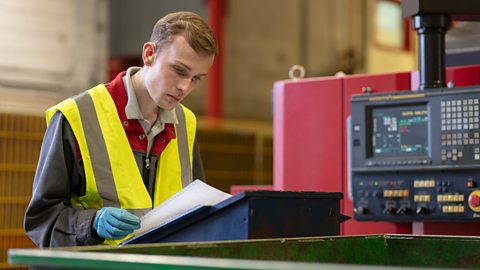
Speaker: Yes, I’m just looking through the user manual for the laser cutting machine.
I’m an engineering apprentice so I am trained on this equipment, however I’d just like to familiarise myself with the risks that are involved with using it.
On this contents page if I go to 'Operating Instructions'… I know I’m on the right page because the heading details 'Safety'.
I know I’m talking about the right machine because the subheading includes 'Laser Safety Compartment'.
I can see straight away here I’ve got bullet-pointed 'Dos' and 'Don’ts'.
Now I’m looking for a risk assessment, which will be under the 'Safety' tab.
So here we can see a table.
This table has got boxes and columns.
The first column includes details of each hazard that we’re likely to come across whilst using the cutting machine.
The one I’m most interested in is the 'Risk Rating'.
I can see from this column that anything above a seven is quite a risk.
The first one I can see here is rated at nine, and that’s when we’re pushing the laser into position.
The next one that catches my eye is the fumes that the laser produces.
So yep, I feel confident with that now.
Which organisational features were used?
Now you've watched the conversation, test your knowledge with this activity.
Taking notes and communicating details
Watch the video to see some examples of how you can open a conversation and ask your colleagues for suggestions and ideas.
Speaker 1: If you could give me a manual feed.
Three hundred and ten I think should be enough.
Speaker 2: Yep, yep that’s correct.
Speaker 1: OK, and then I can start the next one.
Interviewer: George, what are you doing?
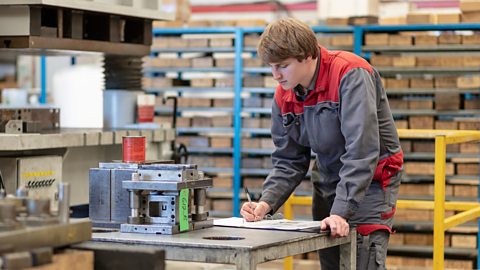
Speaker 2: (TO AUDIENCE) Me and Sam are working on the laser cutting machine.
It’s cutting holes into a section of steel for our project.
Once it’s completed we’ll check it, reference it to a drawing and then adjust it accordingly.
Speaker 2: (TO OTHER PEOPLE) I think we should go down and check multiple holes, yeah?
Speaker 1: OK.
Speaker 2: OK?
Speaker 1: Go for it. I’ll document them.
If you mark down what we’ve got, what number we’re on, and I’ll write down the measurements for each hole.
Speaker 2: OK. So I’m getting this first one here Sam, at 4.8 millimetres.
Speaker 1: 4.8. OK.
Speaker 2: I’m just going to label that one with an asterisk sign. OK?
Speaker 1: So I think that’s a little bit low.
Speaker 2: That’s a little bit low.
Speaker 1: (TO AUDIENCE) We’re very good at helping each other.
That also enables us to check each other’s work as we’re going.
We can then exchange information and make sure we’re not making any mistakes as we go along.
How did the engineers communicate?
Now you've watched the conversation, test your knowledge with this activity.
Spelling specialist words
Watch the video to see some examples of how you can open a conversation and ask your colleagues for suggestions and ideas.
Speaker 1: I’m typing up a document that describes what me and Sam have just done out on the cutting machine.
This is a formal document and we have to make sure that all the spelling and punctuation is correct.
Speaker 2: (TO OTHER PEOPLE) Alright George?
Speaker 1: Hi Sam. I’ve just finished writing these notes.
Would you mind giving me a hand looking through some of the spelling?
Speaker 2: Yeah, let’s take a look mate.
Start with the sheet travelling over the first tool in alignment with pin 17.
I think 'alignment' is incorrect. It sounds right but looks wrong.
Speaker 1: Uh huh.
Speaker 2: There’s possibly a silent letter in there?
Speaker 1: Yep.
Speaker 2: I think it’s a ‘g’.
A-L-I-G-N. Give it a spellcheck to check?
So there’s an extra ‘e’ in there as well.
Speaker 1: Yeah, yeah.
Speaker 2: So that’s correct.
Speaker 1: 'Reduction'. Erm.
Speaker 2: It sounds like a ‘shun’, doesn't it?
But it doesn’t spell like that.
So I’m sure that you’ve got to put a ‘t’ after the ‘c’.
Speaker 1: Yep. OK.
Speaker 2: 'Reduction', yep that reads well.
Speaker 1: OK, so this will be signed off by my supervisor before being used in production.
Spot the misspelt words
Now you've watched the conversation, test your knowledge with this activity.
Careers advice and tips from BBC Bitesize
Future careers, further studies and the world of work - we're here to help with advice from experts and from young people who've found their path.

More on Engineering
Find out more by working through a topic