How to calculate mass

When you add, subtract, multiply or divide mass in grams and kilograms, sometimes you need to convert the measurements so that they are in the same unit.
You can use this fact:
1 kilogram = 1,000 grams
You can also write it like this:
1kg = 1,000g
To convert from kilograms to grams you multiply by 1,000.
To convert from grams to kilograms you divide by 1,000.
Quiz: Solving problems involving mass
Test out your knowledge of how to solve problems involving mass with this quiz, then read on to complete the page.
How to add grams and kilograms
The mass of these oranges is 500g and the mass of these apples is 600g.
Together the mass of the oranges and apples is 1,100g.
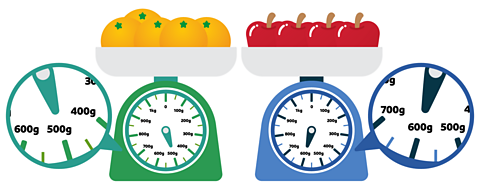
To convert this mass into kilograms and grams, remember:
1 kilogram = 1,000 grams
As 1,100g is greater than 1,000g, you can split it into 1,000g (which is 1 kilogram) and the remaining 100g.
So:
1,100g = 1kg 100g
You can also write this as a decimal in kilograms.
To do this, divide the total number of grams by 1,000.
For example:
1,100 ÷ 1,000 = 1.1
So, 1,100g can also be written as 1.1kg.
How to subtract kilograms and grams
The mass of the pineapple is 1.2kg or 1kg and 200 grams.
The mass of the strawberries is 700 grams.
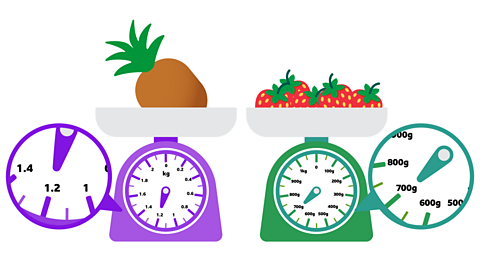
To find the difference between the mass of the pineapple and strawberries, first convert the mass of the pineapple into grams.
1 kg 200g = 1,200 grams
Then, subtract the mass of the strawberries.
1200g - 700g = 500g
The pineapple is 500 grams heavier than the strawberries.
You can represent this on a number line.
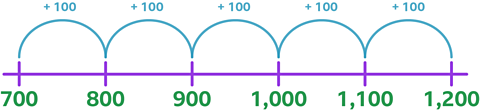
You could also use the counting on method to find the difference here, counting on in hundreds from 700 to 1,200.
How to divide kilograms
You can divide measurements of mass in the same way that you divide other values.
Before you start to calculate, check if any values in the problem need converting from kilograms to grams, or grams to kilograms.
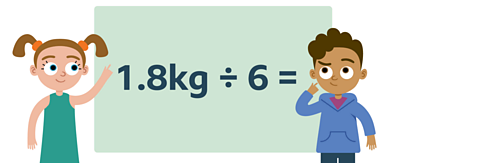
Think about the problem:
1.8kg ÷ 6 = ?
To divide 1.8kg by 6, first convert 1.8kg into grams by multiplying it by 1,000.
1.8 × 1,000 = 1,800
So 1.8kg = 1,800 grams.
Then divide 1,800 by 6.
1,800 ÷ 6 = 300
Therefore:
1.8kg ÷ 6 = 300g
This division is shown in the bar model below.

Example 1
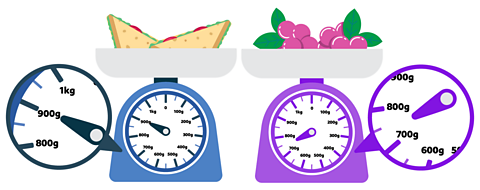
The mass of the sandwiches is 900g and the mass of the grapes is 750g.
What is the total mass of the sandwiches and the grapes?
✓ The total mass is 1kg 650g.
When you are adding grams which will come to a total greater than 1,000g, you can add first and then convert the answer into kilograms and grams.
For example:
900g + 750g = 1,650g
1650g = 1 kg 650g
Example 2

Lucas picks 2kg 200g of apples from a tree.
He gives 750 grams of apples to his Grandma.
What mass of apples does Lucas have left?
✓ Lucas has 1,450 grams or 1kg 450 grams of apples left.
To work this out first convert the 2kg 200g into grams.
2kg 200g = 2200g
Then subtract the 750 grams:
2,200 - 750 = 1450
Example 3
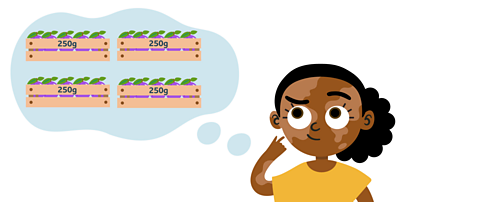
Chloe has four boxes of plums. Each box full of plums has a mass of 250 grams.
She empties all the plums into a fruit bowl and then eats 150 grams of the fruit.
How many grams of plums does she have left?
✓ Chloe has 850 grams of plums left.
To work this out you can calculate:
250g × 4 = 1,000g
This tells you that Chloe has 1,000g of plums before she empties out the plums and eats some of them.
She eats 150g of plums. So this should be subtracted from the 1,000g.
1,000g - 150g = 850g
Play our fun maths game Guardians: Defenders of Mathematica. game
Use your times tables and more maths skills to defeat monsters and reclaim the Kingdom of Mathematica

More on Weight and mass
Find out more by working through a topic
- count1 of 3
- count2 of 3