What are chromosomes?
Chromosomes are long strands of DNA (deoxyribonucleic acid).
They are subdivided into The basic unit of genetic material inherited from our parents. A gene is a section of DNA which controls part of a cell's chemistry - particularly protein production..
In most cells, Genetic structures that usually occur in functional pairs in the nucleus of cells (except in gametes and bacteria). are found in the Control centre of a cell containing genetic material. in functional pairs.
Humans have 46 chromosomes arranged in 23 pairs.
Chromosomes are not in functional pairs in Sex cell (sperm in males and ova/eggs in females). (which have only half the number) or in bacterial cells (which have no The nucleus controls what happens inside the cell. Chromosomes are structures found in the nucleus of most cells. The plural of nucleus is nuclei.).
The entire genetic material of an An organism is a living thing that shares characteristics such as the ability to move and reproduce including plants, animals, fungi, bacteria and protoctists. is known as the The complete set of DNA found in an organism..
What are genes?
A gene is a short length of DNA found on a chromosome that codes for a particular characteristic or protein.
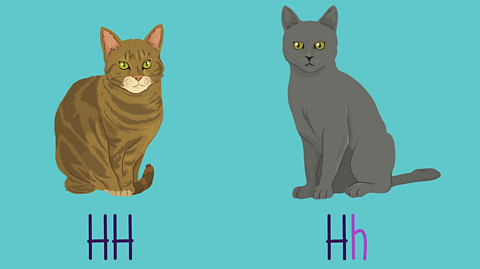
Alleles are different forms of the same gene. For example, eye colour is the gene but blue, green, brown etc are alleles.
How is DNA structured?
DNA has a double helix structure, made up of two chains of nucleotides.
Each nucleotide contains a phosphate group, a sugar (deoxyribose), and a base.
The phosphate and sugar molecules link together to form the backbone, while the interlinking bases hold the two strands together.
There are four bases, which pair as follows:
Adenine (A) with thymine (T)
Cytosine ( C ) with guanine (G)
This is known as the complementary base-pair rule.
What is the DNA code?
Each person (except for identical twins) has unique DNA, meaning their sequence of bases is different from others.
DNA carries the genetic code to make proteins.
Three bases (a base triplet) code for one amino acid.
Amino acids are then joined in this order to make the protein.
This is known as the base triplet hypothesis.
Watch: Explaining DNA structure and the genetic code
Test your knowledge
More on Genetics
Find out more by working through a topic
- count2 of 6
- count3 of 6
- count4 of 6
- count5 of 6