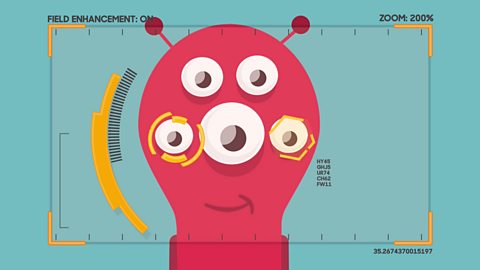
A prime number is a special number that can only be divided by one and itself.
It makes them a pain for this fella who likes to divide things into neat, equal piles.
Let’s dig further…
Take the number three.
Three is a prime number, it’s only factors are three and one, so it can only be divided into one group of three, or three group of one.
There is no other combination.
Now four is not a prime number, as well as groups of four and one, we can also divide four into two groups of two.
Oh, here we go again, this isn’t going to end well.
Five is a prime again, it only has two factors, one and five.
You can keep going higher and higher, finding bigger and bigger prime numbers like seven, eleven, thirteen and even 997!
But don’t forget, number one doesn’t count because it only has one factor.
Sorry!
Prime numbers
Prime numbers are special numbers that can only be divided by themselves and 1.
19 is a prime number. It can only be divided by 1 and 19.
9 is not a prime number. It can be divided by 3 as well as 1 and 9.
The prime numbers below 20 are: 2, 3, 5, 7, 11, 13, 17, 19.
Don't forget: the number 1 is not thought of as a prime number.
Play Bitesize games
Level up now! Take on the latest primary games on Bitesize.

More on Number and number processes
Find out more by working through a topic
- count6 of 25

- count7 of 25
- count8 of 25

- count9 of 25