When we use decimals you can think of one whole divided into ten parts, they’re tenths.
Or if you divide into one hundred parts, these are hundredths.
So, how do we write them?
Say hello to the decimal point.
We place digits to the left or right of the decimal point, depending on their value.
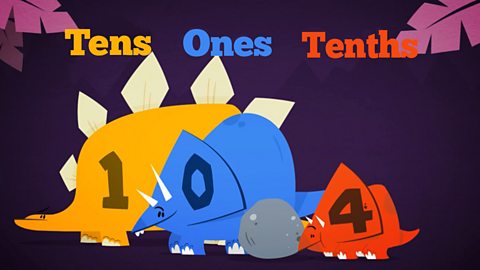
On the left are our tens and ones and on the right are our tenths.
Here she is… aww isn’t she sweet?
When the tenths get up to nine we need the ones.
Now, what about the hundredths?
Aww isn’t he cute?
So, now we’ve got the tens and ones on one side of the decimal point and the little tenths and hundredths on the other.
Ah, one big happy family.
Decimal numbers
A decimal is a way of writing a number that is not whole.
Decimal numbers are 'in between' numbers. For example, 10.4 is in between the numbers 10 and 11. It is more than 10, but less than 11.
Take care when reading the values of decimal numbers.
4.2 means 4 and 2 tenths.
4.20 means 4 and 2 tenths and 0 one-hundredths. The last zero does not need to be there.
4.02 means 4 and 0 tenths and 2 one-hundredths.
Where next?
Play Bitesize games
Level up now! Take on the latest primary games on Bitesize.

More on Number and number processes
Find out more by working through a topic
- count3 of 25

- count4 of 25

- count5 of 25

- count6 of 25

