- Explore how music publishing relates to how artists make money.
- Find out about rights, royalties and splits and how to get your music out there.
- Learn how Stormzy, Amy Winehouse and Mac DeMarco have dealt with music rights.
Watch Lynden Campbell from Domino Records explain how musicians can get started releasing their music.
MUSIC
This is the sound of us.
Lynden: It’s really catchy.
Tara: We’ve actually just finished recording it and it’s our first song, so we really need to find some information about how we can get the track out there. And I know you work here at this independent record label, so I thought it would be really great to get some of your advice about how we could do that.
Lynden: No worries, yeah. Happy to help.
Tara: First of all, what are the different ways that we can release our track?
Lynden: One of the things that a lot of our artists do is use social media to share their releases with their friends and family, build up their following. And then there’s lots of different online platforms that you can use to share your music more publicly. So, there’s things like SoundCloud, Spotify, Apple Music, Deezer and there’s lots of different companies that can help you connect with those platforms if you’re not sure how to do it yourself.
Tara: Can you tell me who actually owns our song? Does it belong to the band?
Lynden: So, if you’ve made the sound recording and you’ve written the lyrics and the notes, you own those rights. If you want to, you can sell the sound rights, the recording to a record label and you can sell the lyrics and the notes to a publishing company. And those two companies will help you release music to a wider audience and help you make money from it.
Tara: Can you tell me some of the ways that we could make money from the song?
Lynden: The first thing I’d suggest is that you play live and you can get the door money from a gig and hopefully loads of people turn up and want to follow you, and stream your music. Another great way to earn money is to license your music. So every time your music is used on a radio show or a TV programme, or even in a compilation, you can earn some money. The important thing to do is to sign up to collection societies and these collection societies will look after that for you. PPL in the UK will collect money for your sound recordings and PRS will collect money for your lyrics and notes, which is publishing.
Tara: Thank you so much for all of your advice.
Lynden: My pleasure. Good luck, Tara.
What is music publishing?
Once you have created a piece of music, you can make money from it in various ways, including when it is:
- performed live
- played on the radio
- streamed
- downloaded
- sold as a CD or vinyl
- used in a game, film or commercial
A publishing deal is when you sell the rights to your music to a company, who then work to get that music out to a bigger audience.
If you haven’t signed a publishing deal, then you are the publisher and all the money should come to you.

Organising the money due
Publishing helps organise the money due to you when your music is used for something.
You can receive some money for being the writer of the music and some for being the performer of it.
An example:
You perform a cover version of a famous song at a music festival. This is then shown on TV.Who is due money from this?
There would be earnings from the performance and the broadcast.You and the original artist would be due money. You get money as the performer.
Sheet music
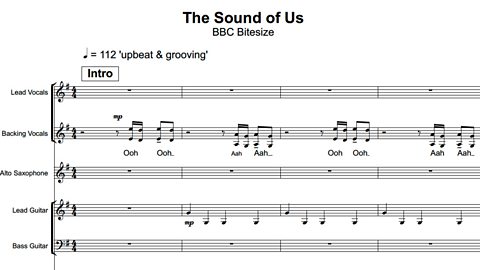
Sheet music is music that has been written down and could be printed on paper. It usually includes musical notes and bars. It can be written by hand or using a computer.
The owner of music has rights to that music printed and sold as sheet music. For example, if a singer performed a song in a theatre using sheet music, the writer of the music would get paid and so would the singer of the song.
The sheet music for The Sound Of Us is owned by the BBC but it is free for you to download, print and play.
The Sound Of Us - Full score. document
Download the sheet music of the band's song The Sound Of Us.
Royalties
If your music is played there are a few ways you could earn from it:
- Performance royalties - when your music is played on the radio, at a music festival, in a shopping centre, cafe or public place.
- Mechanical royalties - when your recorded music is streamed, downloaded or sold as a physical product like vinyl or CDs.
- Licensing & sync royalties - when your music is used on a TV program, computer game, film or advert.
In the UK, PPL and PRS organise the collection of royalties:
PPL (Phonographic Performance Limited) - collect money from businesses that play your recorded music and pay it to you.
PRS (Performing Rights Society) - collect money when someone uses the music composition or lyrics that you have created and pay it to you.
When you register your songs with PPL or PRS, they will then send you statements (like a bank account) and pay you money when it is due.
Listen to these tracks and find out more about how they were published
Listen to Do Better from Stormzy. He started off publishing his own music and videos on YouTube and iTunes and creating his own record label #MERKY. #MERKY signed a deal with Warner’s Atlantic Records to release his album Heavy Is The Head.
Listen to Valerie by Amy Winehouse - a cover of a song by The Zutons. The Zutons (the writers) earn money from performances, streams and radio plays of the song. As Amy Winehouse (the performer) died in 2011, her estate earn money from plays of her recording.
Listen to All of Our Yesterdays by Mac DeMarco from his album Here Comes the Cowboy on his own record label Mac’s Record Label. He set it up in 2018 after six years with Captured Tracks. His music is distributed by Caroline, an offshoot of Universal Music Group.
What to do with your music
Make a piece of music and then consider what you will do with it. How would it be published?

Splits
Sometimes music is made in collaboration, by a band or group. The band must decide how their share will be split and this gets complicated when different amounts of writing are done by different members. It’s best to agree how to split up publishing when you write a song, to avoid these problems later.
Record and publishing deals
These occur when you agree to sell some of the rights to your music to a record label, in exchange for them helping to release and promote it. Often this takes the form of you giving them a percentage of your recording/publishing, and they manufacture and distribute the music to a wider audience.
You should carefully consider any deals offered by a record label - often the record label may end up making more money from the music than the artist! At the same time, record labels and publishing companies can be the best way to take your music to a wider audience.
Keywords
| Keyword | Definitions |
|---|---|
| sheet music | A piece of music written out using notation so it can be read on paper. |
| performance royalties | What you receive when your music is played on the radio, at a music festival, in a shopping centre, cafe or public place. |
| mechanical royalties | What you receive when your recorded music is streamed, downloaded or sold as a physical product like vinyl or CDs. |
| licensing & sync royalties | What you receive if your music is used on a TV program, computer game, film or advert. |
Careers advice and tips from BBC Bitesize
Future careers, further studies and the world of work - we're here to help with advice from experts and from young people who've found their path.

More on Music technology
Find out more by working through a topic
- count1 of 5

- count2 of 5

- count3 of 5

- count4 of 5