- Find out what technology is needed to DJ.
- Listen to examples of top DJs including Joris Voorn, Peggy Gou and Euphonique.
- Explore key concepts of DJing such as mixing, cueing and scratching.
Watch DJ Jordss talk about how she started mixing music and how you can too!
MUSIC
Dujon: First question, how did you get into DJing?
Jordss: I was always that go-to music person. I was always making CDs for friends and family. At parties, I was always playing the music so DJing felt like the natural progression. I’ve been DJing now for about eight years maybe professionally.
Dujon: What type of music do you play?
Jordss: I play a range of genres. Everything from R&B to garage. I started mixing using Jamaican dancehall music, mainly because the songs are made of 'riddims', which is the Jamaican word for rhythms. Which ultimately means that the songs have the exact same instrumental but just the vocals, the lyrics are different. So, when it comes to learning how to mix and beat match, it makes it very easy because the songs are ultimately the same.
Dujon: What exactly is mixing?
Jordss: It’s different for all DJs. For me, it is mixing two completely different songs together and making it sound good. So, just to explain the setup that we have here, we’ve got one CDJ, we’ve got another CDJ. These two play music and the mix-it in the middle allows you to go from one song on this one, to the other on this one. So we’ll start with this song, which is currently at the speed of 133BPM, which is beats per minute. Press play, and that’s playing out in the speakers to the crowd.
MUSIC STARTS PLAYING
Jordss: With this second deck, you’re picking the other song that you want to play. This one, I need to speed up so it’s 133BPM, using this, so they’re the same speed. Using your headphones, you listen to this track, find a cue point which is the start point. Found it. And now, you listen to this track that’s playing out. And it’s just about finding your timing; when is the right time to bring it in? With my headphones, I’m finding the perfect time to mix the two songs together, which seems like… Here. Using the crossfaders, I bring this one up…
NEW PIECE ADDED TO THE MUSIC
Jordss: …So now they’re playing at the same time, and sounding good. They’re blending together. Bring one up and you can bring the other one down.
ONLY NEW PIECE PLAYS
Dujon: So, what tech would I need to start mixing music?
Jordss: Nowadays, it’s really simple. So, you can get apps on your phone, your tablet or your laptop. This setup is quite expensive, these are CDJs. So maybe once you’ve mastered the apps, you can graduate onto these. I would say pick a type of music, learn how to mix it well and also go and watch other DJs mix. Everyone has different styles of mixing. Also be patient because I have been DJing for a very long time and I still have a lot to learn, and I’m nowhere near mastering DJing. So, it takes time, so just be patient.
Dujon: Thank you so much for showing me all of your DJing skills. I’m going to go get started.
Jordss: Good luck!
DJing is the art of mixing two or more tracks together.
It emerged in Jamaica, the USA and the UK in the 1960s and 1970s with DJs mixing vinyl records on sound systems and at parties.
You can listen to some DJs mixing music on these BBC shows:
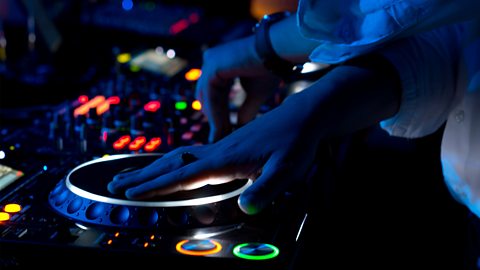
DJ equipment
- Vinyl record decks. The first DJs used vinyl records and some still do today.
- CDJs - mixing CDs is a popular alternative to vinyl.
- DDJs - DJ decks that play digital audio files (eg. MP3, WAV, AAC) - carrying music on USB sticks is an easy way to transport thousands of songs.
- A laptop running software containing a collection of songs.
- Phone apps mixing streamed songs.
One key function that all types of equipment have is the ability to change the tempo of the track. This can be done without changing the pitch. This means you can speed up or slow down tracks so that they can be mixed together more smoothly without clashing (or clanging, as DJs sometimes call it).
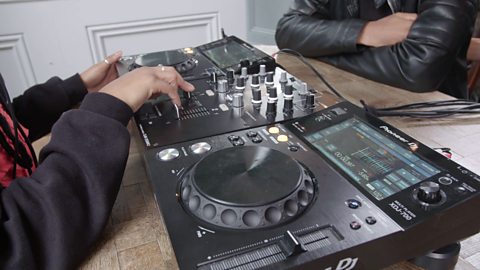
Mixer
Whatever equipment you use, it will usually have a mixer which has:
- Volume faders - for each track to fade in or out.
- Cue control - so you can decide which track you want to play next.
- Crossfader - to blend between two pieces of music, controlling what the audience hears out of the speakers. Normally moving the crossfader from left to right will blend from one track to the other. When in the middle, the crossfader will let both tracks play out loud.
Headphones
Headphones are essential so that the DJ can hear different pieces of music to what the audience hears. For example, the DJ will be listening to the next track on their playlist and getting it ready while the audience is still listening to the one currently playing. This is called cueing.
Sound system
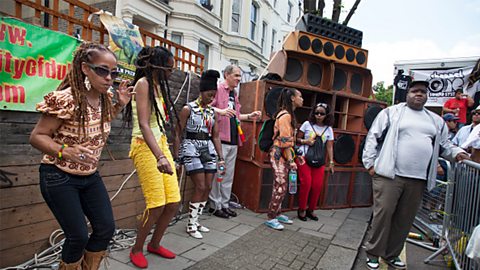
A sound system is something you connect the mixer to so you can play the tracks out loud. These are usually speakers which can allow the audience to hear the tracks clearly. The early pioneers of DJing, especially Jamaican artists, were famous for their sound systems, combining their decks with huge speakers.
Key techniques
Mixing is the process of using the decks, mixer and headphones to blend one track smoothly into the next. Usually this is done by changing the tempo (or speed) of the second track to match the first and then using the volume control, crossfade and EQ to blend them together.
EQ (or equalisation) is an effect which allows you to control the amount of bass, middle and treble - or the low, middle and high parts of the track the audience hears.
As well as mixing records for the dancefloor, some DJs add turntablism to their selection. Turntablism is when DJs combine techniques, like scratching and juggling beats, to transform their turntables into an instrument in their own right. They create new sounds and performances from the records.
Listen to these examples of DJs mixing music
Listen to Incident by Joris Voorn. In this track, he mixes his own composition with The Reese Project’s The Colour of Love.
Listen to It Makes You Forget (Itgehane) by Peggy Gou. She mixes her vocal track with synthesiser, bass and percussion tracks (among others).
Listen to Glow by Euphonique. In this drum and bass track, the fast drum beat contrasts with the slower melodic vocal line.
Try DJing
The key to being a DJ is knowing your music and being able to keep the audience or dancefloor happy. This is called ‘selection’ and most DJs agree this is really the key to being a great DJ.
Try finding a collection of tracks that you want to mix into a DJ set. Look for tracks that you think would work together, that maybe have a similar style or tempo, and that you think would work well if you played them in a party or to a group of your friends.
Now try blending tracks if you can. There are many different free apps or software that can be used on a computer or mobile phone. Once your selection is ready, play it for your friends and see what they think.
Quiz
Keywords
| Keyword | Definition |
|---|---|
| DJing | Mixing together records live. |
| crossfader | A tool that blends between two pieces of music, controlling what the audience hears out of the speakers. |
| EQ | Equalisation - the part of the mixer that allows you to adjust the amount of the bass, middle and treble you hear from each track. |
| turntablism | Using the turntable to create new sounds with the records. |
| selection | Choosing the right tracks for the audience, to create a great experience for them. |
Careers advice and tips from BBC Bitesize
Future careers, further studies and the world of work - we're here to help with advice from experts and from young people who've found their path.

More on Music technology
Find out more by working through a topic
- count1 of 5
- count2 of 5
- count3 of 5