What is body percussion?
Sometimes we might be somewhere without any musical instruments. But this doesn't mean we can't make music!
Body percussion is one way we can make music just using our bodies.
How many sounds can you make just using your body?
You can:
- tap your knees
- stamp your feet
- click your fingers
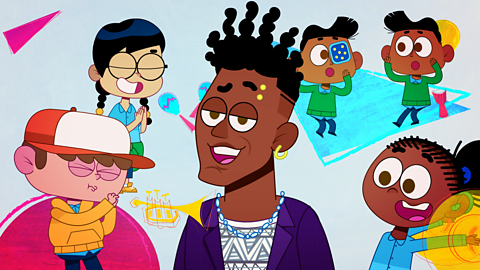
Watch: This is me with Omar
There are many different sounds you can make with your body. Let's explore more with singer and songwriter Omar.
BOY 1: A mystery box.
TEACHER: And inside the box is something you can use to make amazing music.
TWINS: Open it!
GIRL 1: I wonder what it could be.
GIRL 2: Maybe a mysterious new instrument from an ancient civilisation?
BOY 1: Or my missing left shoe?
TWINS: Open it!
ALL: Huh?
OMAR: Hi! I’m Omar.
GIRL 1: Body percussion! My Great Granny Gracie is a total pro at this!
BOY 1: Have you seen my shoe?
OMAR: Nope! Have you seen someone make music just using their body?
This is body percussion. Try it!
BOY 1: I can flap my arms… like a penguin!
OMAR: Hey that’s wild! What about you guys?
TWINS: We can stomp… like a dinosaur!
OMAR: Woah! Jurassic!
Wow! I wish I had a unicorn.
GIRL 1: What was it Great Granny used to do again… Aha!
OMAR: Woah. Do that again!
BOY 1: What? This? # PRPRPRPRPRPRP #
OMAR: Yeah, keep that up. What other instruments sounds can you do with your body?
GIRL 2: Hmm… # SHHH #
OMAR: A cool vibe man.
TWINS: # POP POP POP #
OMAR: Feel that rhythm!
Now that is what I’m talking about.
Watch: What is beatboxing?
As well as using our bodies, we can also use our voice.
Beatboxing can often be about trying to copy sounds of the drum kit.
Watch how to use our voice as a percussion instrument by beatboxing.
Mr Brown: As clogs said we’re going to make music with out voices and bodies today. Let me introduce to you a professional beatboxer and he’s going to show us how. Welcome Lee Gibling! Hi Lee.
Lee: Hi Guys.
Katie: Hi Lee. First, can you tell us, what does beatboxing involve?
Lee: Beatboxing involes using our voice to recreate sounds that we hear on percussion instruments like a drum kit.
Katie: Ooh!
Lee: The best way to understand is for me to show you.
Katie: Yay. That was so good. How good was that? I now see why Clogs said that our voices are music instruments. It sounded like they were music instruments. That was amazing, can i have a go?
Lee: Of course, anyone can beatbox. Let’s star by learning some simple sounds that we can use to beatbox. Here on the screen is an image of a drum kit. It’s important to know a big part of mimicking sounds is listening carefully. I’m going to play you some different sounds that it can make and see f you can copy them with your voice.
Katie: OK, i’ll give it a go.
Lee: The big circular drum in the middle is called a kick drum. It has a low, deep sound like this.
Mr Brown: Can you try to copy this kick drum sound with your voice? Think about what your tongue lips and mouth need to be doing to make it.
Katie: OK, is it like this? Pfft.
Lee: Try it more like this. Puh, puh, puh.
Katie: Puh, puh, puh. Puh, puh, puh.
Mr Brown: Oh, nicely done. Now, another part of the drum kit is the high-hat, which makes a sound like this.
Katie: Tss
Lee: Yep, like this. Tsh, tsh, tsh,
Mr Brown: Good, good listening Katie. And the last drum sound we’re going to make with our voice is from the snare drum. They have a very different sound to the other two. Have a listen to this.
Katie: Ck, ck, ck.
Lee: Yep, a little bit shorter. Ck, ck, ck.
Katie: Ck, ck, ck.
Mr Brown: That was perfect, well done Katie. Now we can combine these three - puh, tsh, ck sounds and give them a bit of rhythm.
Katie: Oh, that was so cool.
Mr Brown: Wow.
Lee: Now it’s your turn to put them together.
Katie: You want me to beatbox?
Mr Brown: Don’t worry bout making mistakes Katie, just focus on making the correct sounds and just have fun with it.
Katie: Let’s do this then.
Lee: Hey.
Mr Brown: Oh, you cracked it with the sounds Katie. Now, let’s turn this into a beatboxing rhythm by combining three different sounds from the drum kit. I’m going to count a pulse to get us started off. Are we ready?
Katie: Yes
Mr Brown: One, two, three, four.
Lee: Now i put the kick-drum sound one beat one.
Lee: One, two, three, four.
Lee: Puh, two, three, four.
Lee: Puh, two, three, four.
Lee: Puh, two, three, four.
Lee: Puh, two, three, four.
Lee: Now lt’s add the snare-drum beat on beat number three.
Lee: Four. Puh, Two, cah. four.
Lee: Puh, two, cah, four.
Lee: Puh, two, cah, four.
Lee: Now we’re going to fill the other numbers with the high-hat sound. Here we go
Lee: Puh, tss, cah, tss. Puh, tss, cah, tss. Puh, tss, cah, tss.
Katie: Yay
Lee: Very good
Mr Brown: OK, now let’s speed up the tempo.
Katie: What - are you going faster than that?
Lee: Bring it on.
Mr Brown: And a-one and a-two and a-one, two, three, four.
All: Pff-tss-cah-tss
Mr Brown: I’m impressed Katie you’re a natural.
Katie: That is exhausting. It’s a lot more difficult when it’s really fast. That was so fun though, thank you so much Lee. And thank you Mr Brown.
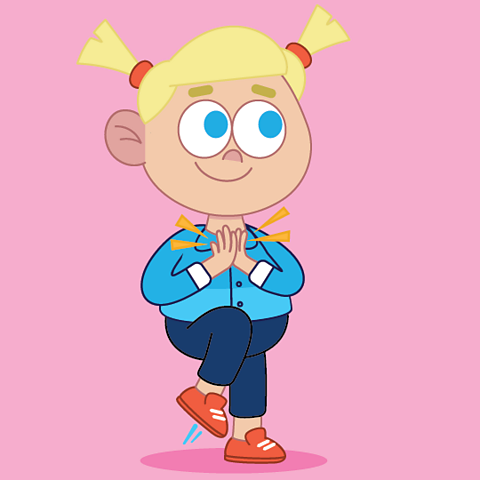
Beatboxing game
To remember some of these sounds, we can play a fun game.
With some friends or family, slowly count to four all together.
When you’re ready, pick a number you are going to clap on instead of saying the number, then repeat saying the numbers one to four. You might choose to clap on the number one, so it would be clap, two, three, four.
When you can do that, change number two to a different sound and practise.
Then number three… keep going until all four numbers are different sounds!
Watch: How to write body percussion down?
Now that we’ve got a good mixture of sounds to choose from, let’s see if we can create our own beat.
Watch how to create a grid for the sounds to go in, to help us remember what to play.
Mr Brown: Now take a look at this grid. I’ve chosen some sounds from the list and put them in each of the spaces on the grid.
Stamp. Pat-pat. Stamp.
Stamp. Tsst.
Stamp. Pat-pat. Clap.
Stamp. Cheek pop.
Katie: Ah, great. Looks pretty good. But what are the empty squares?
Mr Brown: The blanks will act as rests in the music.
Now we’re going to practice and perform it together.
Let’s go through it starting with the first line.
One, two, three, four.
[Body percussion]
Katie: Yay!
Mr Brown: Brilliant.
Katie: How was that?
Mr Brown: That was really good.
Now, let’s try the second line.
One, two, three, four.
[ Body percussion,Tsst! body percussion].
Katie: Yay! This is so much fun.
Mr Brown: OK. It’s all come together really nicely.
Now all that’s left is the last line which is all yours.
Katie: Oh, OK, I’ll give it a go.
[Body percussion]
Mr Brown: Brilliant. Well done, Katie.
Now we’ve had a practice, it’s time to perform it from start to finish.
Katie: No pressure, then.
Mr Brown: You can do this, Katie.
Katie: OK, my hands and feet are at the ready.
Let’s do this, and you can join in too.
One, two, three, four.
[Body percussion]
Hey!
Mr Brown: Ah, good we did it.
Katie: That was a bit tricky.
Who would have thought I could make a piece of music using just my body?
Mr Brown: Why not have a go at making your own body percussion pieces too.
You can even challenge yourself to play the sounds quieter or louder, or faster or slower.
Katie: Just wait until I combine beatboxing and body percussion. It’ll be a musical triumph.Thanks Mr Brown.
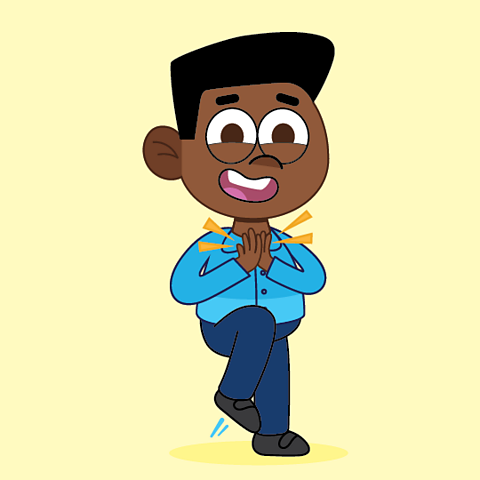
Activities
Create your own beat
Have a go at composing your own body percussion music.
You could draw a grid like Mr Brown or write your ideas on pieces of paper so you can move them around.
Once you're happy, you've got your very own beat that you can play anywhere.
Can you teach it to your friends or family? Maybe you can even play it with some other people playing instruments and create your own piece of music!

Slow it down if it's too tricky.
If you're finding it easy, try making some of the sounds louder and quieter.
You can try and play the whole piece faster.
Quiz
Glossary
Here's the meanings to some important words.
Body percussion - Making sounds with your body or voice.
Composing - Creating your own music.
Dynamics - The volume of the music. How quiet or loud it is.
Play BBC Bitesize games! game
Fun, interactive games for children aged 4-11, with maths, English, science, history and many more subjects.

More on Musical Journeys
Find out more by working through a topic
- count8 of 9