How do we read and write and music?
There are different ways of reading and writing music.
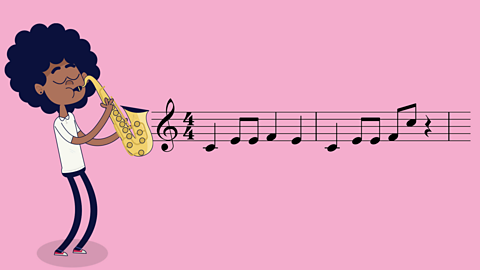
Image caption, Traditional notation
Notes are written on a stave telling us what to play
1 of 3
What are graphic scores?
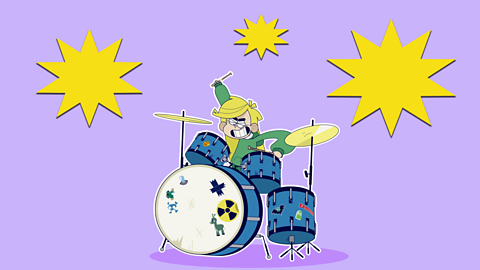
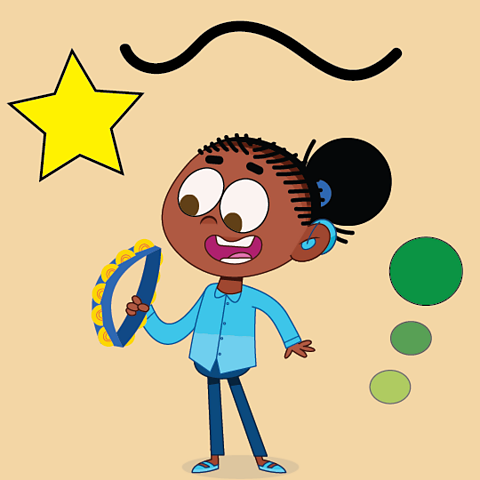
Graphic scores are a way of reading and writing music.
Instead of using music notes, graphic scores use images, signs and symbols.
In music notation, the notes tell the musician exactly how to play something.
A graphic score is made up of lots of different images. The musician decides how they think each image might sound.
This means every performance of the same graphic score can be totally different!
Watch: Make your own graphic score
Take a look at this short video to see how you can create your own graphic score.
Clogs: In this next lesson, you will be creating your very own graphic score.
Naomi: Oh, I can’t wait. No rules, I just do whatever I like.
Clogs: Exactly. However, some graphic scores come with instructions. They might tell you what instruments to use or how fast to play, but they will always leave some things up to the musician’s imagination or interpretation.
Naomi: So that means you could listen to two performances and they would sound similar but still different. I do like the idea of no rules, though.
Clogs: One of the most famous graphic scores, called Treatise, by Cornelius Cardew, is 193 pages long and contains no instructions at all. This means every performance is completely different.
Naomi: Oh, I hope Mrs Thomas doesn’t expect me to write a score that’s that long. Time to find out.
Mrs Thomas: Are you excited about composing your own graphic score?
Naomi: Yeah, I cannot wait. Where do I start?
Mrs Thomas: OK, well, on the easel you have some pieces of card for you to draw on. Each will be a different part of your song. Once you’re done with a part, lay it on the floor where we’ll be able to see the score come together.
Naomi: OK, understood. What shall I draw first?
Mrs Thomas: Well, maybe think of a sound you like and find a way to draw that, or focus on drawing something that you think will inspire the reader.
Naomi: Well, I want a big dramatic start, so maybe four loud bangs?
Mrs Thomas: Oh, what shapes or symbols could you use for that?
Naomi: Big pointy stars. I imagine each sound is going to sound sort of the same, so I’m going to draw these stars the same size.
Mrs Thomas: Oh, great work. Right, first one done. What’s next?
Naomi: OK, I’d then like the music to start very quiet and get louder. I can draw a smooth line from the bottom to the top, like this.
Mrs Thomas: Oh, good idea. In music, getting louder is called crescendo and getting quieter is called decrescendo. If you want, you can also add some instructions to this section to make it clearer.
Naomi: Right, so do I just write “make this quiet” here and “make this loud” here?
Mrs Thomas: Well, you could use a single letter to give that instruction. P in music stands for piano, which means quiet. Can you guess what pp might mean?
Naomi: Does that maybe mean very quiet?
Mrs Thomas: Yes, exactly. That’s also called pianissimo. The letter f stands for forte, meaning loud and ff is fortissimo, which means…
Naomi: Very loud. So I’ve put pp down here and ff up here.
Mrs Thomas: All right, onto the next one. What do you want to do?
Naomi: I’m going to do some wavy arrows, all three aiming up to the right. So let’s start here. One… Two… Three…
Mrs Thomas: Great. Do you want to add any instructions?
Naomi: No, I think I’ll leave this one up to the musician’s imagination.
Mrs Thomas: OK, Well, we can start thinking about the structure of our graphic score now. For example, you could repeat some bits so that the music feels familiar to the listener. It doesn’t have to be new every time.
Naomi: Well, in that case, I fancy doing the four stars again.
Mrs Thomas: Oh, very nice. Do you have any idea how you want to lay out your score? You could put the sections in a straight line like traditional notation, or you could try something new.
Naomi: Hmm, how about a spiral around the whole carpet?
Mrs Thomas: Oh, well, that’s a good idea although it means you’ve got a lot more drawing to do.
Naomi: Yeah, that’s true.
Naomi: That’s it, my graphic score is complete.
Mrs Thomas: Oh, well done. You’ve created an amazing piece of art. How would you feel about me performing your masterpiece?
Naomi: Really? Yes, please. I can’t wait to hear what you do with it.
Mrs Thomas: OK, I’m going to play the keyboard and I may sing a bit too. Why don’t you try and follow along and work out what part of your graphic score I’m playing.
Naomi: OK, will do. I’ll give you the big introduction. Everybody, please put your hands together for the incredible, the sensational, the ridiculously talented Mrs Thomas!
MRS THOMAS SINGS SOFTLY
MRS THOMAS SINGS LOUDLY
PIANO NOTES INCREASE IN PITCH
FOUR SHORT NOTES
ONE LONG NOTE
LOTS OF SHORT NOTES
FOUR SHORT NOTES
MRS THOMAS SINGS SOFTLY THEN LOUDLY
PIANO NOTES DECREASE IN PITCH
MRS THOMAS SINGS
MRS THOMAS SINGS
NOTES THEN INCREASE THEN DECREASE IN PITCH
Naomi: That was so cool to hear my score performed. I love your interpretation.
Mrs Thomas: Oh, thanks, Naomi. We’ve learned that a graphic score will inspire a musician in different ways.
Glossary
Here's the meanings of some important words.
Notation - A way of understanding music using notes.
Graphic score - A way of making music using images, signs and symbols.
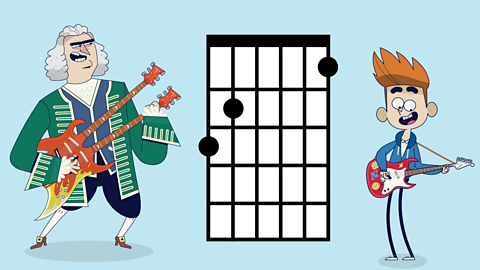
Guitar tab - A way of understanding music using symbols for guitarists.
Rhythm - A pattern of sounds of different lengths.
Pitch - How high or low a sound is.
Dynamics - The volume of the music, how loud or quiet it is.
Activities
Quiz
Play BBC Bitesize games! game
Fun, interactive games for children aged 4-11, with maths, English, science, history and many more subjects.
More on Musical Journeys
Find out more by working through a topic
- count8 of 9
- count2 of 9