What does this article on methods of manufacturing cover?
Production types: Job (customised), batch (sets), and flow/process (continuous, automated).
Pros and cons: Job is bespoke but costly; batch offers variety but less flexibility; flow/process is efficient but expensive and less personalised.
Productivity: Use a mix of methods, invest in machinery, incentivise workers, provide training, and encourage efficiency ideas.
Technology: Increases output, consistency, and cost-effectiveness, but must balance costs, quality, and flexibility.
Methods of manufacturing
What are production processes?
Businesses providing A product that can be touched. can choose from three different types of production process. These are Individual products are made one at a time to meet specific customer needs., Where one group of identical products is made at the same time, before moving onto producing the next group. and Where identical, standardised products are produced on an assembly line..
What is job production?
Job production is when individual products are made one at a time to meet specific customer preferences. An example would be tailor-made suits, which are made specifically to each customer’s measurements and tastes.
What is batch production?
Batch production involves making a set quantity of identical products. This quantity is known as a ‘batch’. The batch size could be ten, 10,000 or a million identical products. An example would be a bakery making a batch of 100 white bread rolls and then making a batch of 50 wholemeal bread rolls.
What is flow production?
Flow production involves continuously making identical products. This allows the production process to be heavily automated.
What is process production
Similar to flow production, in that the product is normally made in bulk quantities through a continuous process. Process manufacturing requires blending of chemicals or ingredients rather than attaching distinct parts together.
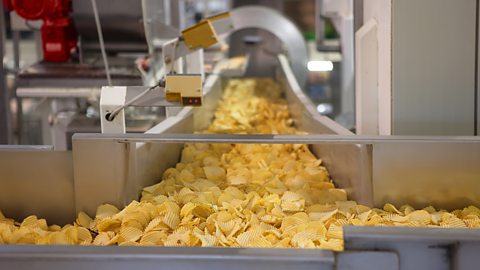
For example:
chemicals
food
drinks
petrol
paint
pharmaceuticals
cosmetics
Advantages and disadvantages of each type of production
| Type of production | Advantages | Disadvantages |
|---|---|---|
| Job | • high profit margins for bespoke products • employees may gain enjoyment from using their specialist skills • customers get exactly what they want | • highly skilled staff are required, which increases costs • highly skilled staff may not be available, which can make training staff very expensive |
| Batch | • able to make a variety of sizes or flavours • can be partially automated • can produce more products than job production | • not as flexible regarding customers’ tastes as job production • as batch production is not fully automated, costs may be higher than in flow production |
| Flow and process (different types of products but same advantages and disadvantages) | • able to make far larger quantities • consistency in production means products are identical, which means customers know exactly what they are buying • highly automated process | • in competitive markets for similar mass-produced goods, profit margins can be very low • customers like products that are tailored to their specific preferences • expensive to buy all the machinery needed for automation |
Try the production process quiz
What is the impact of production processes on productivity?
Businesses often use a combination of job production, batch production and flow production. For example, a bakery might use batch production to bake a batch of cakes but then use job production to ice the cakes to each customer’s preferences.
One major reason a business might choose one production process over another relates to The amount of work produced by a person in a given time.. Productivity is a measure of efficiency. It can be measured in products produced per worker, per day, month or year.
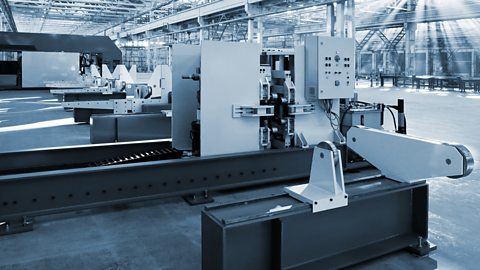
A business can improve productivity in various ways:
investing in up-to-date machinery – This can help workers to produce more products in the same length of time. It can also reduce the need for employees by replacing them with Turning a set of manual steps into an electronic operation that requires no human input. machinery.
providing An encouragement or reason to do something. to encourage workers to work harder and faster – There are several ways this can be achieved, such as through The advancement of an employee’s position within an organisation. opportunities or pay incentives.
providing training to staff to improve their skills so they can work more efficiently.
encouraging staff to come up with time-saving ideas that allow them to work more efficiently – Many businesses have suggestion boxes where staff can provide ideas on how the business could operate better.
Being more productive enables businesses to keep their costs per unit as low as possible. This means they can price their goods or services more competitively or increase their The difference between sales revenue and total costs expressed as a percentage..
What is the impact of technology on production?
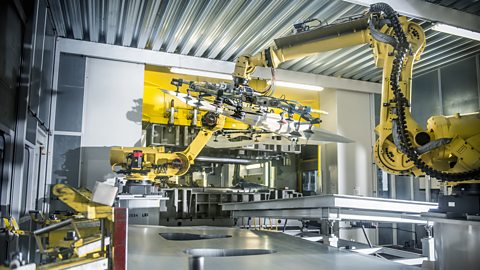
Technology has a big impact on businesses, in terms of both updating existing products and finding new ways of manufacturing products. Technology benefits businesses as it allows them to produce higher quantities, make products more consistent and be more cost-effective.
Businesses try to use technology in a balanced way so that its disadvantages don’t outweigh its many advantages. They need to balance:
Costs- Technology costs money to purchase but reduces the cost of producing products. For example, using machinery to complete dangerous tasks means a business no longer needs to pay the higher wage costs associated with risky jobs. This both reduces costs and improves employee health.
Productivity - Using machinery to mechanise or automate parts of the production process leads to an increase in productivity. This means a business can either reduce its prices to remain competitive or increase its profit margins.
Quality - Businesses need to be consistent in the quality of the products they produce. Mechanising or automating parts of production can help with this.
Flexibility - Businesses often need to balance technology with human flexibility. Automation is good for mass production but it doesn’t work so well for products that will be personalised to meet individual customers’ preferences. For example, in the luxury car industry, customers have a wide variety of optional extras to choose from, which may need to be hand-finished.
Try the methods of manufacturing quiz
Final checks
What is one major disadvantage of using highly automated flow production for manufacturing mass-produced goods?
Profit margins can be very low in competitive markets for similar mass-produced goods.
