Watch: Rights and responsibilities of employers and employees
Narrator:
If you're a full time employee you're going to spend 21% of your waking life in work.
If you're going to spend that much time doing anything, you want it to be pleasant, right?
Our rights and responsibilities at work ensure that everyone is treated fairly.
You might be following your highest calling or working to make ends meet - either way there are some basic things that you can expect.
Everyone has a right to receive a salary or a wage in exchange for their efforts.
Your employer will pay you no less than the minimum wage, organise your income tax, make National Insurance payments and in certain situations pay into your pension pot.
Work isn't just about an exchange of labour for money. It's about refining your skills.
Your employer should help you learn your trade by offering you new challenges and opportunities to develop.
They must also ensure that you understand the risks of your job by providing health and safety training.
What happens if something goes wrong at home? What if a family member passes away or your kids are sick? Will you be forced to work even when you need to be elsewhere, not at all!
Employees have the right to compassionate leave, which means you can take time off to manage things in your personal life.
Work is exhausting, even when you enjoy it.
What if you need some down time? Employees have the right to take holidays each year.
It's important for your health and tired workers damage a business. Everyone wins when you hit the beach.
It stinks to feel like the odd one out. Your employer must ensure that everyone feels like part of the team.
We all deserve respect regardless of our gender or sexuality, race, religion, politics or ability.
Working brings lots of benefits, but don't forget your responsibilities.
You'll get the most out of work when you give it your best effort.
Employees who work hard and support their employers often get promoted, earn more money and have fun.
What is a contract of employment?
Employers must ensure that all employees have a contract of employment. This is in the interests of both employers and employees.
The contract of employment is a legal document that can be used to resolve disputes between the employer and employee. It outlines information on many things.
- Pay — this is important because it gives the employee the right to a guaranteed income and allows employers to manage their budget.
- Conditions such as employee's responsibilities. The employer can take action, such as dismissal, if an employee is in breach of their contract.
- Terms of employment (such as the start date and the length of the contract) are included. This helps to protect employees from being released from their job before the contracted period is completed.
- Entitlements such as sick leave, holiday pay, and compassionate, maternity or paternity leave. This helps the employee plan ahead.
- Hours of employment — this prevents employees from being asked to do overtime without payment.
What are an employer's responsibilities?
Employers and employees both have rights and responsibilities in the workplace.
The balance between employers and employees is adjusted from time to time, but the following is an overview of the main responsibilities of both parties.
Employers have a responsibility to provide some basic conditions for their employees. These are:
Pay
Employers must ensure that their workers are paid in the form of a wage or a salary.
| Wage | An hourly rate of pay that is calculated and paid each week or month. |
| Salary | A yearly rate of pay which is divided equally over twelve months. |
Wages are more common for hourly roles, while salaries are typical for permanent, professional positions
Employers must ensure their employees pay income tax, make National Insurance payments and, in certain circumstances, are a member of a pension scheme.
Career development
Employers are responsible for ensuring that their employees are fully trained in the use of all the equipment in the workplace.
Every employee must receive health and safety training, to make sure that accidents and injuries are kept to a minimum.
Other career development opportunities must be negotiated between the employer and employee.
Compassionate leave
Employees are entitled to unpaid compassionate leave, should an emergency arise with a dependent. Dependents include:
- children
- husbands and wives
- partners and fiancés/fiancées
- parents
- elderly relatives
This includes being able to attend a funeral. Some employers will pay staff who are absent on compassionate leave.
Holidays
Employers have a responsibility to give their employees annual leave for holidays. They must put this in the employment contract. These holidays are in addition to annual bank holidays in the UK and Ireland.
Health and safety
Employers have a responsibility to ensure the health and safety of everyone in their workplace including staff, customers, and members of the public.
They must provide health and safety training to each of their workers.
Health and safety signs must be clearly visible throughout the workplace.
Equality
Employers have a responsibility to ensure that their employees are treated fairly. They cannot discriminate against anyone based on their:
- gender
- race
- religion
- sexual orientation
- age
- disability
What are an employees' responsibilities?
Employee responsibilities are the duties and expectations that employees must fulfil to contribute to the smooth and effective functioning of an organisation.
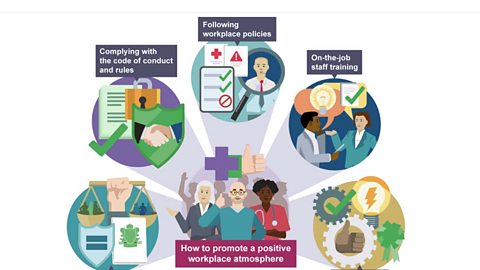
- Follow all company policies, procedures and guidelines, including those related to conduct, safety and use of resources.
- Employees should be familiar with and understand the policies and procedures that apply to their role.
- Treat colleagues and clients with respect and professionalism. Maintain a positive and cooperative attitude.
- Deliver high-quality work that meets or exceeds job requirements and organizational standards.
- Follow all health and safety protocols and report any hazards or unsafe conditions to management.
- Protect sensitive and confidential information related to the company, clients and colleagues.
- Follow company procedures for reporting absences and providing appropriate documentation if required.
What is the impact of not meeting responsibilities?
What happens if employees don't meet their responsibilities?
Employees may face disciplinary action if they fail to meet their responsibilities. That said, employers must recognise that they may be affected by problems outside of work.
Employees may be offered counselling as part of the disciplinary process.
The steps of disciplinary action include:
| Action | What it means |
|---|---|
| Verbal warnings | The employer will talk to the employee about what is going wrong; warning them that an improvement needs to be made in either their conduct at work or their work rate. |
| Written warnings | Issued after verbal warnings this is an official document informing the employee that they have breached company policy and explaining how they can correct it. |
| Retraining | Employee may be asked to relearn their job and undertake additional training. |
| Dismissal | The contract of employment is ended by the employer. This is the most serious part of the process and is issued after verbal and written warnings have been given to the employee. |
Other actions may also be taken by employers dissatisfied by employees failing to meet their responsibilities.
- Employers can reduce an employee's pay if deadlines or targets are not being met.
- If there has been serious employee misconduct, employers can suspend employees without pay if this is included in their work contract.
What happens is employers don't meet their responsibilities?
Impact on Employees
| Impact | |
|---|---|
| Health and safety risks | Failure to provide a safe working environment can lead to higher rates of workplace accidents and injuries. Inadequate health and safety measures can result in long-term health issues for employees, including stress, chronic illnesses, and occupational diseases. |
| Low morale and decreased motivation | Poor treatment, lack of support or unfair practices can lead to decreased job satisfaction, lower morale and disengagement among employees. |
| Legal issues | Employees may seek legal recourse or file complaints against employers who fail to meet their responsibilities, leading to legal disputes and potential financial compensation claims. |
Impact on the Organisation
| Impact | |
|---|---|
| Decreased productivity | Lower efficiency: if the company does not look after their employees and their responsibilities to their staff, such as inadequate training or poor working conditions, these can result in decreased productivity and lower work quality. High staff turnover: employees don’t feel valued and leave to work elsewhere meaning money has to be spent on the recruitment process. |
| Damage to reputation | Negative publicity: failure to meet responsibilities can damage an organisation’s reputation, leading to negative publicity, loss of customer trust and reduced profits… Customer loss: customers may choose to avoid businesses known for poor employee treatment or unethical practices, impacting revenue and market share. |
| Increased costs | Potential legal disputes and compensation claims are costly and affect profits. |
More on Rights and responsibilities of employers and employees
Find out more by working through a topic
- count3 of 4