What are the key learning points about density?
Density = mass / volume.
The density of a material is the mass of 1 cm3 (or 1 m3) of the material. It is a measure of the compactness of a material. Density is measured in grams per centimetre cubed (g/cm3) or kilograms per metre cubed (kg/m3). is measured in g/cm3 or kg/m3.
As the The volume of a three-dimensional shape is a measure of the amount of space or capacity it occupies, eg an average can of fizzy drink has a volume of 330 cm3. of a material increases its The amount of matter an object contains. Mass is measured in kilograms (kg) or grams (g). also increases.
Solids have the highest density → smallest distance between All substances are made of particles. Particles could be atoms, molecules or ions..
Liquids have medium density → medium distance between particles.
Gases have the lowest density → largest distance between particles.
What is density?
It is tempting to think that some materials are always heavier than other materials.
For example, someone might say that metal is heavier than air.
But it depends on how much of each material there is, a lot of air could be heavier than a tiny amount of metal.
It is true however to say that metal is denser than air, and so for equal volumes of metal and air then the metal would be heavier.
Density is used to make a fair comparison between materials.
Density is a measure of how tightly the mass of an object is packed into the space it takes up.
It can be calculated by dividing mass by volume.
It is a A quality, or characteristic, of something. Physical properties of matter are measurable - for example, melting point or boiling point. of a material, and it is constant for a particular material, in other words; it does not matter how much of a material there is, it will always have the same density.
Key point
- Density is the mass per unit volume of a material - ie density is the mass of 1 cm3 or 1 m3 of a material.
The density of aluminium is 2.7 g/cm3 – this means that 1 cm3 of aluminium has a mass of 2.7 g.
All Sub-atomic particles and anything made from them, such as atoms and molecules, are matter. Energy and forces are not matter. contains particles.
The difference between the different states of matter is how these are arranged:
In a solid particles are packed close together in a regular structure - they vibrate about fixed positions.
In a liquid particles are packed close together but are not fixed in position – they are free to move past each other.
In a gas particles are very far apart and move randomly in all directions.
Does changing the temperature or the state of a material change its density?
Normally, when solids are heated their density decreases.
The spacing between the particles increases, but there is no change of The amount of matter an object contains. Mass is measured in kilograms (kg) or grams (g)..
So, a bigger volume has the same mass which means the density is smaller.
Similarly, when liquids evaporate the density decreases as the spacing between particles increases greatly.
What are the densities of some common substances?
| Material | Density / g/cm3 |
|---|---|
| Aluminium | 2.7 |
| Iron | 7.9 |
| Ice | 0.9 |
| Water | 1.0 |
| Air | 0.0013 |
What is the equation for calculating density?
The density of a material is the mass of 1 cm3 (or 1 m3) of the material. It is a measure of the compactness of a material. Density is measured in grams per centimetre cubed (g/cm3) or kilograms per metre cubed (kg/m3). can be calculated using the equation:
Density = \(\frac{mass}{volume}\)
D = \(\frac{m}{V}\)
D = density in g/cm3
m = mass in g
V = volume in cm3
| D = \(\frac{\text{m}}{\text{V}}\) | D = \( m \div V\) |
| \(m = VD\) | \(m = V \times D\) |
| \(V =\frac{\text{m}}{D}\) | \(V = m \div D\) |
Note: If using the formula triangle, it is important to also write out the correct formula in full (both sides of the equals sign) to obtain credit for this in the exam.
If the mass is given in grams (g) and the volume is given in cm3 then the density will have units of g/cm3.
If the mass is given in kilograms (kg) and the volume is given in m3 then the density will have units of kg/m3.
Example
What is the density of a material if 450 cm3 of it has a mass of 200 g?
D = \(\frac{\text{m}}{\text{V}}\)
m = 200 g
V = 450 cm3
D = \(\frac{\text{200~g}}{\text{450~cm}^3}\)
0.44 g/cm3
The density of the material is 0.44 g/cm3.
How is density measured?
1. How to measure the density of regular-shaped objects
To calculate The density of a material is the mass of 1 cm3 (or 1 m3) of the material. It is a measure of the compactness of a material. Density is measured in grams per centimetre cubed (g/cm3) or kilograms per metre cubed (kg/m3)., the mass and the volume of the material must be known.
If the object is a regular shape, the The volume of a three-dimensional shape is a measure of the amount of space or capacity it occupies, eg an average can of fizzy drink has a volume of 330 cm3. can be found by using a ruler to measure the length, breadth and height and using the equation:
Volume = length x breadth x height
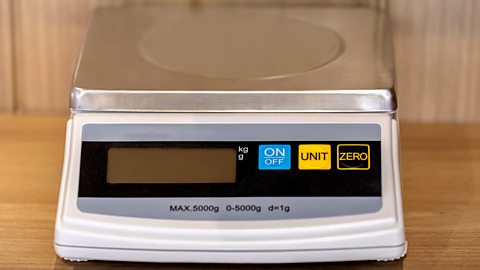
The mass can be found using a top-pan balance.
Then use the equation for density:
Density= \(\frac{mass}{volume}\)
2. How to measure the density of irregular-shaped objects
If the object has an irregular shape the mass can again be found using a top-pan balance, but the volume cannot be measured using a ruler.
The volume can be measured using a measuring cylinder or a displacement can.
What is the measuring cylinder method?
Volume of stone = Final Volume – Initial Volume
Volume of stone = 75 cm3 – 50 cm3 = 25 cm3
If the mass of the stone is measured using a top pan balance and found to be 175 g.
D = \(\frac{m}{V}\)
D = \(\frac{175~g}{{25~cm}^3}\)
Density of the stone is 7 g/cm3
What is the displacement can method?
The volume of larger irregular objects can be measured using a displacement can.
- Place the stone on the top pan balance and measure its mass.
- Fill the displacement can until the water is level with the bottom of the pipe.
- Place a measuring cylinder under the pipe ready to collect the displaced water.
- Carefully drop the stone into the can and wait until no more water runs into the cylinder.
- Measure the volume of the displaced water.
- Use the measurements of mass and volume to calculate the density of the stone using the formula: density= \(\frac{mass}{Volume}\)
3. How to measure the density of liquids
To find the density of a liquid the mass and the volume of the liquid must be known.
The volume of a liquid can be found using a measuring cylinder.
Place the measuring cylinder on a flat surface.
Pour the liquid to be measured carefully into the cylinder using a funnel if necessary.
The liquid’s volume should be read at eye level, with the measuring line at the bottom of the The curved upper surface of a liquid in a tube. .
It is not possible to pour the liquid directly onto a top-pan balance to find the mass.
Instead, first find the mass of an empty measuring cylinder and subtract this from the mass of the measuring cylinder with the liquid in it.
Place an empty, dry measuring cylinder on the top pan balance. Read the mass and record in a suitable table in g.
Remove the cylinder from the top pan balance. Pour 50 cm3 of the liquid into it and place it on the balance again. Read the mass and record in the table.
To calculate the mass of the liquid, subtract the mass of the empty cylinder from the mass of the cylinder plus liquid. Record the mass in the table.
Then use the equation for density:
Density= \(\frac{mass}{volume}\)
Question
An aluminium block has a The volume of a three-dimensional shape is a measure of the amount of space or capacity it occupies, eg an average can of fizzy drink has a volume of 330 cm3. of 480 cm3.
What is the The amount of matter an object contains. Mass is measured in kilograms (kg) or grams (g). of the block if the The density of a material is the mass of 1 cm3 (or 1 m3) of the material. It is a measure of the compactness of a material. Density is measured in grams per centimetre cubed (g/cm3) or kilograms per metre cubed (kg/m3). of aluminium is 2.7 g/cm3?
Answer
\(m = V \times D\)
D= \(2.7 g/cm^3\)
\(V=480 cm^3\)
m = 480 cm3 x 2.7 g/cm3
m = 1296 g
The mass of the aluminium block is 1296 g or 1.296 kg.
What is the unit of measurement for density?
For small volumes density is measured in g/cm3.
For larger volumes density is measured in kg/m3.
1 g/cm3 = 1000 kg/m3.
To convert from kg/m3 to g/cm3, divide by 1000.
To convert from g/cm3 to kg/m3, multiply by 1000.
Aluminium has a density of 2.7 g/cm3 = 2,700 kg/m.
Water has a density of 1.0 g/cm3, or 1000 kg/m3.
Knowing the density of a material enables an engineer or architect to calculate the mass of a building or structure from its volume.
This in turn enables them to determine the correct depth of foundation to make the building safe.
Question
An Olympic size swimming pool measures 50 m long, 25 m wide and has an average depth 2 m.
What is the mass of water in the pool if the density of water is 1000 kg/m3?
The swimming pool is a regular shape and so the volume of water is calculated using the equation:
Volume = length x breadth x height
Volume = 50 m x 25 m x 2 m = 2500 m3
m = \(V \times D\)
D = \(\)1000 kg/m3
V = 2500 m3
m = 2500 m3 x 1000 kg/m3
m = 2,500,000 kg
The mass of water in the swimming pool is 2,500,000 kg or 2500 tonnes.
Prescribed practical P4 - Mass and volume
A guide to carrying out an experiment to investigate the relationship between the mass and volume of liquids and regular solids
What is the purpose of prescribed practical P4?
To investigate experimentally the relationship between the mass and volume of liquids and regular solids, and analyse and interpret the data gathered.
The main variables in a science experiment are the independent variable, the dependent variable and the control variables.
The independent variable is what we change or control in the experiment.
The dependent variable is what we are testing and will be measured in the experiment.
The control variables are what we keep the same during the experiment to make sure it’s a fair test.
Variables
In this experiment the:
Independent variable is the volume of the object
Dependent variable is the mass of the object
Controlled variables are:
- the material of the object and
- the temperature of the object.
Remember - these variables are controlled (or kept the same) because to make it a fair test, only 1 variable can be changed, which in this case is the volume of the object.
Equation
Density = \(\frac{mass}{volume}\)
What is the prediction for this experiment?
As the volume of the material increases, the mass will also increase.
Justification for the prediction:
The greater the volume of the object the greater the number of atoms present.
This will result in the object having greater mass.
Regular objects
What apparatus is needed for this practical?
Six regular objects of the same material but different volumes, a half-metre rule, a top pan balance.
What method is used in this practical?
- Select the smallest object. Measure the length, breadth and height using a half-metre rule. Record the results in cm in a suitable table.
- Repeat each of these measurements of length, breadth and height and calculate the average.
- Using the average values of length, breadth and height, calculate the volume of the object using: Volume = length x breadth x height. Record the volume in cm3 in the table.
- Place the object on the top pan balance. Record the mass in g in the table.
- Repeat the procedure for the other five objects.
| Object 1 | Object 2 | Object 3 | Object 4 | Object 5 | Object 6 | |
|---|---|---|---|---|---|---|
| Mass/g | ||||||
| Length/cm (1) | ||||||
| Length/cm (2) | ||||||
| Breadth/cm (1) | ||||||
| Breadth/cm (2) | ||||||
| Average breadth/cm | ||||||
| Height/cm (1) | ||||||
| Height/cm (2) | ||||||
| Average height/cm | ||||||
| Volume/cm3 |
Graph
Plot a graph of mass in g on the y-axis against volume in cm3 on the x-axis.
Draw a line of best fit through the points.
The gradient of the graph = \(\frac{mass}{volume}\)= density
Calculate the gradient of the graph and hence the density of the object.
Conclusion
We can see from the graph that as the volume of the object increases its mass also increases.
This agrees with our prediction.
In fact, since the line of best fit is a straight line through the origin, we can be even more precise.
We can say that the volume of the object is When one variable is zero so is the other. As one variable increases the other does at the same rate. When 𝒚 is plotted against 𝒙 this produces a straight-line graph through the origin. to its mass.
As the volume increases the mass of the object increases in direct proportion.
The gradient of the graph equals the The density of a material is the mass of 1 cm3 (or 1 m3) of the material. It is a measure of the compactness of a material. Density is measured in grams per centimetre cubed (g/cm3) or kilograms per metre cubed (kg/m3). of the material.
Cause of error
The main cause of error in this experiment is the measurement of length, breadth and height.
This can be kept to a minimum by repeating each measurement and calculating the average.
Liquids
Apparatus
A measuring cylinder, a top pan balance, tap water.
Method
This experiment is very similar to the one for regular solids but there is a different way of measuring the mass and volume of the water.
- Place an empty, dry measuring cylinder on the top pan balance. Read the mass and record in a suitable table in g.
- Remove the cylinder from the top pan balance. Pour 50cm3 of water into it and place it on the balance again. Read the mass and record in the table.
- To calculate the mass of the water, subtract the mass of the empty cylinder from the mass of the cylinder plus water. Record the mass in the table.
- Read the volume of water from the measuring cylinder. Record the volume of water in cm3.
- Repeat the procedure adding 50cm3 each time up to 300cm3 for 6 results.
Safety
Water should not be poured into the measuring cylinder when it is on the top pan balance.
Water spilled on the electric balance could cause electric shock.
Always remove the measuring cylinder from the balance before adding water.
Results
| Mass of empty measuring cylinder /g | Mass of measuring cylinder + water /g | Mass of water /g | Volume of water / cm3 |
|---|---|---|---|
Graph
Plot a graph of mass in g on the y-axis against volume in cm3 on the x-axis.
Draw a line of best fit through the points.
The gradient of the graph = \(\frac{mass}{volume}\) = density of water.
Calculate the gradient of the graph and hence the density of water.
Conclusion
As for the previous experiment, the line of best fit is a straight line through the origin.
We can say that the volume of water is When one variable is zero so is the other. As one variable increases the other does at the same rate. When 𝒚 is plotted against 𝒙 this produces a straight-line graph through the origin. to its mass.
As the volume of water increases its mass increases in direct proportion.
The gradient of the graph equals the density of water.
Error
The main cause of error in this experiment is reading the volume of water.
Care should be taken to read the volume at eye level, with the measuring line at the bottom of the meniscus, with the measuring cylinder placed on a flat bench.
The density of water changes with temperature so care must also be taken to keep the water at a constant temperature throughout the experiment.
Sinking and floating
An object or a liquid will float if it is less dense than the liquid beneath it.
Ice floats on top of water because the density of ice (0.9 g/cm3) is less than the density of water (1.0 g/cm3)
A ship floats on water because the average density of the ship (the metal from which it is made, cargo, people and air contained within it) is less than 1.0 g/cm3.
Hot water floats on top of cold water because hot water is less dense than cold water.
Hot air rises because it is less dense than the surrounding cold air.
How much do you know about density?
More on Unit 1: Density and kinetic theory
Find out more by working through a topic
- count2 of 3