Levers and linkages

A lever is a simple mechanism that uses a bar to pivot around a fixed point called a fulcrum.
Levers can be joined together to form linkages.
Simple linkages can be used to change the direction of motion and the amount of force.
Video: What are levers and linkages?
Join Sam in the workshop to learn all about levers and linkages.
Hello!
We are going to explore the mystery of lever mechanisms.
This may look to you like it’s just a mini seesaw, but it’s also a type of lever mechanism.
A lever mechanism is made up of a length of wood, metal or other material.
It turns around or is supported by a pivot point, called a fulcrum.
If we put the load we want to lift at one end of the lever and we push down on the other end, we can lift it.
The force we are applying is called the effort.
As you can see, as we push down, the lever turns around the fulcrum.
Levers work in different ways, and this depends on where the fulcrum, the effort and the load are.
This lever has the fulcrum in the middle, and the load and the effort are at opposite ends.
If we move the fulcrum to one end…
and we place the load we want to lift in the middle, the lever acts in a different way when we apply force here, by pulling the lever up.
This is how a wheelbarrow works.
If we leave the fulcrum at this end but move the load to the opposite end, when we apply the effort in the middle, the lever can lift the load.
A shovel is a lever mechanism that works in this way.
And did you know we can connect levers together?
These joined-up levers are called linkages.
And they use multiple levers and fulcrums.
They can move in different directions, with different amounts of force.
There are lots of linkage mechanisms used in everyday items.
Foldout chairs, ironing boards, and umbrellas.
They use levers linked together to make a mechanical movement possible.
So, start looking around for levers and linkages; you’ll be surprised at how many you can find.
What is a lever?
A lever is a simple mechanism that has a rigid bar or beam that pivots or rotates around a fixed point called a fulcrum.
A lever has three important parts:
1. Load - The load is the thing to be moved. It could be a big rock, a bucket of toys, or even a friend sitting on a seesaw.
2. Fulcrum - This is the spot where the lever sits. It allows the lever to move up and down, side to side, in a curve or round and round.
3. Effort - This is the power we use to make the lever work. When we push or pull to move things we use our muscles to make the lever do its job.
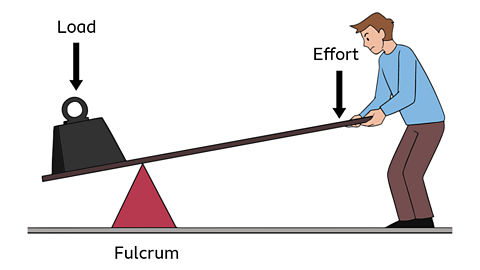
Levers can make work easier by changing the direction or strength of a force.
When effort is used to push down on one end of the lever, the load on the other end goes up.
This makes it easier to lift heavy objects because you can use the lever to help with the hard work.
Some examples of everyday levers are scissors, bottle openers and cooking tongs.
What is a linkage?
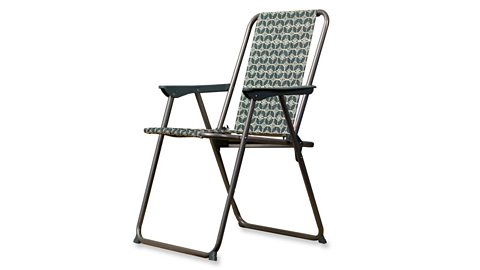
A linkage is a mechanism which is made by connecting levers together through joints known as pivot points.
The levers in the linkage work together.
Depending on the design of the linkage, the levers can move in different directions and move with different amounts of force.
Linkages are found in many different machines, including folding chairs, windscreen wipers and the arm of a digger.
Fixed or free pivots
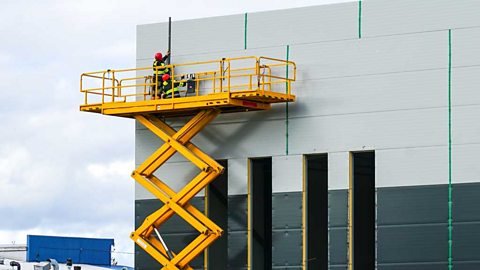
Linkages typically have multiple pivots.
There are two types of pivots:
- fixed pivots
- moving pivots
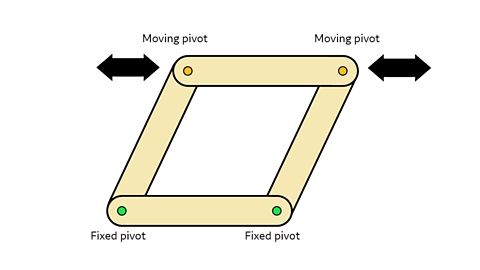
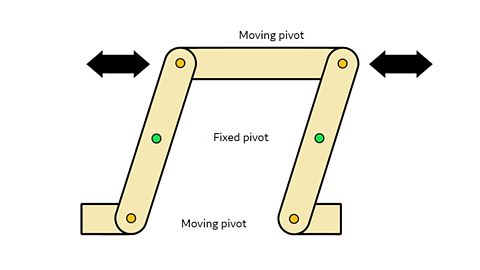
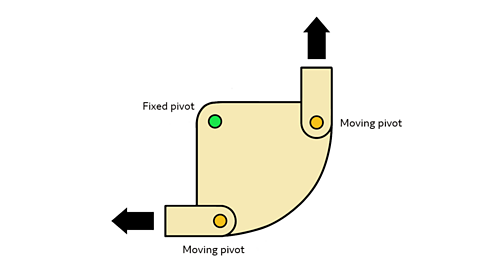
Fixed pivots are held tightly in place, meaning that they move at one point only.
Moving pivots move more freely, because they are not fixed to a point or held in place
Types of linkages
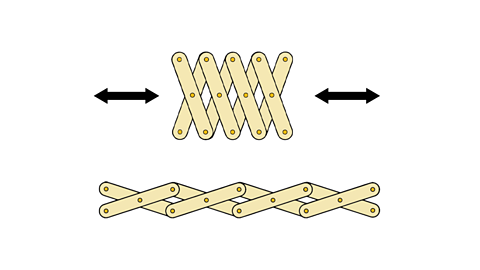
There are many different linkages you can make. Here are just a few.
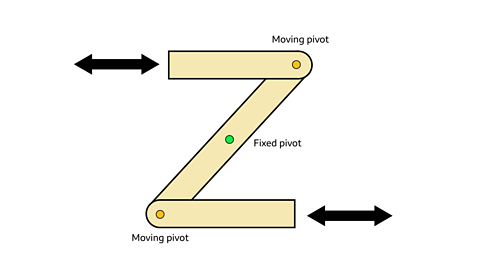
Image caption, Reverse motion linkage
This is a reverse motion linkage. The pivot in the middle is fixed. When you pull one of the levers, the other moves in the opposite direction.
1 of 5
Key words
| Fulcrum | The place where the lever turns or is supported. |
| Levers | A simple mechanism that helps us move things more easily. It has three important parts: the fulcrum, the load, and the effort. |
| Linkage | A mechanism made by connecting levers together through joints known as pivot points. |
| Mechanism | A set of moving parts that work together to make something happen. |
| Pivot point | A point around which an object can move or rotate. |
Quiz
Let's see how much you can remember about levers and linkages.
Race Across the Continents game - new update! game
Help this team of adventurers race their way to victory. Explore the globe in this exciting game update to discover new audio voiced by Ade Adepitan and fun animations. Challenge yourself with brand-new achievements and become a high-flyer!

More on Mechanical systems
Find out more by working through a topic
- count2 of 3
- count3 of 3