NARRATOR
Alright guys? What have you got there?
Ah, you've each got one of the three states of matter — solids, liquids, and gases.
Solids, like this block of ice or this ball, retain their shape and volume.
You can hold them and cut them into pieces, and they always take up the same amount of space.
Liquids, like water or honey, can flow or be poured.
And they're pretty tricky to hold.
They change shape depending on the container, but always keep the same volume.
Gases are crazy and don't keep their shape or volume.
They spread out and can fit any container they're put in.
Often you can't even see them!
Gas is put into some drinks to make them fizzy, and when we drink them the gas can sometimes try to uh… escape from our bodies.
Oh, delightful.
Solids, liquids and gases are called the three states of matter.

Solids
The properties of solids include:
- Solids stay in one place and can be held.
- Solids keep their shape. They do not flow like liquids.
- Solids always take up the same amount of space. They do not spread out like gases.
- Solids can be cut or shaped.
- Even though they can be poured, sugar, salt and flour are all solids. Each particle of salt, for example, keeps the same shape and volume.

Liquids
The properties of liquids include:
- Liquids can flow or be poured easily. They are not easy to hold.
- Liquids change their shape depending on the container they are in.
- Even when liquids change their shape, they always take up the same amount of space. Their volume stays the same.
Gases
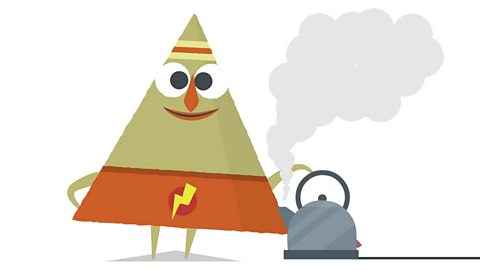
The properties of gases include:
- Gases are often invisible.
- Gases do not have a fixed shape. They spread out and change their shape and volume to fill up whatever container they are in.
- Gases can be squashed.
Play Bitesize games
Level up now! Take on the latest primary games on Bitesize.

More on Materials
Find out more by working through a topic
- count6 of 10
- count7 of 10
- count8 of 10

- count9 of 10