NARRATOR
Hey there, looking sharp.
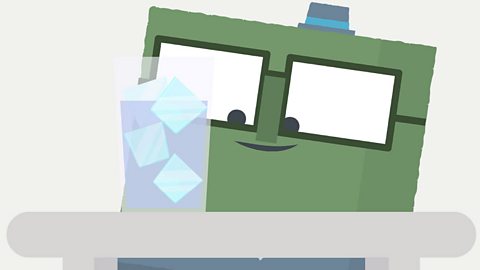
You're going to show us how to change the state of a substance by heating or cooling it, with the aid of these temperature-controlled rooms.
When solids are heated, they can melt into liquids.
And when we freeze a liquid, it becomes a solid.
Hadn't you better check on them?
Right. After being heated, the ice has melted into water.
For water, this melting point is zero degrees Celsius.
And it looks like you've done a fair bit of melting yourself.
When we freeze water, it becomes ice.
It's changed from a liquid into a solid.
This happens when the temperature drops below zero degrees Celsius.
Someone here’s become a bit icy too.
But of course, freezing and melting are totally reversible processes.
So! Who wants another go?
Freezing and melting
Solids and liquids can be changed from one state to another by heating or cooling.
Heat melts a solid and turns it into a liquid. Cooling freezes a liquid into a solid.
Heating
If ice (solid) is heated, it changes to water (liquid). This change is called melting.
Cooling
If water (liquid) is cooled, it changes to ice (solid). This change is called freezing. Water freezes at 0°C
More on Materials
Find out more by working through a topic
- count7 of 10
- count8 of 10

- count9 of 10
- count10 of 10