What are food miles?
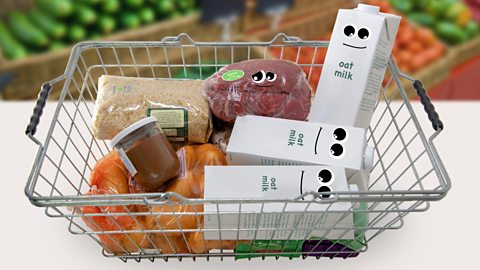
All food makes a journey from where it is grown or produced to your plate. How far food has travelled is known as its food miles.
We should be aiming for as few miles as possible. Choosing foods with fewer food miles helps reduce pollution and protect our planet.
In this article you can learn:
- what food miles are
- how we can make better food choices for the environment
This resource is suitable for Health and Wellbeing for primary school learners.
Video - Food miles
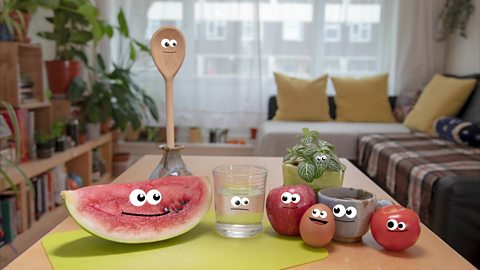
In this video, the Great Spoon explains what food miles are and why local food is often a better option for the environment.
Find out how our food choices can have an impact on the environment.
PEAR Do you know what mate? I just got a bit bored hanging around. So it’s great to come somewhere different - have a change of scene. You know?
CUCUMBER Aye. It’s good to travel. Where is it you’re from?
PEAR Outside. There. In the garden.
CUCUMBER Ah! You’re a local. I’m pretty local too. Well, Scottish anyway. D’you wanna see my tattoo?
PEAR Not really, that’s not a tattoo that’s a sticker, pal.
CUCUMBER Oh…
PEAR Aye. It says “Product of Scotland”.
CUCUMBER Scottish and proud.
PEAR Oh.
CUCUMBER Oh!
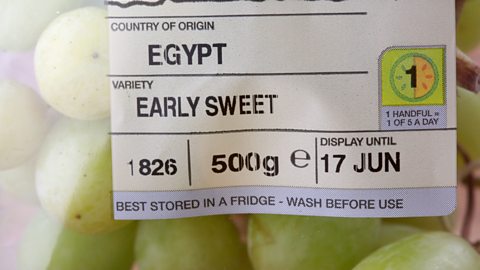
THE GREAT SPOON That sticker tells shoppers where you came from. You come from Scotland so you haven’t had to travel far. That’s better for the environment. And it means you’re fresher too.
PEAR I don’t have a sticker but then I literally came from the human’s garden.
THE GREAT SPOON Some foods can be produced easily in Scotland. Some can only grow in greenhouses that are warmer. You grew in a greenhouse in Inverclyde and were driven fifty miles to the supermarket. That chocolate bar travelled here too, but from far, far away.
CUCUMBER I’ve actually never seen a chocolate bar tree! Where do they grow?
CHOCOLATE BAR There’s no such thing as a chocolate bar tree! I come all the way from Switzerland – that’s where I was made.
CUCUMBER Oh…
CHOCOLATE BAR Milk from Europe was mixed with sugar from Brazil and my main ingredient, cocoa beans from Ghana. That’s in Africa. I’ve properly travelled.
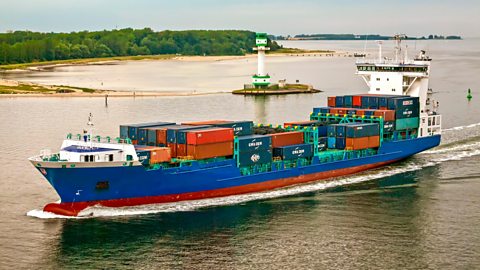
THE GREAT SPOON Cocoa beans need humid weather - warm and wet. That’s why they are grown in parts of Africa. Like so many other foods, cocoa beans get from where they grew to where they were processed using many methods of transport: a truck to the port then a boat to Europe then another truck. The journey can take weeks!
PEAR And now you’re in Scotland! You’re a very well travelled bar of chocolate!
CHOCOLATE BAR 6,400 miles in total.
CUCUMBER That’s a lot of food miles.
PEAR Food miles? What are food miles?
THE GREAT SPOON Travelling by boat, plane and truck all use up energy. And that releases greenhouse gases that add to global warming.
PEAR And to think, I grew just out there in the garden not even 10 metres away!
THE GREAT SPOON The fewer food miles the better. Local foods like you add less to global warming. Cutting down on foods with lots of food miles can help the environment.
PEAR People can still enjoy them, just not so often.
CUCUMBER Here’s an idea. We could plant chocolate bar trees and grow our own chocolate bars in the garden!
PEAR Pal, have you no been listening to anything anyone’s been saying?
Fruit and food miles
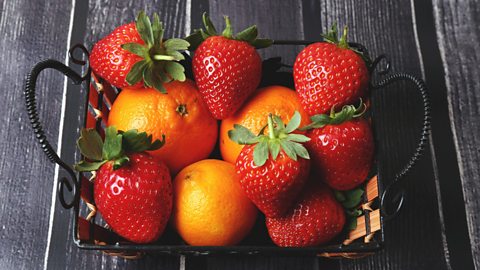
Healthy snacks such as strawberries and oranges can help explain food miles.
- Strawberries grown and sold at a local farm have travelled very few food miles before they reach our plate.
- However, oranges grown in Spain and then transported to our supermarkets by plane and lorry have travelled a lot further.
- The local strawberries produce a smaller number of food miles than the oranges that travelled from another country.
When adding up food miles you might need to include your journey to and from the shop. If you travelled by car, bus or train, these all create carbon emissions and add to the food miles. Walking or cycling don’t need to be counted and they are healthier too!
Interesting words about food miles
- food miles – the distance food has travelled to get to your plate. Food must travel from the farm it is grown on or the factory it is made in to a supermarket or shop to be sold.
- carbon emissions – harmful gases such as carbon dioxide are released into the earth’s atmosphere when we use Fuels that come from the Earth. Fossil fuels are all old life forms that have decomposed and been compressed over a long period of time under ground or under the sea. Coal, oil and gas are fossil fuels. to provide energy. We need energy to grow, produce and transport food. Some food uses more energy than others.
- local – a place close to where you live. Fruit and vegetables that were grown near you would be considered local. A shop in your town would be a local shop as opposed to a shop you had to travel to.
- transport – moving people, animals, or items for sale like food from one place to another. Food can travel by car, bus, lorry, boat and plane. These methods of transport all need a lot of energy.
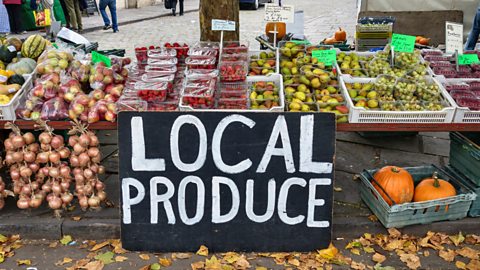
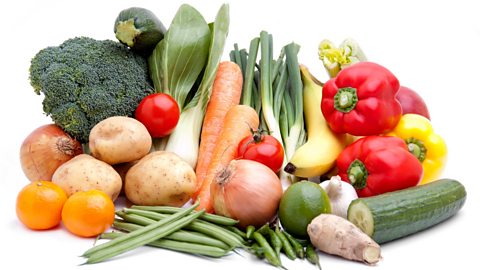
Image caption, Local food
Fruit and vegetables that were grown near your home would be considered local. This is better for the environment because less energy has been used to get the food to you.
1 of 3
Test your knowledge
Try this quiz about food miles and the environment.
Challenge
With the help of an adult, investigate what local food is available near you.
- Is there a farmer’s market or a local fruit and vegetable shop?
- Are any farms nearby selling eggs?
- Does a fish van come to your area?
Climate change food calculator. activity
Use this climate change food calculator to discover more about food miles and carbon emissions.
More on Food and health
Find out more by working through a topic
- count1 of 10
- count2 of 10
- count3 of 10
- count4 of 10