Do we always have the same food needs?
What we need from food changes as we grow. Babies, children and teenagers have particular food needs so they can grow, learn and be active.
In this article you can learn about:
- what young people should eat at different life stages
- the vitamins and nutrients we get from some foods
- the different ways a baby learns to eat solid food
This resource is suitable for Health and Wellbeing for primary school learners.
Video - Food at different stages
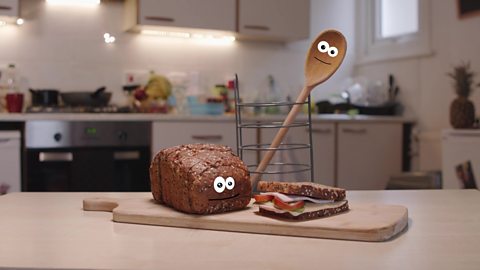
In this video, we visit a family kitchen to find out how different foods can provide nutrition to young people at different stages in their development.
ROOSTER CROWS AND ALARM SOUNDS
THE GREAT SPOON Attention food! It is 7 a.m. also known as breakfast time! The family will be here any moment now. Are we assembled and ready?
ALL FOOD Yes, sir!
THE GREAT SPOON Protein?
EGG Yes, sir.
THE GREAT SPOON Carbohydrates?
BREAD Yes, sir.
THE GREAT SPOON Fat?
PEANUT BUTTER Yes, sir.
THE GREAT SPOON Fibre?
CEREAL Yes, sir.
THE GREAT SPOON Vitamins?
ALL FOOD Yes, sir!
THE GREAT SPOON Minerals?
ALL FOOD Yes, sir!
THE GREAT SPOON Water?
WATER Come on! Let's do this! Woo-hoo!
THE GREAT SPOON Baby incoming.
BABY FOOD GRUNTS
BABY FOOD Baby Food, reporting for duty! Already being devoured.
THE GREAT SPOON Good job!
BABY FOOD The baby has no teeth and I provide the sloppy nutrients. You wouldn’t know to look at me but this mush is actually pears, strawberries, rice and yoghurt all blended up. Proud to be of service, sir.
THE GREAT SPOON Milk and Cereal, it’s your time. Are you clear on your job?
MILK AND CEREAL Yes, sir.
MILK To provide the 4 year old with calcium and vitamin D at breakfast time, sir! To help them grow big and strong, sir!
THE GREAT SPOON Correct. And Cereal?
CEREAL To provide folic acid, iron and fibre, sir! Helping digestion and making sure hair, skin and nails are healthy and strong, sir.
THE GREAT SPOON Proceed to be eaten.
CEREAL Yes, sir.
THE GREAT SPOON Water - you’re going to be very busy today - children need to drink six to eight glasses of water a day. This is your first shift.
WATER Woohoo!
THE GREAT SPOON Now, who will make sure the teenager is well fed until lunchtime?
EGG Us, sir.
BREAD And me.
PEANUT BUTTER And me.
BANANA And me.
THE GREAT SPOON Okay. Eggs, we will boil you - you’re full of protein and proteins are just what teenage bodies need when they’re growing fast.
Bread. We will toast you - packed with energy for the Teenager.
Peanut butter, you will be spread on the toast - you’re giving the teenager her magnesium and vitamin B-6, making sure she won’t get poorly.
And banana, the teenager will eat you on the walk to the bus stop - you’re providing vitamin C and potassium - important for a healthy heart. Is that clear?
ALL FOOD Yes, sir!
THE GREAT SPOON Good luck team! Water - prepare to be drunk.
WATER Honestly - best day ever!
THE GREAT SPOON Another meal time organised to perfection. Now I can rest.
CHILD Muuuuuuuum! What’s for lunch?
THE GREAT SPOON GULPS
At each stage of our life we have different nutritional needs.
Babies (0-2 years old)
- Babies have milk from birth then slowly learn how to eat solid food when they are ready (from around six months old).
- When they are ready, they can eat food that is blended or mashed up. This is called spoon feeding or traditional weaning.
- They can also eat small portions of food that they can "chew" using their gums. This is often called baby led weaning.
- Babies should be given a wide variety of food. This way they learn lots of different tastes.
- Babies do not need any salt or sugar added to their food.
Children (3-12 years old)
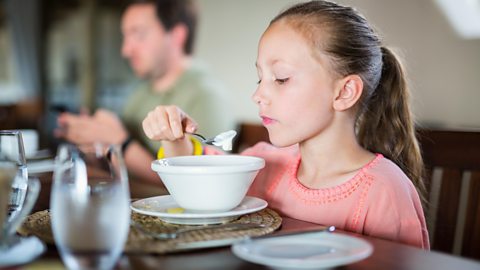
- Children have a full set of teeth and should be eating a wide variety of foods.
- They need carbohydrates for energy and should eat foods that are low in salt and sugar.
- Children should also drink plenty of water every day.
- All of these things will help power children through their school work and activities.
Teenagers (13-19 years old)
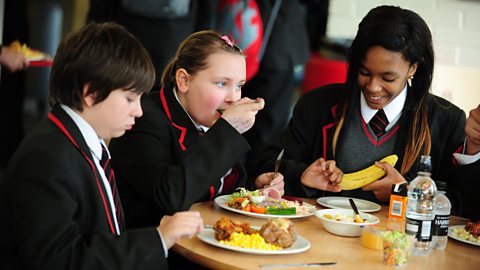
- Teenagers need to eat a well-balanced diet.
- A teenager's body is preparing to become an adult. They need to give their body good fuel for all that growing and changing.
- It's important for teenagers to get into healthy eating habits that they can carry through their adult lives.
- Their meals should include foods from all five food groups, aiming for targets like five portions of fruit and vegetables a day.
- Teenagers should also drink six to eight cups of water a day.
At all stages of our growth we need food that contains lots of nutrients and energy.
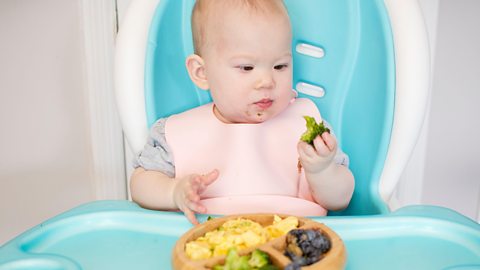
Image caption, Babies (0-2 years old)
Babies have milk from birth and then slowly learn how to eat foods from around six months old - once they are showing signs they are ready.
1 of 3
What we get from specific foods
Babies
- Meat, fish and eggs contain protein and iron which babies need to grow and develop. They can also get protein from beans and lentils. Some breakfast cereals, dark green vegetables and beans contain iron.
- Fruit and vegetables provide lots of vitamins like vitamin A and vitamin C to help babies fight off germs. Vitamin A is good for skin and eyes. Vitamin C helps you absorb iron from other foods.
Children
- Dairy foods like milk, cheese and yoghurt contain calcium which helps bones grow strong and healthy.
- Brown bread, some cereals and vegetables are full of fibre which helps us digest food.
Teenagers
- Foods rich in potassium such as spinach and sweet potatoes are great for a healthy heart and blood pressure.
- Nuts and avocados are full of magnesium which helps with growing pains. This is very useful at this life stage as it has rapid growth spurts (when our body grows quickly).
Interesting words about nutrition
- digest – Breaking down food in our bodies so that we can absorb its nutrients.
- diet – What we eat and drink.
- nutrition – The contents of food and how it affects our bodies.
- proteins – Food which build healthy muscles and allow our bodies to grow and repair. This includes fish, meat, beans, pulses and eggs.
- carbohydrates – Food which keeps our energy levels up like rice, bread, pasta and potatoes.
- fats – Food which acts as an energy store such as butter, margarine and olive oil.
- fibre – Food which helps food move through our bodies, like brown bread and broccoli.
- vitamins and minerals – These can be found in a wide variety of foods. They help all areas of body work correctly and stay healthy. Potassium, magnesium and calcium are all examples of minerals. A, C, D and B6 are all examples of vitamins.
- traditional weaning or spoon feeding - When a baby is fed soft solid food that has been puréed or mashed, usually with a spoon.
- baby led weaning – When a baby feeds themselves solid foods that they can easily chew with their gums.
Test your knowledge
Try this quiz all about food at different life stages.
Challenge
Can you draw a healthy dinner for a baby, child or teenager? Can you include a food that contains calcium?
More on Food and health
Find out more by working through a topic
- count6 of 10
- count7 of 10
- count8 of 10
- count9 of 10