What is decomposition?
Decomposition is the process where bacteria and Refers to organisms, like fungi and bacteria, that obtain their nutrients from dead and decaying organic matter. fungi break down dead organisms into simple A substance formed by the chemical union of two or more elements..
Steps
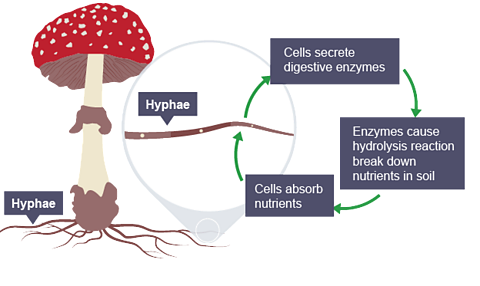
Bacteria/fungi To release a substance, in this case an enzyme.Proteins that act as biological catalysts, meaning they speed up reactions without being used up themselves.out onto the dead organisms.
Enzymes digest the organic matter outside their cells. This is known as extracellular digestion as it happens outside the cells.
The products of digestion are absorbed by the bacteria and fungi.
This process returns nutrients like carbon and nitrogen to the soil, air, and water (The non-living, physical, and chemical parts of an environment that impact living organisms and ecosystem functioning.) so plants can use them. Plants then support animals (All the living organisms, including plants, animals, fungi, and microorganisms, within an ecosystem, as well as their waste and dead remains.). The remaining material forms The dark, rich, organic matter in soil formed from the decomposition of plant and animal matter. in soil, which improves soil fertility.
How do you investigate the key features of the decay process?
Procedure
- Place bread samples in aerobic (with oxygen) and anaerobic (without oxygen) setups.
- Spray half the samples with water; leave the rest dry.
- Store at -18°C (freezer), 4°C (fridge), and 20°C (room) for two weeks.
- Observe and record signs of decay.
Results
Key: ✓ = signs of decay x = no signs of decay
| Conditions | water / oxygen | no water / oxygen | water / no oxygen | no water / no oxygen |
|---|---|---|---|---|
| -18°C | x | x | x | x |
| 4°C | x | x | x | x |
| 20°C | ✓ | x | x | x |
Only 20°C is a suitable temperature, as the other two temperatures are too cold and the other columns have one or more key condition needed for decay to be absent.
Conclusion
Decomposition occurs quickly when:
- the temperature is warm
- water is present
- oxygen is available
Nutrient cycles
In A community of animals, plants and microorganisms, together with the habitat where they live., plants absorb Not derived from living matter. nutrients like carbon dioxide (from the carbon cycle) and nitrates, (from the nitrogen cycle) to build complex molecules.
These molecules pass through food chains and, when organisms die, decomposers break them down, returning carbon and nitrogen to the atmosphere and soil for reuse.
How does the carbon cycle work?
Narrator: Carbon is a chemical element essential to nearly all life on earth.
It exists in the atmosphere as carbon dioxide.
The process through which carbon moves around the planet is called the carbon cycle.
It moves like this.
Plants absorb the carbon dioxide from the atmosphere using light energy they convert the carbon dioxide into glucose. This process is called photosynthesis.
Carbon then moves through the food chain through feeding. As animals eat the plants and then through the process of respiration convert the glucose they’ve eaten into carbon dioxide and release it into the air.
Animals produce waste through the processes of excretion and egestion releasing carbon compounds into the soil.
Then, when animals and plants die they undergo decomposition through bacteria or saprophytic fungi which releases more carbon dioxide into the atmosphere.
The carbon cycle is a continuous movement as carbon is removed from, and returned to, our environment.
However, after organisms die some of the carbon inside them can become buried underground. Through the process of fossilisation this carbon can turn into fossil fuels like coal, oil and gas. When the fossil fuels are then burnt, the process of combustion releases carbon dioxide into the air.
Increased carbon dioxide levels, driven by combustion and deforestation are the major contributors to climate change.
A balanced carbon cycle is essential.
Carbon is a major component in carbohydrates, fats and proteins.
The carbon cycle involves the exchange of carbon between living organisms (biotic) and their atmosphere (abiotic).
In the carbon cycle, carbon is constantly removed from, and returned to, the environment keeping it in balance.
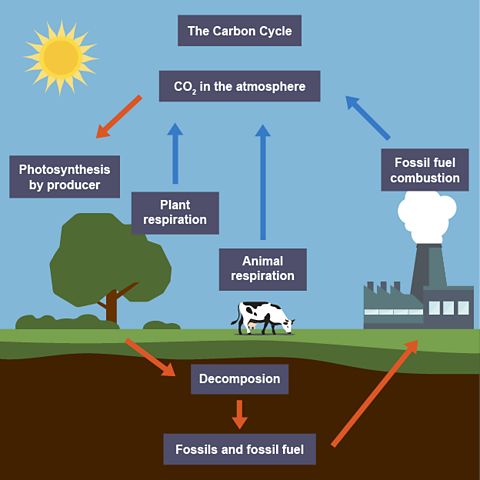
Processes involved in the carbon cycle are:
Photosynthesis
Plants absorb carbon dioxide from the atmosphere use it to form sugars and starch. This is the only process that reduces carbon dioxide levels in the air.
Feeding
Carbon in biological molecules moves through the food chain as animals eat plants and other animals.
Respiration
All living organisms (plants, animals, and decomposers) release carbon dioxide into the atmosphere when they respire. This is a form of Process by which waste products from chemical reactions in an organism are removed..
Fossilisation
If conditions are not favourable for the process of decomposition, dead organisms decay slowly or not at all. These organisms build up and, if compressed over millions of years, can form fossil fuels (coal, oil or gas).
Combustion
Burning fossil fuels releases stored carbon back into the atmosphere as carbon dioxide.
Excretion
Waste materials (eg urine) are released by organisms. Decomposers break these down, releasing carbon dioxide to the air.
Egestion
Animals remove undigested food as faeces, which contain carbon. Decomposers break faeces down, releasing carbon dioxide into the air.
Decomposition
Bacteria and saprophytic fungi break down complex carbon compounds in dead organisms, faeces and urine into simpler carbon compounds, returning them to the atmosphere or soil.
Test your knowledge
More on Biodiversity
Find out more by working through a topic
- count1 of 5
- count2 of 5