What is a variable?
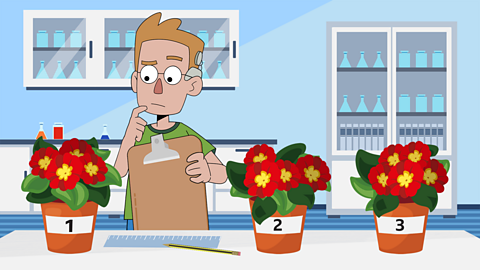
In science, a variable is something that can be changed, measured or controlled in an experiment.
Scientists look at variables to understand how they affect things.
Watch: What are variables?
Learn about variables.
A variable is any one of the things in a test we can change.
Let's measure the time it takes for paper helicopters to fall.
There are lots of variables we could change.
We could change the length of the wings, the number of paperclips or the type of paper.
To make it a fair test we're only going to change one variable at a time.
Okay, let's test the length of their wings and keep everything else the same.
One has short wings, one has medium length wings and one has long wings.
We'll drop them all at the same time.
The helicopter with the longest wings took the longest time to fall.
What are three types of variables?
Independent variables
This is the variable that a scientist changes on purpose to see how it affects something else.
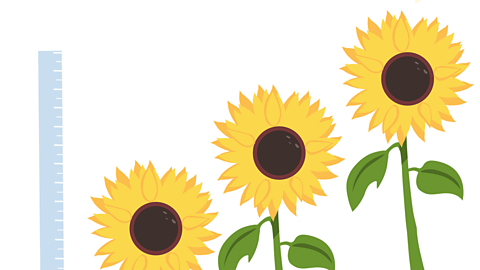
For example, if you want to see how water affects plant growth, you would change the amount of water a plant is given. Therefore, the amount of water is the independent variable.
Dependent variables
This is the variable that the scientist measures or observes.
In the plant example, the growth of the plant is the dependent variable.You would measure how tall the plant grows based on how much water it receives.
Controlled variables
These are the variables that the scientist keeps the same during the experiment to make sure that the test is fair.
In the plant experiment, controlled variables might include the type of plant, the amount of sunlight and the type of soil.
Why are variables important?

- Understanding relationships
Variables help scientists understand how different things are connected. - Fair tests
By controlling variables, scientists can be sure that any changes they see in their experiments is because of the independent variable and not something else. In a fair test only the independent variable changes - Learning
Studying variables allow scientists to make discoveries and learn more about how the world works.
What's next?
Once you have identified your variables, the next step is to form a question, which you hope to answer at the end of your investigation or experiment.
Your questions should mention the independent variable and dependent variable. You could use this sentence stem to help form your question:
What is the effect of X (independent variable) on Y (dependent variable) if I change X but keep everything else the same?
Examples:
- What is the effect of water on plant growth if I change the amount of water but keep everything else the same?
- What is the effect of exercise on heart rate if I change the duration of exercise but keep everything else the same?
Plant Investigation
Imagine you were investigating how long it took beans to germinate and grow to three centimetres tall at different temperatures.
The thing that you are changing (the variable) is the temperature.
The variable you are measuring is the length of time the beans take to grow to three centimetres.
If you place one pot of beans on a sunny windowsill above a warm radiator, and another on a shady cold windowsill, what error would you be making?
This is not a fair test. There are two variables which have been changed: temperature and sunlight. You would not know which of these caused the beans to germinate and grow.

What is a method?
Once you have decided on your question, the next step is to decide how you will go about collecting information and answering the question.
This is called the method. You will need to consider the following:
- What equipment do you need?
- What method will you follow?
- How will you measure and collect the data?
- Will the experiment take place over a long period of time?
- How will you make sure that the investigation is a fair test?
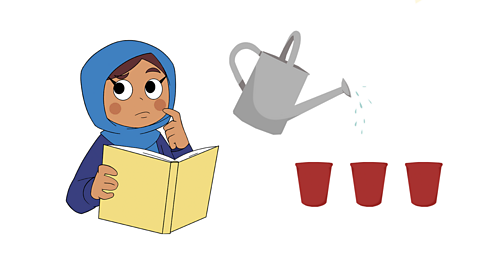
In the plant example, the method may look something like this:
Equipment
3 measuring cylinders
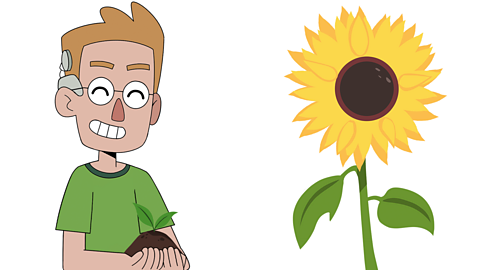
3 sunflower seeds
3 pots
Soil
Water
1. First, place each sunflower seed inside of the pot and cover with the same amount of soil.
2. Then, …
And so on…
Important words
Controlled variables – The variables that scientists keep the same during an experiment to make sure that a test is fair.
Dependant variables – The variable that a scientist measures or observes.
Experiment – A scientific procedure or test, often in a laboratory, that produces results.
Fair test – Keeping variables the same apart from the independent variable.
Independent variables – The variable that a scientist changes on purpose to see how it affects something else.
Method – How scientists go about collecting information and answering a question.
Scientists – Scientists are people who are experts in an area of science.
Variables – Something that can be changed, measured or controlled in an experiment.
Activities
Activity 1 – Find the variables
Activity 2 – Quiz
Activity 3 – Conducting an experiment
Ask a responsible adult to help you with this activity.
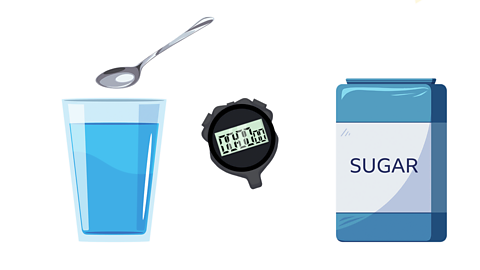
You will need sugar or salt to dissolve, and water at different temperatures.
It is very important that you only use hot water if the adult is working with you, because spilling it might hurt you.
Put water into three glasses or cups:
- cold (from the fridge or left outside overnight)
- medium (half-filled from above and the other half from below)
- warm (left on the radiator or in the sun)
Put one teaspoon of sugar or salt into each cup and stir it until it disappears.
Record the time this takes.
Activity 4 – Experiments and variables
New game! Horrible Science: Stinky Space. game
Join Pipette on her epic mission and learn some revolting facts about space along the way.
More on Working scientifically
Find out more by working through a topic
- count4 of 5
- count5 of 5
- count1 of 5
- count2 of 5