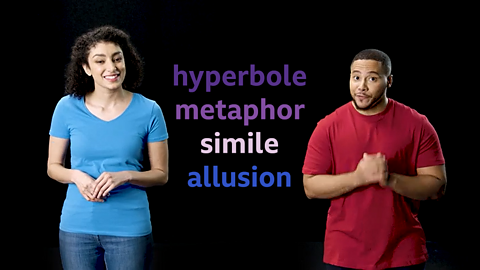
Did you know many of the terms we use for language techniques come from Latin words? This can help you remember them.
- alliterationWhen the beginning sound of words is repeated in nearby words. is from the Latin word littera meaning 'letter of the alphabet'.
- sibilanceThe repeated use of the ‘s’ sound in the beginning, middle or end of nearby words. comes from sibilare, the Latin word for 'hissing'.
- simile A comparison between two objects using ‘like’ or ‘as’. comes from the Latin word similis meaning 'similar, like'.
Introduction
Language choice is key when creating mood, atmosphere and tone. Writers use different techniques depending on the effect they want to achieve. The sounds of words, the images they create, the literal meaning of words as well as the ideas suggested by or associated with certain words and phrases all count.
The language choices you make when writing can influence the way a reader responds to your stories. Likewise, as a reader it's important to consider choices writers make and the specific effects that these create.
Video about using language
Learn how to use language to bring characters and settings to life
Creating mood and atmosphere
Language choices help to create a sense of mood and atmosphere. Mood is the target emotion – how you want the reader to feel. Atmosphere creates and maintains that emotion through language, imagery, and specific detail. Mood and atmosphere is most clearly shown in the choice of setting (place and time).
For example, in Emily Brontë’s Wuthering Heights, she describes a storm:
About midnight, while we still sat up, the storm came rattling over the Heights in full fury. There was a violent wind, as well as thunder, and either one or the other split a tree off at the corner of the building: a huge bough fell across the roof, and knocked down a portion of the east chimney-stack, sending a clatter of stones and soot into the kitchen-fire.
Here, Brontë has selected verbs such as ‘rattling’, ‘split’ and ‘fell’ to suggest the intensity of the storm. Adjectives such as ‘violent’ reinforce this idea.
Repeating the sounds in ‘rattling’ and ‘clatter’ - the consonanceThe repetition of similar consonant sounds in nearby words. of the double tt - gives an onomatopoeiaWhen a word sounds like the word it is describing. For example, ‘buzz’ or ‘hiss’. quality to the description alongside the destructive movement. We can hear the sound of ‘rattling’ and ‘clatter’ in the words themselves.
The use of these word types and sounds push the narrative in a specific way. As a writer you need to consider all these ideas when planning your writing.
Which technique is used?
In the following description of a storm in The Woman in Black, which language technique does the author, Susan Hill use?
The house felt like a ship at sea, battered by the gale that came roaring across the open marsh. Windows were rattling everywhere and there was the sound of moaning down all the chimneys of the house and whistling through every nook and cranny.
- Consonance and onomatopoeia to show the noise and intensity of the storm
- Verbs to show the noise and intensity of the storm
- Consonance, onomatopoeia, and verb choices to show the noise and intensity of the storm
Answer
- 'battered', 'roaring', 'rattling', 'moaning' and 'whistling' are all verbs which use onomatopoeia. 'Battered' and 'rattling' also use consonance with the double 'tt' sound.
Creating tone
Tone is the way an author shows their own or their character's feelings about something. For example, they might use a humorous, angry or sarcastic tone. In the opening to The Lie Tree by Frances Hardinge creates a bleak, fearful tone – the choice of words channel the feelings of the character, Faith:
The boat moved with a nauseous, relentless rhythm, like someone chewing on a rotten tooth. The islands just visible through the mist also looked like teeth, Faith decided.
Hardinge uses two simileA literary technique where a comparison is made between two things using ‘as’ or ‘like’. to create a disturbing comparison between a) the motion of the boat and the action of biting and b) the islands and teeth. It seems as if Faith is actually being chewed up inside a rotten mouth and hints that her destination might be a dangerous place.
Hardinge has also used words with lots of ‘s’ sounds that reflects the whooshing sound of the sea around Faith, but also helps to generate a sinister feeling. This repetition of the ‘s’ sound is called sibilance.
In Edgar Allan Poe’s The Tell-Tale Heart, the narrator decides to commit murder:
When the old man looked at me with his vulture eye a cold feeling went up and down my back; even my blood became cold. And so, I finally decided I had to kill the old man and close that eye forever!
The narrator uses a metaphorMakes a direct comparison by presenting one thing as if it were something else with the characteristic. For example describing a brave person as a lion. to describe the man’s eye as a ‘vulture eye’. Since vultures are birds that eat dead things, this comparison is effective in helping the reader understand the narrator’s horror. This description along with the phrases ‘cold feeling’ and ‘blood became cold’ create a tone of disgust and fear about the eye and the old man.
Similes and metaphors
As the examples above show, similes and metaphors are useful ways to make writing more exciting and memorable whilst also helping readers to understand and imagine what is happening.
Find out more about using literary devices.
Simile or metaphor?
Narrative voice
Writers choose the point of view from which the story they are writing is told. Sometimes stories have an obvious narrator (the person telling the story) and sometimes the reader doesn’t notice a narrator at all. Writers might choose to have stories narrated from one character’s point of view or from multiple points of view. Writers often create a distinctive 'voice' for the character who is telling the story – the reader 'hears' this voice in the writing.
To create a convincing narrative voiceThe perspective the story is told from: the voice the reader ‘hears’ in the writing. a writer will think about how their language choices reveal information about the narrator including their personality and beliefs. For example, do the word choices or sentence structures suggest they are young or old, polite or rude, a historical character or something else?
For example, in Great Expectations by Charles Dickens, the narrator Pip is looking back on his childhood. It is written in the first-person, using ‘I’.
My sister, Mrs Joe Gargery, was more than twenty years older than I, and had established a great reputation with herself and the neighbours because she had brought me up ‘by hand.’ Having at that time to find out for myself what the expression meant, and knowing her to have a hard and heavy hand, and to be much in the habit of laying it upon her husband as well as upon me, I supposed that Joe Gargery and I were both brought up by hand.
The narrator’s voice is clearly from a historical time period (the novel was written in 1861) and we recognise this in the long sentences and old-fashioned language. The voice sounds adult, intelligent and humorous (pointing out the fact his sister’s boasting about having brought him up ‘by hand’ could also refer to how she hit him.).
Now read this narrative voice from Laurie Halse Anderson’s The Impossible Knife of Memory:
It started in detention. No surprise there, right?
Here, the voice sounds like a modern teenager talking directly to the reader (‘right?’). They sound sarcastic and angry (‘idiots’), using bitter humour (‘cats in the dishwasher’).
Which narrator?
In Stone Cold by Robert Swindells there are two narrators:
- Link, a homeless teenager
- Shelter, an ex-soldier who is murdering homeless people.
Can you work out which is which from their character voice?
- ‘Hang about and I’ll tell you the story of my fascinating life.’
- ‘It is 19:00 hours and this has been a most satisfactory day. Most satisfactory. The secret of victory in any campaign is planning and preparation.’
Answer
- Link, the homeless teenager, uses informal language ‘hang about’ and sarcasm ‘my fascinating life’.
- Shelter, the ex-soldier, uses military language ‘19:00 hours’, ‘victory’ and ‘campaign’ as well as formal language ‘most satisfactory’.
Sibilance, assonance and alliteration for effect
The sound of words in a sentence is another tool that writers use to create mood or atmosphere. They might use alliterationWhen the beginning sound of words is repeated in nearby words., sibilanceThe repeated use of the ‘s’ sound in the beginning, middle or end of nearby words., assonanceThe repetition of vowel sounds in a series of two or more words. or onomatopoeiaWhen a word sounds like the word it is describing. For example, ‘buzz’ or ‘hiss’..
For example, a 'whistling wind' uses both onomatopoeia ('whistling') and alliteration (the 'w' sound is at the start of both words). This helps the reader hear the sound of the wind.
These techniques can also help emphasise key words or link words and ideas together.
For example, in Strange Case of Dr Jekyll and Mr. Hyde by Robert Louis Stevenson, Mr. Hyde is hated on sight by many characters. He is described as:
…something displeasing, something downright detestable. I never saw a man I so disliked and yet I scarce know why.
The alliteration uses the 'd' sound to emphasise all the negative adjectives. The sibilance also underlines the way Hyde is seen as unpleasant and sinister. Notice sibilance can be at the beginning, middle or end of words.
Which technique?
What is the main technique that the author Lois Lowry uses in this passage from her novel The Giver?
A bright, breezy day on a clear turquoise lake, and above him the white sail of the boat billowing as he moved along in the brisk wind.
a) Alliteration
b) Assonance
c) Sibilance
Answer
a) alliteration of the 'b' sound.
Using vocabulary for effect
Vocabulary is the words we know and use. The best way to expand your vocabulary is by reading and picking up new words from other writers. Using more sophisticated vocabulary and expanding our vocabulary can make our writing more powerful and memorable. It can also make our writing more accurate and precise if we know the exact word for what we want to describe.
It is worth replacing over-used words and phrases, like 'bad', 'a lot' and 'said' with more precise words. 'Bad' for example could mean many things. As a writer you need to make it clear to the reader what you mean: does 'bad' in fact mean evil, dangerous or even rotten?
Let’s try describing a storm. We might start with: "The sky was lit up by lightning". We could add more precise and descriptive vocabulary: "The pitch-black sky was lit up by forked lightning." Perhaps we could use a more active verb: "The forked lightning flashed." and make the lightning seem alive: "The forked lightning flashed, ripping open the brooding pitch-black sky with its blinding claws."
As a writer it is up to you to make your writing as gripping as possible and vocabulary is a key tool to do this.
Try different vocabulary
Which of these more precise words could be used instead of:
a) said?
b) a lot?
c) good?
- excellent, delightful, expert
- whispered, stated, stuttered
- multiple, numerous, repeatedly
Answers
a-2, b-3, c-1
Test your knowledge
In this extract, also from A Christmas Carol, Dickens describes his main character Ebenezer Scrooge. Can you spot the language techniques and associations used here?
What do they tell us about Scrooge?
Oh! but he was a tight-fisted handA metaphor with a few associations – usually a “hand” would represent help, but to be “tight-fisted” means you keep everything you have for yourself. Scrooge won’t give anything away, even assistance. at the grindstoneThe grindstone is a piece of heavy equipment for milling flour from wheat by crushing it or for sharpening blades and tools by grinding their edges off. It is also used as a metaphor for working hard when someone "puts their nose to the grindstone” – this may suggest Scrooge is all about work and no play., Scrooge! a squeezing, wrenching, grasping, scraping..These are present participles, which is when verbs (doing words) are used as adjectives (describing words). The list of actions associated with Scrooge makes him seem endlessly greedy, always grabbing at things for himself.squeezing, wrenching, grasping, scraping..These are present participles, which is when verbs (doing words) are used as adjectives (describing words). The list of actions associated with Scrooge makes him seem endlessly greedy, always grabbing at things for himself., covetousIf you covet something, you want it for yourself. “Covet” is a word featured in the Ten Commandments, so this biblical term fits with Scrooge being an “old sinner”. old sinner! Hard and sharp as flintA simile comparing Scrooge to a type of stone – Scrooge sounds harsh, impatient and unforgiving., from which no steel had ever struck out generous fireFlint is used to strike sparks for starting a fire. Fire here is described as “generous” – it’s warm and gives off heat and light – but it is not associated with Scrooge, showing he is not generous but mean.; secret, and self-contained, and solitaryA list of three with sibilance (alliteration of s sounds) that might sound like hissing or spitting – an unfriendly sound to show Scrooge is also unfriendly., secret, and self-contained, and solitaryA list of three with sibilance (alliteration of s sounds) that might sound like hissing or spitting – an unfriendly sound to show Scrooge is also unfriendly. as an oysterSimile. Oysters shut themselves up in their shells alone – they make beautiful pearls but hide them from view so no one can see them. This suggests Scrooge is not only alone but keeping everything he has hidden away for himself and sharing nothing..
Explore language for effect
Quiz
More on Fiction writing
Find out more by working through a topic
- count2 of 5
- count3 of 5
- count4 of 5