Introduction to WW1 trench warfare
In World War One, the trench system on the Western Front extended from the English Channel to the Swiss Alps - a distance of roughly 475 miles.
It was in trenches that British soldiers spent most of their time, waiting for the next major offensive. But why were trenches required and what was day-to-day life in them like?
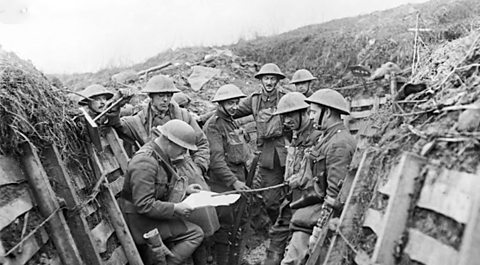 Image source, ALAMY
Video - Trench warfare in World War One
Watch this video to find out about life in the trenches during World War One, including the experiences of Scottish soldier, Arthur Roberts.
What was life like in the trenches of World War One?
"At last, through the darkness and rain, word was passed to prepare to move. One moment we were wading up to our middles in water, and the next we were wobbling and bouncing over the bodies of our unfortunate comrades."
"The journey was a nightmare. We arrived at jumbled mess of sandbags, sheet iron, planks, rifles, and dead bodies. Would the supports that follow in our tracks find me mangled and torn, gazing into the great beyond?"
This account of the lead up to an assault, from the diaries of Arthur Roberts, is all too familiar and quite unlike what anyone had imagined combat to be like at the outbreak of World War One.
As World War One broke out, excitement and enthusiasm was in the air – the promise of adventure! Of money! – and the sense that the war would be over by Christmas. Scots – particularly Highland Scots – had long-standing, proud military traditions, and 190,000 men volunteered to fight before conscription made it compulsory.
But, upon arrival at the front lines, this war of action and adventure quickly became something quite different. Tactics changed, direct attacks and horseback charges were easily mowed down by machinegun fire, as quicker-loading, more powerful cannons and rifles sent soldiers seeking shelter. And so both sides dug trenches for protection – a 400 mile line that changed the war from one of active battles, to four long years of a gruelling stalemate.
A trench was dug on one side protecting Scots and other Allied soldiers, whilst nearby, a second, housing the German army, was separated by forty-five to two hundred and thirty metres of ‘No Man’s Land’ in between. Trenches were two and a half metres deep, made of wooden planks, sandbags, barbed wire and a whole lot of mud, dug with pickaxes and shovels.
Life in the trenches was gruelling and dangerous. Fly-ridden summers, wet, freezing winters, all in conditions that led to trench foot and, eventually, amputations. Poor hygiene led to infection and sickness, and for Scots, lice crept into their kilts, which spread trench fever.
Long stretches of boredom and tension were broken by intense action with orders of going ‘over the top’ to capture the German trenches.
One such assault was the Battle of Loos in 1915. An exposed, terrifying charge by the British across No Man’s Land, and the first use of poisonous gas by the Brits. One that hurt them as much as their enemy. 7,000 Scots died in the battle – ultimately a failure to break through the lines of the German trenches. One of many such failures.
Trench warfare dragged on for years, with millions of futile deaths on both sides from gunshots, shells, or just awful conditions. Groups of friends and relatives – sometimes entire sports teams – had signed up to fight side-by-side, but ultimately, some families lost multiple sons and communities were ripped apart by the loss of a generation of young men.
In most town across Scotland, memorials to those that died can be seen to this day.
Why were trenches important in WW1?
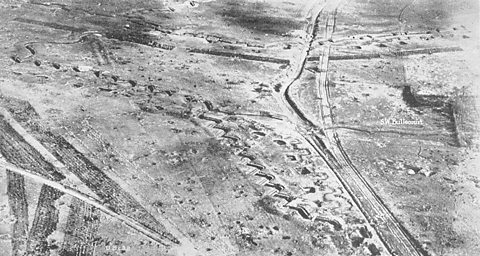 Image source, ALAMY
Long before World War One, Germany had created a plan to avoid fighting with its rivals France and Russia at the same time.
This was known as the Schlieffen Plan – named after Alfred von Schlieffen, the German General who devised it in 1905. The plan was that Germany would invade France through Belgium and win a swift victory before Russia (an ally of France) had time to respond.
The plan gambled that Britain would not intervene in response to the invasion of Belgium. It also assumed that it would take Russia six weeks to organise its army before it could enter a war.
The plan was wrong about both.
A defensive war
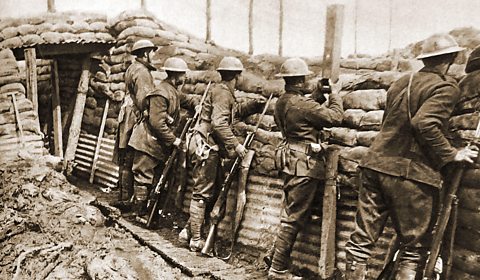 Image source, ALAMY
In the east, the Russian Army was able to mobilise more quickly than the Germans had anticipated and began advancing towards Germany’s borders.
In the west, Britain chose to send an army – the British Expeditionary Force – across the English Channel to honour a previous treaty to uphold Belgium’s A political decision that means that a country refuses to take sides during a conflict..
The result of Britain's intervention meant that they were able to successfully disrupt Germany’s plan to surround Paris and force a French surrender.
This failure, along with the introduction of modern weapons such as machine guns forced both sides to dig trenches as a means of protection from gunfire and as an attempt to encircle the opposition.
Germany's "quick" war would go on for four years and cost millions of lives.
Image source, ALAMYWhat was trench warfare like in WW1?
While much of a soldier’s life at the front line was characterised by boredom and not much happening, when fighting broke out it could be terrifying.
WW1 artillery bombardments
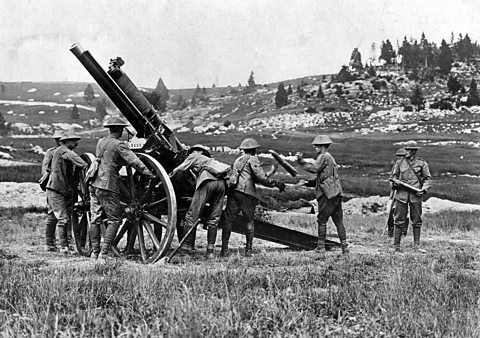 Image source, ALAMY
As trenches were very good at defending soldiers from the direct attacks of enemy soldiers, other methods for winning battles were soon developed.
Huge field guns called howitzers were developed that would bombard enemy trenches with explosive shells. They were designed to destroy the trenches, tear through barbed wire defences, and shatter the morale of the enemy soldiers.
These bombardments could last for hours or even days. The British bombardment of German trenches at the Battle of the Somme in 1916 lasted for eight days!
The horror and destruction of these bombardments caused great suffering to soldiers. It even created a new medical condition called shellshock – where experience of the shelling left soldiers too traumatised to carry out their duties.
Image source, ALAMY'Over the top': WW1 trench raids
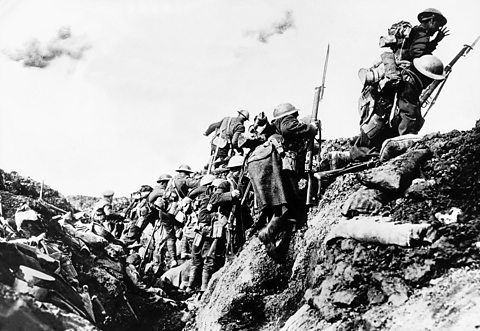 Image source, ALAMY
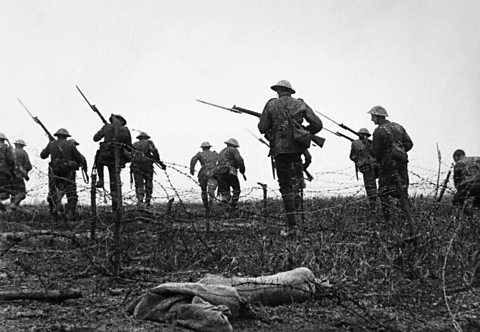
Another feature of trench warfare were trench raids. These involved soldiers leaving the safety of their own trenches and advancing on their enemy’s trenches to attempt to capture them.
This became known as going ‘over the top’ since it involved soldiers climbing out of their own trenches.These raids were very dangerous as they involved crossing the stretch of land between the trenches known as no man’s land.
Before such raids, artillery would bombard o man’s land to destroy barbed wire defences as well as the enemy trenches.
While this weakened the enemy, it also made o man’s land very hard to cross quickly as there were lots of holes, shell craters, and fallen trees.
Image source, ALAMYWW1 machine guns
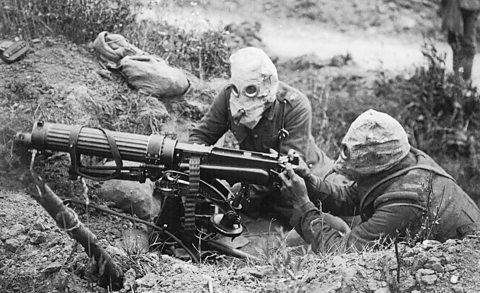 Image source, ALAMY
Trench raids were made highly dangerous by the arrival of modern weapons such as machine guns.
Machine guns – such as the Vickers model used by the British army – could fire over 400 bullets a minute.
With that kind of firepower, only a few machine guns were needed to make crossing no man's land deadly.
On the first day of the Battle of the Somme, the British army lost over 57,000 men – many of them killed or injured by German machine guns.
Image source, ALAMYPoison gas in WW1
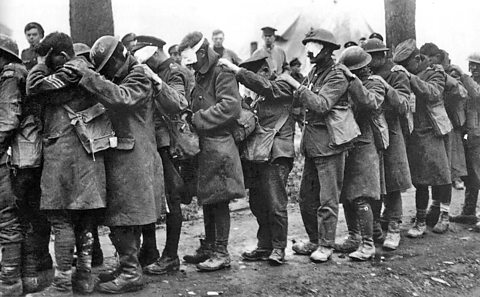 Image source, ALAMY
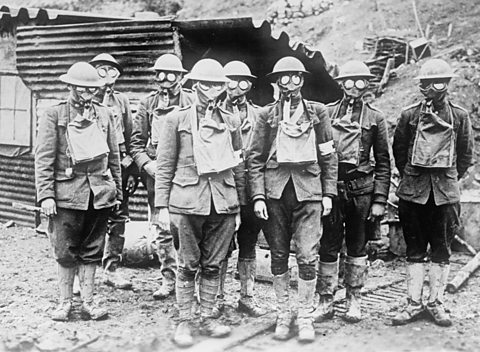
Another terrifying weapon that the soldiers In the trenches had to deal with was attack from poison gas.
There were several different kinds of gas used. The most common were:
- chlorine gas
- phosgene gas
- 'mustard' gas
Poison gas had been created decades before World War One but it had never been used on such a large scale before.
The first major use of poison gas in World War One came on 22nd April 1915 at Ypres in Belgium.
The German army released chlorine gas and clouds of it drifted across to the allied trenches. The gas caused extreme breathing problems and even death in the British, Canadian, and French forces. As this point, troops had no gas masks to protest themselves.
Poison gas became a common weapon and it became standard for soldiers to be issued with gas masks and protective clothing.
While these gases did not kill huge numbers of soldiers, they did cause horrible injuries in tens of thousands of soldiers.
Many of the gases caused permanent damage to the lungs and throat. Others caused agonising blisters on the skin and left people blind.
Image source, ALAMYWhat was it like to live in WW1 trenches?
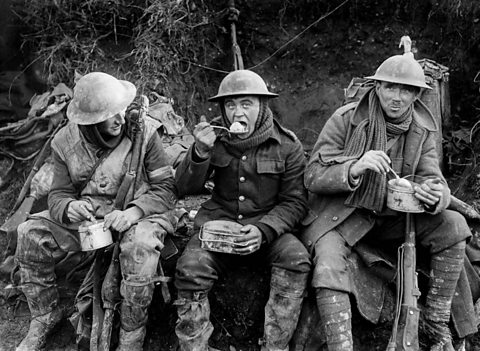 Image source, ALAMY
For many, daily life in the trenches was one of routine and mundane tasks.
Each day would begin at dawn with the soldiers ordered to ‘Stand To’. This was an order to protect the trenches from a potential German attack.
As the sun would rise behind the German trenches, dawn was a particularly good time for them to attack the British trenches as the British would have been blinded by the rising sun.
Once it was determined that the Germans were not going to attack, the British troops would be ordered to ‘Stand Down’ and the men would make their breakfast – this usually consisted of tea and bacon which was made on a simple, portable cooker called a primus stove.
Image source, ALAMYDaily tasks in the trenches
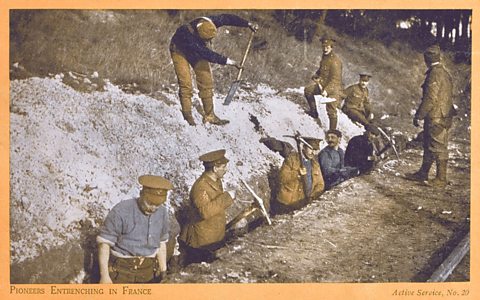 Image source, ALAMY
After breakfast, the troops would complete a wide range of tasks including cleaning their rifles and carrying out basic duties:
- strengthening and repairing trenches
- digging new A simple type of toilet, usually a hole in a wooden seat emptying directly into a river or pit that would need to be manually emptied.
- ensuring that the sandbags that were part of the trench defences were refilled
- restocking the trenches with ammunition and food supplies
The army also had regiments of engineers at their disposal. Their job was to repair bridges and roads to allow supplies to reach the trenches or to allow the army to advance against the Germans.
Some soldiers were signallers and it was their responsibility to lay telephones lines so that messages could be carried throughout the trenches and back to army headquarters.
These lines would often get damaged during enemy bombardments and would need to be repaired or replaced regularly.
Image source, ALAMYRest and relaxation in the trenches
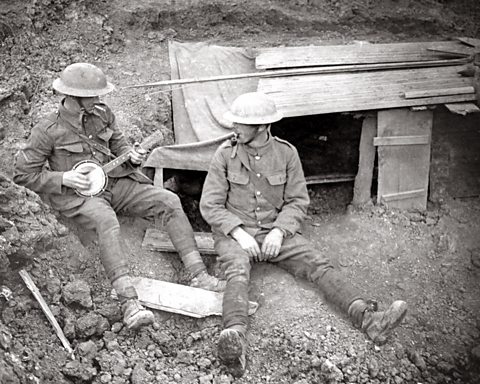 Image source, ALAMY
Soldiers did not spend all their time fighting. If the men had completed their tasks, they were given time to themselves.
Some would write letters home to their loved ones, others would keep a diary, whilst others would pass the time playing cards or chess.
Soldiers also didn't spend all of their time at trenches in the front line.
The troops were on a constant rotation and it was expected that they would receive 14 days off duty before serving in the trenches for a total of 16 days.
When not in the trenches, soldiers could enjoy time off in the French and Belgian towns that were under British control. This gave them time to rest and recover from the difficult and dangerous lives they lived in the trenches.
However, this did not always happen. The Scottish Black Watch regiment once served 48 days in the trenches without a break.
Image source, ALAMYHealth and hygiene in WW1 trenches
 Image source, ALAMY
Hygiene and sanitation in the trenches was difficult to maintain.
Whilst the troops were encouraged to use toilet pits called latrines, some men opted to use nearly holes and craters made by shell explosions.
When drinking water was in short supply, some troops would drink water from these shell holes. Contaminated water lead to outbreaks of A waterborne disease which causes severe diarrhoea, dehydration, lethargy and erratic heartbeat. It can be fatal within hours of infection..
Rats were a constant issue in the trenches. Dead bodies attracted them to the trenches and the troops soon found that the rats were helping themselves to the food supplies and spreading lice throughout the trenches.
Lice would lay their eggs in the seams of the troops’ overcoats, and in the case of the Scottish soldiers, in the pleats of their kilts. The lice caused the spread of A disease caused by infected lice. It caused a high temperature, headaches and joint pain. and An infectious disease spread by lice. It causes a fever and can be fatal. amongst the soldiers.
The mud also created health problems for the troops as it prevented men from keeping their feet dry and clean.
This led to many soldiers developing a condition known as trench foot. This disease would rot the flesh from a soldier’s feet, exposing the bone and muscle underneath.
The lack of fresh fruit caused some to develop trench mouth. This was a disease which would cause the gums to bleed and recede.
Left untreated, ulcers could form along the inside of the mouth and down the throat, resulting in the soldier experiencing pain whilst they ate and swallowed.
They would also have chronic bad breath. Many soldiers who suffered from this condition took up smoking as a means of masking their breath.
Image source, ALAMYShell shock
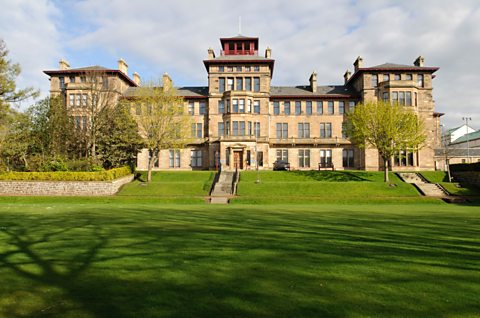 Image source, ALAMY
The horrors that the soldiers faced on a daily basis, combined with the noise from artillery bombardments, caused many men to develop shell shock.
These men would display symptoms such as their limbs shaking uncontrollably, foaming at the mouth and becoming incontinent. Some became confused and would even be found wandering behind the trench system without knowing where they were.
We now call this condition Post-traumatic stress disorder is a mental health condition where people relive traumatic incidents from earlier in their lives..
Unfortunately, in the early stages of the war, the army viewed shell shock as cowardice. Of the 306 British soldiers executed by firing squad (and since pardoned), many showed symptoms of shell shock.
Eventually military hospitals, such as the one at Craiglockhart in Edinburgh, were established to help treat soldiers suffering from shell shock.
Image source, ALAMYThe war poets
Craiglockhart Hospital treated many patients for shell shock during the World War One.
The best known were the poets Wilfred Owen and Siegfried Sassoon. The poets became famous for the poems that they wrote about the horrors of war.
The two men met and became friends while both stayed at Craiglockhart and received treatment for shell shock.
Owen, was sent to the hospital after being knocked unconscious by the blast of a German artillery shell. Sassoon, was sent to the hospital after writing ant-war statements and refusing to return to the Western Front.
Test your knowledge
More on World War One
Find out more by working through a topic
- count4 of 9
- count5 of 9
- count6 of 9
- count7 of 9