Political representation in the UK
Quick version
The UK public elect MPs to represent them in the UK Parliament.
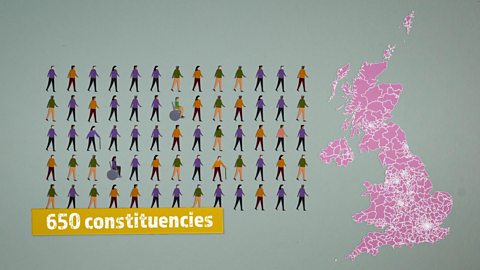
The UK is divided into 650 constituencies and there are 650 MPs, one for every constituency.
A general election is usually takes place every five years and the public vote to elect their MPs.
In their constituency MPs:
- respond to letters and emails
- hold surgeries
- attend local meetings and events
- meet with other local representatives
In the UK Parliament MPs:
- organise meetings with relevant ministers
- speak in debates and ask questions during PMQs
- introduce Private Members Bills
- raise the profile of an issue in the media
- work in committees which scrutinise the work of the government
MPs can also represent their party or government:
- serving as a minister in the government
- serving as a party whip
Video - The role of MPs
Watch this video explaining what MPs and MSPs do and how they hold our government to account.
As well as representing the views of their constituents in Parliament, MPs andMSPs also represent us by holding our governments to account.
At the UK Parliament in Westminster, MPs can question the government directlyduring debates and at Prime Minister's questions.
This takes place each Wednesday and gives MPs 30 minutes to quiz the PrimeMinister about government decisions and constituents concerns.
MPs and members of the House of Lords can also take part in committees.
These are set up to consider government policy and scrutinise the work of theGovernment and its spending.
Committees have the power to question government ministers and the PM ontheir decisions and make recommendations.
Majority government rule is the most common type of government inWestminster.
When the government has the majority of MPs, it can be easier for them to passlegislation that reflects the policies for which they were elected, but that isprovided the governing parties MPs all vote together.
This is where the Whip system comes in.
Each party appoints a group of MPs or Lords as party Whips with theresponsibility to maintain party unity.
They do this by encouraging party members to vote the way their party wants.
At the Scottish Parliament, similar methods are used to hold the ScottishGovernment to account.
Every Thursday the First Minister spends 45 minutes answering MSPsabout the performance of government during First Minister's questions.
This is an opportunity for members of the Scottish Parliament to highlight issuesand for the opposition parties to put forward alternatives.
But MSPs from the governing party can also ask questions at this time, focussingon the successes of the government.
Scottish Parliament also has its own powerful committee system.
Committees are cross-party groups independent of the government.
They are responsible for proposing as well as scrutinising bills, taking evidencefrom witnesses and conducting enquiries.
Committees produce reports that make recommendations to the ScottishGovernment and other public bodies.
The Government must respond to the committee's recommendations, saying ifthey agree or not.
In Scotland, like in the UK Parliament, majority government and the whip systemare also used for passing legislation in line with the policies they were elected for.
While a Scottish or UK government is in power, there are many ways in which ourelected representatives can hold it to account, but it is ultimately voters whojudge the performance of a government at elections, either choosing to showtheir support by re-electing them or registering their desire for change bybacking another party.
Learn in more depth
- How are MPs elected?
- What is the role of an MP in their constituency?
- What is the role of an MP in Parliament?
Keep going to learn more.
How are MPs elected?
Members of Parliament (MPs) are politicians who are elected by the public to represent them in the UK Parliament.
MPs sit in the House of Commons where they raise issues, debate, consider and make laws and scrutinise the work of government. Some MPs serve as members of government.
As well as working for the UK in general, all MPs represent people in their own constituency.
The UK is divided into 650 constituencies (seats).
In general, each constituency represents a similar number of voters.
Some constituencies have fewer voters but are kept as specific constituencies because they cover a very large area or because they are islands, for example Na h-Eileanan An Iar (Western Isles),
MPs are elected every five years at a General Election using a voting system called First Past the Post (FPTP).
At the election the candidate with the most votes in their constituency becomes the MP.
Usually, the party with the most MPs becomes the government.
What happened at the last General Election?
The last General Election in the UK was held on Thursday 4th July 2024 with the following results across the UK and in Scotland:
Results of UK General Election, 2024
| Political party | Number of MPs returned |
|---|---|
| Labour | 412 |
| Conservative | 121 |
| Liberal Democrat | 72 |
| SNP | 9 |
| Sinn Féin | 7 |
| Other | 28 |
Results of UK General Election 2024 in Scotland
| Political party | Number of MPs returned |
|---|---|
| Labour | 37 |
| SNP | 9 |
| Liberal Democrat | 6 |
| Conservative | 5 |
What is the role of an MP?
The role of a Member of Parliament (MP) is to represent their constituents, including those who did not vote for them or did not vote at all.
MPs divide their time between working in their constituency, and working in the House of Commons in Parliament:
- sessions in the House of Commons are usually on Monday to Thursday
- there are usually an additional 13 Friday sessions each year, where MPs consider Private Members Bills
- many MPs will also sit on committees in Parliament.
- when not sitting in parliament, MPs carry out work in their constituency, or on visits or meetings in other locations.
MPs represent their constituents in areas where the UK Parliament takes decisions.
The 57 MPs who represent Scottish constituencies can only represent their constituents directly on reserved matters such as immigration, defence and employment rights.
Scottish MPs have the right to speak and vote on any matter that comes up in the UK Parliament, even those which will not affect Scottish constituents directly, such as education or health which are devolved matters controlled by the Scottish Parliament.
As well as representing their constituents, many An MP who does not hold a job in government or act as a frontbench spokesperson for an opposition party MPs will feel that they have a responsibility to their political party as the party helped the MP secure election.
What work do MPs do in their constituency?
MPs have an office in in their constituency where the work they carry out in the area is organised.
MPs work in their constituency in a number of ways:
- MPs respond to letters and emails from local people and organisations who want their support
- MPs hold surgeries where constituents can bring their problems and questions, which the MSPs will try to address
- MPs attend local meetings and events where they meet and discuss important issues with groups of constituents
- MPs meet with other local representatives (for example councillors), business leaders, or members of the community, to discuss priorities in the area
- All these activities allow MPs to get to grips with the local issues facing their electorate and to ensure they represent them fairly.
MPs can take on a constituent's problem in one of a number of ways:
- by contacting a government minister
- by starting a debate or asking a Parliamentary question
- by introducing a Private Members' Bill or proposing an amendment to a bill
Most MPs represent a political party and will often meet with their local constituency political party. They require the support of the local party to ensure that they will be selected to stand as a candidate in future elections.
What work do MPs do in Parliament?
MPs can represent the interests of their constituents in a number of ways in Parliament:
- writing to or organising meetings with relevant ministers
- speaking in Parliament during a debate
- asking questions during Prime Minister's Questions (PMQs)
- introducing Private Members Bills on topics of concern to their constituents
- raising the profile of an issue in the media
- speaking to lobbying groups about issues that affect the area they serve
- involvement in committees which scrutinise new legislation or question the work of the government
As well as representing their constituents, MPs can also represent their party or government:
- serving as a minister in the government
- serving as a party whip
What are Parliamentary Committees?
One way members of Parliament scrutinise or check on the government is by regularly meeting in small groups called committees. These committees can make recommendations to the government on particular issues such as education, the environment and foreign affairs.
For example, the Petitions Committee of the House of Commons exists to consider any petitions or e-petitions put forward by members of the public and make recommendations for which petitions should be debated in Parliament.
Committee recommendations are given to the head of the government department (called a minister) in charge of that particular issue. This means reports by the Health Committee will be sent to the minister responsible for that area of health policy.
There are different types of committees that MPs could be involved in:
- Commons select committees - made up of MPs only - these look at the work of specific government departments
- Joint committees - made up of MPs and Lords - carry out similar work to select committees
- General committees that look at particular bills and proposed legislation
What are Public Bill Committees?
Public Bill Committees are a type of general committee created on a temporary basis to scrutinise in detail new laws which are being proposed.
For example, the British Sign Language Bill Committee was set up to scrutinise a proposed law to recognise BSL as a language of England, Wales and Scotland in its own right. This committee ended when the Bill became an Act of Parliament in April 2022.
What are Private Members' Bills?
Although there is not much time available, any MP who is not a government minister may try to introduce a Private Members' Bill.
A Private Members' Bill is less likely to become law than a bill introduced by a majority government. However the bill could create publicity around an issue that has an indirect impact on legislation.
An example of a successful Private Members' Bill is the Homelessness Reduction Act (2017) which was introduced by Conservative MP for Harrow East, Bob Blackman.
This Act, drafted in consultation with an expert panel including homelessness charity Crisis, built on the landmark 1977 Housing (Homeless Persons) Act by making local housing authorities responsible for the needs of all people who are homeless or at serious risk of homelessness regardless of whether they are involuntary or ‘intentionally homeless’.
What are whips?
Whips are MPs (or Lords) from each political party who organise the party's representatives in parliament. They are responsible for maximising the turn out of their party members for important votes. They also work to ensure that MPs will vote to support their party's position.
Sometimes the views of the party may come into conflict with the views of constituents, so MPs can be faced with difficult decisions about how they will vote. Voting against their party can result in sanctions such as losing the whip. This means an MP is expelled from their party and becomes an independent MP without party support.
Quiz
Recap what you have learned
MPs are politicians, elected by the public to represent them in the UK Parliament.
There are 650 MPs, one for every constituency in the UK.
MPs are elected every five years at a General Election, using the First Past the Post (FPTP) voting system.
Their role is to represent the citizens and residents of the UK, raising issues, conducting debates, considering and make laws and scrutinising the work of government.
MPs divide their time between working within people and organisations in their local constituency on important local issues and working in the House of Commons in Parliament where issues can be raised and where some serve as members of government, many sit on committees and some become party whips.
Parliamentary committees make recommendations to the government on particular issues such as education, the environment and foreign affairs. The types of committee are:
- Commons select committee
- Joint committee
- General committee
MPs are also responsible for examining the work of the government, how it spends the money it receives from taxes.
Whips are MPs from the governing party who ensure their colleagues support the government and vote for their policies.
More on Democracy in the UK
Find out more by working through a topic
- count15 of 18
- count17 of 18
- count18 of 18