Key points about Islam, peace and conflict
- The Arabic definition of Islam is 'submission' and also has roots from the Arabic word for peace - salaam.
- Whilst there is not a distinct Just War theory in Islam, rules about behaviour before and during war are provided in Islamic sources and have evolved over time.
- Lesser jihad can be defined as a war which is justified according to a set of rules within Islam. Holy wars can be a form of lesser jihad.

Remember
There are two main branches of Islam - Sunni and Shi’a. Find out more about the different branches of Islam.
This means that there is a variety of Muslim teachings on many ethical issues, including those found in the thematic study of religion, peace and conflict.
Video
Watch the video below to compare Muslim, Christian and Sikh attitudes towards whether war can ever be justified.
Christian presenter: Hello. I'm a Christian.
Muslim presenter: I'm a Muslim.
Sikh presenter: And I'm a Sikh.
Christian presenter: All our religions agree that war is one of the worst things that can happen to humanity.
Muslim presenter: But wars are fought right across the world.
Sikh presenter: For many different reasons.
Christian presenter: Can war ever be justified?
Muslim presenter: In other words? Is it ever right to go to war?
Sikh presenter: Or is war never justified because so many innocent people suffer? What do our religions say about it?
Christian presenter: About 800 years ago, a Christian thinker called Saint Thomas Aquinas came up with a list of conditions which had to be met before Christians could fight in what he called a Just War. It has to be for a just cause, such as self-defence. It must be declared by the official government of the country, and the aim must be for good, to defeat evil.
Muslim presenter: So what does Islam teach? A war must meet several conditions in order to be justified as a Holy War, which in Arabic is called a Harb al-Muqadis. It must be declared by a religious leader, it must be fought in self-defence or the defence of others, it must bring about good and not evil, and it should never be fought to gain more money, land or power. War should always be a last resort. Force should only be used after peace talks have failed.
Sikh presenter: And it's similar in Sikhi. In 1699, the leader of the Sikhs, Guru Gobind Singh Ji formed the Khalsa, a group of Sikhs who committed to the Sikh identity and who stood up against the oppressive rule of the emperors in India. Guru Gobind Singh Ji argued that people had a right to defend themselves against injustice. Guru Ji wrote, ‘When all other means have failed it is permissible to draw the sword', so all members of the Khalsa and Sikhs in general should be ready to fight in a Dharam Yudh, which means a war in the defence of righteousness. But Sikhs should only fight when all peaceful solutions have failed.
Christian presenter: So that's how our religions justify going to war. But there are also rules on how a war should be fought. Saint Thomas Aquinas also said that Christians should only fight as a last resort and if there's a good chance of winning, so that lives are not wasted. The force used should be enough to defeat the enemy, no more. And innocent people should be protected.
Muslim presenter: The Qur'an says 'Fight in the way of Allah those who fight against you, but do not transgress'. Which means that Muslims must always follow Allah's rules when fighting a war and never disobey them. Innocent people should not be made to suffer and even trees, crops and animals should be protected.
Sikh presenter: The rules for a Sikh Dharam Yudh say that only the minimum force should be used to defeat an enemy, and any land or property captured during a war should be returned. Every Sikh who fights should be a “Sant Sipahi” a “saint soldier” who is devoted to upholding righteousness, challenging injustice, and who wouldn't use violence against innocent people.
Christian presenter: So all three of our religions say that the innocent should be protected during a war.
Muslim presenter: But those rules were all made a long time ago when wars were fought with swords and spears.
Sikh presenter: So can a war still be justified using the type of weapons we have today?
Christian presenter: We saw the horror of nuclear weapons when atomic bombs were dropped on Japan at the end of World War Two.
Muslim presenter: Surely, it's impossible to protect the innocent.
Sikh presenter: So - knowing the cost in innocent lives can going to war ever be justified, when eventually, both sides are going to have to sit down and talk whatever happens?
Christian presenter: But what if you're up against an enemy that refuses to talk?
Muslim presenter: Governments have a duty to keep their citizens safe, so there might be situations where strong action is needed to protect them.
Sikh presenter: Some people say that there are circumstances when people have to make difficult decisions, and what's right and wrong depends on the situation. The usual rules don't apply.
Christian presenter: It's called situation ethics and helps to explain why so many Christians,
Muslim presenter: And Muslims,
Sikh presenter: And Sikhs,
Christian presenter: fought in World War Two, because allowing the Nazis to win would have been a greater evil than fighting a war to stop them.
Muslim presenter: It's all very well talking about the theories, but I believe that the reality of war and the tragedy of innocent people being killed should be a good enough reason not to fight. I've lost family in recent wars, and so have many of my friends. It's a pain that never goes away.
Sikh presenter: War might sometimes appear to be a lesser evil, but can it ever be justified?
Christian presenter: Our religions set out rules for warfare, but they weren't made for the modern world.
Muslim presenter: And innocent people always suffer.
Sikh presenter: What do you think?
Key concepts in religion, peace and conflict
The key terms below will appear repeatedly through the theme of Islam, peace and conflict.
Religion, peace and conflict key terms quiz
For your exam on religion, peace and conflict, it is important to know the definitions of key terms. Take the quiz below to test your knowledge.
War
Causes of war
War is an organised conflict, usually consisting of intense violence carried out by one state or states against another state or states.
The reasons for war are often complicated and interlinked. Islamic teachings say they may include one of these three elements:
Greed - Muslim teachings warn against greed. “God does not like arrogant, boastful people, who are miserly and order other people to be the same, hiding what God has given them”. (Qur’an 4:36-37)
Self-defence - Some Muslims may accept war may be necessary if acting in self-defence, especially if peaceful attempts at reconciliation have failed. “Those who have been attacked are permitted to take up arms because they have been wronged. God has the power to help them.” (Qur’an 22:39)
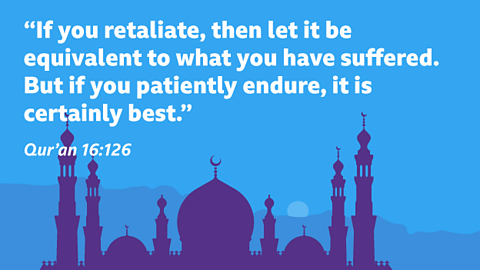
Retaliation - This is seen by many Muslims as making a bad situation worse. Whilst teachings show that forgiveness and reconciliation are the better course of action, sometimes retaliation is the only effective response. “If you have to respond to an attack, make your response proportionate, but if you are patient, it will be better for those who are patient.” (Qur’an 16:126)
Lesser jihad
Lesser jihad is a physical struggle that can involve defending Islam from threat. is about defending Islam from threat:
Permission [to fight] has been given to those who are being fought, because they were wronged. And indeed, Allah is competent to give them victory”
Qur’an 22:39
While the Qur’an allows violence to defend Islam, it warns against going beyond the limits of what is necessary for this defence:
Fight in the way of Allah those who fight against you but do not transgress. Indeed, Allah does not like transgressors”
Qur’an 2:190
Similarly, every opportunity should be seized to make peace with an enemy:
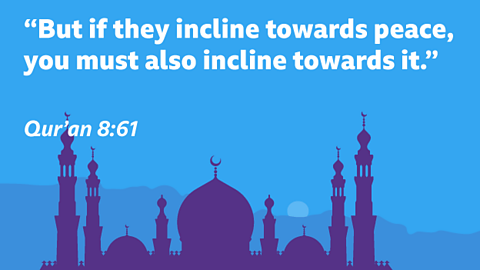
If the enemy is inclined towards peace, do make peace with them, and put your trust in Allah. He is the One Who hears all, knows all”
Qur’an 8:61
There are strict rules about how lesser jihad can be carried out. For instance:
- It must be in self-defence
- No harm must be done to innocent people
- Peace must be restored
- Mercy must be shown
Islam teaches that lesser jihad can never be used to justify terrorist attacks.
Conduct during war
Whilst there is not a distinct Just War theory in Islam, rules about behaviour before and during war are provided in Islamic sources and have evolved over time.
The main rules that have developed are:
Last resort - Going to war should be the very last choice after trying to resolve issues. All other ways of resolving the conflict should have been tried first, such as diplomacy or economic sanctions.
Fought in self-defence - The initial act of aggression should come from elsewhere and all efforts should have been made to resolve the issues before going to war.
Legitimate Islamic authority - Those declaring war should be in a legitimate position to do so, such as the recognised government or religious leaders.
Just cause - Protection or self-defence could be seen as acceptable reasons for going to war.
Intention of going to war - The intention of the war should be that it results in peace. There should be more good achieved by the war than the evil leading to it.
An Islamic country has been attacked - It may be seen as acceptable to engage in war if a Muslim nation, or individuals are attacked.
Proportional and appropriate force - "Fight in the cause of Allah those who fight you, but do not transgress limits…if they cease let there be no hostility." (Qur'an 2:190-193)
Many Muslims believe that behaviour in war is extremely important:
Do not commit treachery or deviate from the right path. You must not mutilate dead bodies. Neither kill a child, nor a woman, nor an aged man. Bring no harm to the trees, nor burn them with fire, especially those which are fruitful. Slay not any of the enemy's flock, save for your food. You are likely to pass by people who have devoted their lives to monastic services; leave them alone”
Abu Bakr – the first Caliph
Terrorism
Islam strongly opposes terrorism.
In opposing terrorism, Muslims may look to the teaching ‘Do not take life, which God has made sacred’ (Qur’an 17:33) to understand that terrorism should not be part of their faith.
Terrorism is illegal and the current UK definition is set out in the Terrorism Act 2000:
The use or threat of serious violence against a person or serious damage to property where that action is: designed to influence the government or an international governmental organisation or to intimidate the public or a section of the public; and for the purpose of advancing a political, religious, racial or ideological cause."
Examples of modern terror attacks include:
11 September 2001, suicide attackers seized US passenger planes and crashed them into two New York skyscrapers, killing 2,977 people.
22 July 2011, Anders Breivik killed 77 people in Norway by firstly detonating a van bomb and then carrying out a mass shooting.
14 October 2017, at least 587 people were killed in a truck bombing in Mogadishu, the capital of Somalia.
After the London Bridge attack in 2019, where Usman Khan murdered two people and injured a further three in a terror-related attack, the Muslim Council of Britain Secretary General, Harun Khan said:
Once again we have witnessed a horrific act of violence on our streets targeting innocent people. Sadly, we mourn the loss of two people and my condolences go out to their loved ones. We praise the swift actions of our emergency services in containing the incident and preventing further loss of life."
This encourages Muslims to stand against terrorism as action as carried out in anger and injustice, do not solve problems, but instead can cause more destruction.
Nuclear war and weapons of mass destruction
Weapons of mass destruction (WMDs) can kill lots of people and include chemical, biological, radiological and nuclear weapons.
Nuclear weapons are enormously powerful explosives that use a nuclear reaction. The explosions they produce are so powerful that one nuclear bomb can destroy a large city, which Does not show any careful thought, choice or planning. kills huge numbers of people.
No religion agrees with the use of weapons of mass destruction.
In Islam the amount and extent of destruction caused by these weapons break the rules of lesser jihad, so their use is forbidden.
Scholars believe that possession and development of atomic weapons and WMDs are not permitted.
Prominent Shia Islamic scholar spoke in 2014 saying that weapons of mass destruction should not be used.
Most Muslims believe that because God is the creator of the world, they have the duty of being a Khalifah which is the responsibility of looking after it.
Do not contribute to your own destruction with your own hands, but do good, for God loves those who do good.”
Qur’an 2:195
Therefore, humans do not have the right to use weapons that cause death, especially weapons that are non-discriminating in who is targeted.
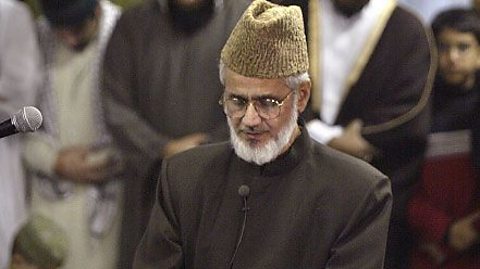
In 2014, Dr. Muzammil H. Siddiqi, a Muslim Academic, said: “It is Haram (forbidden) to develop and deploy nuclear weapons. The Shari’ah, the ethical and moral law of Islam, absolutely prohibits the development of such destructive weapons.”
GCSE exam-style question
Explain two religious beliefs about the use of weapons of mass destruction.
Refer to sacred writings or another source of religious belief and teaching in your answer.
Answers could include:
Most Muslims believe that because God is the creator of the world, they have the duty of being a Khalifah. “Do not contribute to your own destruction with your own hands, but do good, for God loves those who do good.” (Qur’an 2:195). Therefore, humans do not have the right to use weapons of mass destruction, that are non-discriminating in the death they cause.
However possessing weapons of mass destruction might be seen as a deterrent, so some Muslims might accept their existence if it means that peace can be upheld. However, most Muslims would be very firm in their belief that weapons of mass destruction should not be used, because of the damage that is caused. “Neither kill a child, nor a woman, nor an aged man … Slay not any of the enemy's flock, save for your food.” (Abu Bakr – the first Caliph).
Justice
For many Muslims, justice means bringing fairness back into a situation. Despite the difficulties in carrying out justice, many believe that justice is important to prevent conflict and deal with the aftermath of war.
In Islam, one of the 99 names of God is, ‘The Just’. Muslims believe that God has given humanity laws to bring justice to all people and where there is injustice, it is the fault of people not following those laws.
You who believe, uphold justice and bear witness to God, even if it is against yourselves, your parents, or your close relatives. Whether the person is rich or poor, God can best take care of both. Refrain from following your own desire, so that you can act justly - if you distort or neglect justice, God is fully aware of what you do.”
Qur’an 4:135
Muslims believe that there will come a time when God, who is the final judge of all things, will ensure that there is ultimate peace in Heaven for those who enter it.
For those whose scales are heavy with good deeds, they will be in a life of bliss. For those whose scales are light, their home will be the abyss.”
Qur’an 101:6-9
However, until that time, many Muslims believe that they should place their efforts into making up for wrongs and striving towards what is right and just.
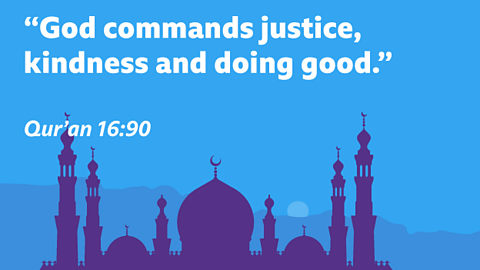
God commands justice and fair dealing.”
Qur’an 16:90
GCSE exam-style question
Explain two religious beliefs about justice.
Refer to sacred writings or another source of religious belief and teaching in your answer.
Answers could include:
Muslims believe that there should be justice that allows all people to flourish and not be held back by conflict. For many Muslims, justice means bringing fairness back into a situation. Despite the difficulties in carrying out justice, many Muslims believe that justice is important to prevent conflict and deal with the aftermath of war.
Muslims believe that God has always existed as judge over his creation. God’s judgement is a process that ends in a decision about whether a person is worthy of his reward of reaching heaven or being sent to hell. Muslims believe that there will come a time when God, who is the final judge of all things, will ensure that there is peace between all nations. However, until that time, many Muslims believe that they should spend efforts making up for wrongs that have been committed, and striving towards what is right and just.
Attitudes to peace and pacifism
Video
Watch the video below to compare Muslim, Christian and Jewish attitudes towards whether religious people should always be pacifists.
Christian presenter: Hi. I'm a Christian.
Muslim presenter: I'm a Muslim.
Jewish presenter: And I'm Jewish.
Christian presenter: We all agree that in an ideal world, there would be no war.
Muslim presenter: We'd all be living in peace.
Jewish presenter: But sadly, that's not the world we live in where violence is a reality.
Christian presenter: A pacifist is someone who believes that violence should never be used.
Muslim presenter: Mainly because human lives are precious.
Jewish presenter: So should religious people like us who want to live good lives in a better society be pacifists?
Christian presenter: In the Bible, Jesus certainly seems to teach about pacifism. He said, 'blessed are the peacemakers. Love your enemies and if anyone slaps you on the right cheek, turn to them the other cheek also'.
Muslim presenter: Muslims traditionally greet each other by saying Salaam alaikum, which means peace be with you in Arabic. And it reminds me to live a peaceful life. The Qur’an says 'Paradise is for those who curb their anger and forgive their fellow men. And the true Muslims walk on the earth humbly. And when the foolish address them improperly, they only respond with peace.'
Jewish presenter: The traditional Jewish greeting is similar. We say Shalom, which means peace in Hebrew. The Jewish prophets look forward to a time without war. 'Nations will not raise their swords at each other, and they will no longer learn war.' And we believe there will be a messiah, a great future leader, who will bring peace. He will be called 'Wonderful Counsellor, Mighty God, Everlasting Father, Prince of Peace'. So all our religions teach that we should live peacefully.
Christian presenter: And many religious people do lead a pacifist life. There's a Christian denomination called the Quakers or the Religious Society of Friends, which was founded on the idea of pacifism. Many Quakers were conscientious objectors during both World wars, which means they refused to fight because of their Christian beliefs. Instead, they used non-violent methods to campaign against injustice. Martin Luther King Jr was a pastor in the Baptist church who, in the 1950s and 60s campaigned to get equal rights for black people in the USA. Because of his Christian beliefs he insisted his protest should always use non-violent methods, even though violence was often used against him.
Jewish presenter: Martin Luther King was helped in his non-violent protest by people from many faiths, including Jewish Rabbi Abraham Joshua Heschel, who not only campaigned but he also called for an end to the USA's war in Vietnam.
Muslim presenter: More recently, the Muslim campaigner Malala Yousafzai became the youngest person to ever win the Nobel Peace Prize when she was just 17 in 2014. In a speech to the United Nations, she outlined her belief that ignorance is a cause of violence. She said, 'let us pick up our books and our pens. They are the most powerful weapons. One child, one teacher, one book and one pen can change the world.'
Christian presenter: But many would argue that sometimes violence has to be met with violence, because the alternative is to let evil win. During the Second World War, a German Christian pastor, Dietrich Bonhoeffer, argued that violence is sometimes necessary to restore peace, and he followed up his argument with action. He was arrested and executed in 1945 for his part in a plot to assassinate Hitler.
Jewish presenter: The Book of Ecclesiastes says, 'There is a time for everything. A time to love, a time to hate. A time for war. A time for peace'. Judaism teaches that we should fight when our existence is threatened, as it was during World War II in Nazi Germany. At a time like that, pacifism doesn't feel like an option to me. But the book of Deuteronomy instructs us to fight only after peace talks have failed, and innocent people should not be killed.
Muslim presenter: Many Muslims also believe that sometimes it's a duty to fight. The Qur’an says, 'Why should you not fight in God's cause? And for those oppressed men, women and children who cry out?'
Jewish presenter: If everyone put their weapons down, then we can all finally live in peace. But my late grandfather was the only member of his family to survive the Holocaust. So I know that there are times when people do have to fight to stay alive. If the UK was threatened by another country, what would my faith tell me to do? I hope that I'd make the right decision.
Christian presenter: It's something I'd have to weigh up really carefully to.
Muslim presenter: And decide if a pacifist alternative to fighting was realistic.
Jewish presenter: I think we'd all agree that although pacifism is difficult in a violent world,
Christian presenter: peace is something that religious people should be actively working towards.
Muslim presenter: Because we all want to live in a community where we are valued and safe. But what do you think?
Peace means an absence of conflict, the opposite of war, which can then lead to happiness and harmony between all in society.
Muslims will often greet or say farewell to others by using the words ‘as-salamu alaikum’ which means, ‘may peace be with you’.
Islamic teaching encourages Muslims to speak peace to others:
The servants of the Lord of Mercy are those who walk humbly on the earth, and who, when aggressive people address them, reply, with words of peace.”
Qur’an 25:63
As well as teaching that, “The faithful are indeed brothers. Therefore, make peace between your brothers and be wary of Allah, so that you may receive His mercy.” (Qur’an 49:10)
Pacifism means rejecting all violence. Islam is not a pacifist religion, although the religion is based on the principles of peace. The Arabic word ‘Islam’ comes from the word ‘salaam’ which means peace as well as also meaning ‘surrender’ or ‘submission’:
Make peace between your brothers and be wary of Allah, so that you may receive His mercy.”
Qur’an 49:10
Individually many Muslims are pacifists. The Qur’an teaches that reconciliation and peace are a better way of fighting than war.
A garden [i.e. Paradise] as wide as the heavens and earth, prepared for the righteous who spend [in the cause of Allah] during ease and hardship and who restrain anger and who pardon the people.”
Qur’an 3:133-124
Question and answer
What does the following extract from Qur'an 10:25 teach Muslims about peace?
Allah invites to the Home of Peace, and guides whomever He wills to a straight path.”
It teaches Muslims that Allah invites people to peace. When they live in peace they will be obeying his wishes and live a good and content life.
Case study - Muhammad Ali

Boxing star Muhammad Ali converted to Islam as an adult. Due to his religious beliefs, he refused to be enlisted into the US army and fight in Vietnam.
I either have to obey the laws of the land or the laws of Allah.”
Muhammad Ali
On 20th June 1967, he was convicted of refusing induction into the U.S. armed forces and sentenced to five years in prison. Although he served this time on bail, it took four years before this decision was overturned by the US Supreme Court.
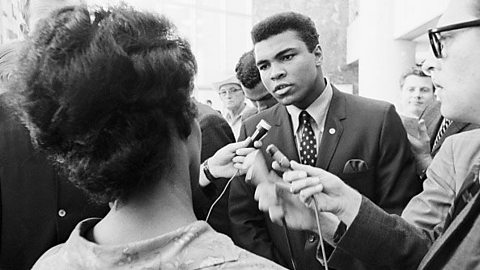
It has been said that I have two alternatives, either go to jail or go to the army. But I would like to say there is another alternative. And that alternative is justice."
Muhammad Ali, 1967
Case study - Khan Abdul Ghaffar Khan
Khan Abdul Ghaffar Khan (1890-1988), was a 20th century leader of the A Muslim ethnic group in Pakistan and Afghanistan.
He became a follower of Mahatma Ghandi and campaigned non-violently against British rule and for the rights of the Pashtun people. He brought together a group from the Pashtun people and encouraged them to represent a non-violent alternative of Islamic political resistance.
GCSE exam-style question
Give two religious beliefs about the importance of peacekeeping.
Answers could include:
Peace can be the absence of conflict but it can also mean a sense of individual well-being and happiness. Many Muslims find this peace through following their faith and being part of the ummah. They are reminded of this as they greet each other by saying, “As-salamu alaikum” - May peace be upon you.
Many Muslims will agree with the principles of pacifism and should accept peace when it is offered, avoiding violence whenever possible. “If they incline towards peace, you must also incline towards it.” (Qur’an 8:61).
Useful quotes about peace and conflict from Islam
1 of 5
Forgiveness & Reconciliation
Islam teaches that forgiveness and reconciliation are important following conflict, or after crimes have been committed.
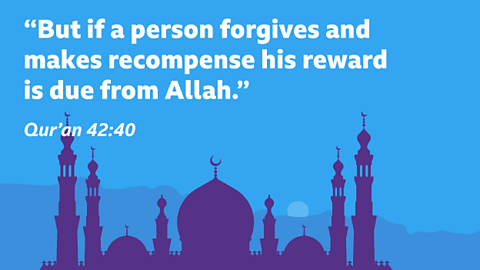
But if a person forgives and makes recompense, his reward is due from Allah.”
Qur’an 42:40
For Muslims, forgiveness is a part of A Muslim's personal struggle with their faith. which in Islam, is a constant duty and is seen as an act of worship.
Greater jihad involves striving to:
- follow the Five Pillars of Islam
- forgive others
- work for social justice
- study the Qur’an
- help those in need
- avoid negative traits, such as greed or laziness
- avoid temptations, such as alcohol
Many Muslims in the UK and around the world will especially seek forgiveness for those who have harmed them whilst commemorating the Night of Power during the month of Ramadan. Forgiving others is believed by many Muslims to bring forgiveness to the individual.
Muslims believe that forgiveness is important if peace is to happen. Where forgiveness is needed, it should be unconditional and not offered grudgingly. This does not mean that no action, where appropriate, should be taken. God is all forgiving and as he forgives them, Muslims believe they should seek to forgive each other.
Reconciliation
Reconciliation is making up and rebuilding relationships between two sides after a conflict. It is more than just apologising, it is actively working towards peace and moving on from the situation.
Despite the difficulties, many Muslims believe that forgiveness and reconciliation are important not just once war has happened but also as a way of preventing conflict.
Something more excellent in degree than fasting, prayer and Giving charity to others. … It is putting things right between people.”
Hadith of Prophet Muhammad, Source: Sunan Abi Dawud 4919
GCSE exam-style question
Explain two religious beliefs about forgiveness and reconciliation.
In your answer you must refer to one or more religious traditions.
Answers could include:
Muslims believe that forgiveness is important for peace to happen. Where forgiveness is needed, it should be unconditional and offered willingly. Forgiveness should be sought, which means that forgiveness is an active process. God is all forgiving and therefore Muslims believe they should seek to forgive each other. “But if a person forgives and makes recompense, his reward is due from Allah.” (Qur’an 42:40).
Reconciliation is making up and rebuilding relationships between two sides after a conflict. It is more than just apologising, it is actively working towards peace and moving on from the situation. Despite the difficulties, many Muslims believe that forgiveness and reconciliation are important not just once war has happened but also as a way of preventing conflict. “Something more excellent in degree than fasting, prayer and almsgiving … It is putting things right between people.” (Hadith of Prophet Muhammad, Source: Sunan Abi Dawud 4919)
Holy war
In Islam, holy war can be seen as a part of the lesser jihad, where Islam and the protection of the ummah is very important.
Originally, a holy war was something that could only be authorised by Allah through Prophet Muhammad. As time went on, a holy war was something that was authorised by a legitimate religious authority. It must only ever be fought if Islam is seen to be under threat or Muslims are being targeted unfairly. However, it must still follow the lesser jihad rules.
To those against whom war is made, permission is given to fight, because they are wronged.”
Qur'an 22:39
Islam scripture quiz
More on Islam
Find out more by working through a topic
- count1 of 2