Key points about Hinduism, peace and conflict
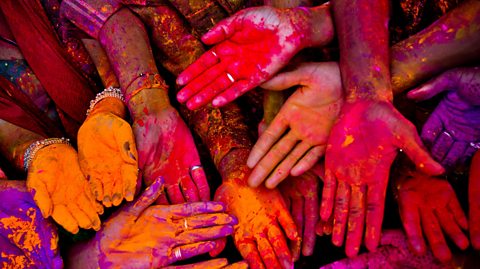
Hinduism promotes A Sanskrit term meaning ‘non-harm’, used in Buddhism, Hinduism and Sikhism. and many Hindus believe that non-violence is the right course of action wherever possible.
However one Hindu caste is kshatriya, which means ‘to protect from harm’. Therefore for this caste, fighting in a just war is seen as acceptable, but the motive must be defence or to protect the innocent.
Many Hindus look to the rules set out in the Bhagavad Gita - The Laws of Manu and Rig Veda to decide if a war is just and fair.

Remember
There are different branches of Hinduism which include:
- Vaishnavism
- Shaivism
- Shaktism
- Smartism
This means that there is a variety of Hindu teachings on ethical issues, including those found in the thematic study of religion, peace and conflict.
Key concepts in religion, peace and conflict
The key terms below will appear repeatedly through the theme of Hinduism, peace and conflict.
Religion, peace and conflict key terms quiz
For your exam on religion, peace and conflict, it is important to know the definitions of key terms. Take the quiz below to test your knowledge.
War
War is an organised conflict, usually consisting of intense violence carried out by one state or states against another state or states.
The reasons for war are often complicated and interlinked. Hindu teachings say they may include one of these three elements"
Greed - Hindu teachings speak against greed, “Anger is an enemy that is difficult to conquer whereas greed is an endless sickness.” (Yudhishthira in Mahabharata 3.313.92)
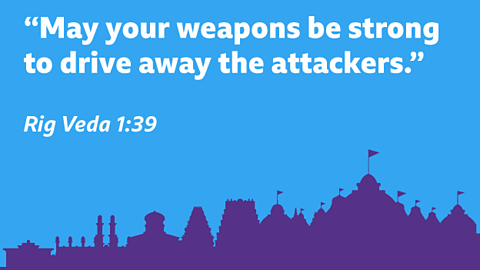
Self-defence - Self-defence is accepted by many Hindus as a justification for an armed response in some situations, especially if a country is under attack. The belief of Ahimsa does not mean that a person cannot protect themselves even if it involves conflict. “May your weapons be strong to drive away the attackers, may your arms be powerful enough to check the foes, let your army be glorious, not the evildoer." (Rig Veda 1-39:2) However, the violence used must be proportional.
Retaliation and revenge - Retaliation and revenge are seen by many Hindus as creating a cycle of violence and hatred in which nobody wins. The Bhagavad Gita teaches against retaliation, emphasising forgiveness and the importance of justice.
Hindu attitudes to conflict
Many Hindus believe that acting non-violently, ahimsa, is the best course of action wherever possible. However, some Hindus would say that violence is acceptable if it is used to uphold important Hindu religious values.
Rig Veda 10. 191:4 supports this by stating:
Meet together, talk together, let your minds apprehend alike; in like manner as the ancient gods concurring accepted their portion of the sacrifice.”
Some Hindus believe that this means that violence is occasionally needed as a sacrifice to ensure peace in the end.
There are many traditional stories in the Hindu scriptures of Hindu gods being involved in wars when they came to Earth. For example, avatars or incarnations of Vishnu like Varaha, fought in divine battles at different times to defeat evil.
Varaha kalpa refers to a period/era when Varaha helped to defeat evil forces in the world. The number of divine battles varies between the holy texts.
As well as the gods, ordinary people like the two rival family groups of the Kaurava and Pandava fought each other. This took place at Kurukshetra to defend Pandava family honour and for the throne of Hastinapura.
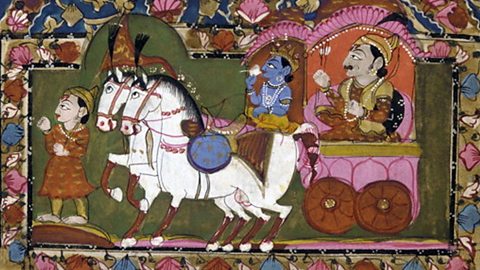
The family rivalry led to the battle mentioned in the Bhagavad Gita11 where Krishna advised Arjuna to fight, as this was the only way to resolve a conflict:
The Lord declares that in the form of Time, He is the destroyer of the three worlds. He has already destroyed the Kaurava warriors, and the Pandavas’ victory is certain. Therefore, Arjun should not be fearful anymore. He should just get up and fight.”
It is the belief of many Hindus that the punishment for omission is eternal condemnation from both humans and other divine beings.
If you do not fight in this just war, you will neglect your duty, harm your reputation and commit the sin of omission."
Bhagavad Gita
What is a Just War?
Just War means a war which meets internationally accepted criteria for fairness and follows traditional rules.
Many Hindus look to the rules set out in the Laws of Manu and Rig Veda to decide if a war is just and fair.
The Laws of Manu set out some guidelines about Just War. Chapter 7 states that war should be avoided by negotiation and reconciliation and be fought only as a last resort. It refers to the right way to behave during wartime, and states that A social class that in traditional Hindu society had the duty of protecting and leading others, and which includes royalty, politicians and armed forces. should fight fairly and show honour, mercy and respect. They should fight according to the following rules.
Only fight other soldiers and the use of force should be proportionate. "When he fights with his foes in battle, let him not strike with weapons concealed (in wood), nor with (such as are) barbed, poisoned, or the points of which are blazing with fire.” (Laws of Manu 7:90) Rig Veda 1-39:2 also states, "May your weapons be strong to drive away the attackers, may your arms be powerful enough to check the foes, let your army be glorious, not the evil-doer.”
Do not hurt any women or children.
Never attack people while they are sleeping.
Never attack when the opposition has surrendered.
Nor one whose weapons are broken, nor one afflicted (with sorrow), nor one who has been grievously wounded, nor one who is in fear, nor one who has turned to flight; (but in all these cases let him) remember the duty (of honourable warriors)”
Laws of Manu 7:93
Bhagavad Gita 2:31 – 38 speaks of Hindus fighting in the right way for righteous causes. 2.31 states:
Besides, considering your duty as a warrior, you should not waver. Indeed, for a warrior, there is no better engagement than fighting for upholding of righteousness."
And 2.33:
If, however, you refuse to fight this righteous war, abandoning your social duty and reputation, you will certainly incur sin.”
GCSE exam-style question
Explain two religious beliefs about war.
In your answer you must refer to a source of wisdom and authority.
Answers could include:
Scripture teachings suggest that Hindus can fight in just wars because killing people does not kill their souls. Most Hindus believe that the soul is eternal, it is the body that fades not the soul:
“Just as the soul acquires a childhood body, a youth body, and an old age body during this life; similarly, the soul acquires another body after death." (Bhagavad Gita 2:13.) The warrior caste in Hinduism known as the Kshatriyas, who are the second-highest caste in the Varna system, are taught by the scriptures that they should resolve never to step back from battle. “Valour, strength, fortitude, skill in weaponry, resolve never to retreat from battle….these are the natural qualities of work for Kshatriyas” (Bhagavad Gita 18:43)
Although most Hindus accept the need to fight Just Wars, many Hindus are opposed to war in any form.
Hinduism emphasises that going to war must be the last resort and war should not be declared unless every effort has been made to try to stop the conflict so that the war does not have to happen. Mahatma Gandhi said:
I see neither bravery nor sacrifice in destroying life or property for offence or defence.”
Terrorism
Based on the beliefs of ahimsa, most Hindus strongly oppose terrorism.
Terrorism is illegal and the UK’s Terrorism Act 2000 defines it as:
The use or threat of serious violence against a person or serious damage to property where that action is: designed to influence the government or an international governmental organisation or to intimidate the public or a section of the public; and for the purpose of advancing a political, religious, racial or ideological cause.”
Examples of modern terror attacks include:
11 September 2001, suicide attackers seized US passenger planes and crashed them into two New York skyscrapers, killing 2,977 people.
22 July 2011, Anders Breivik killed 77 people in Norway by firstly detonating a van bomb and then carrying out a mass shooting.
14 October 2017, at least 587 people were killed in a truck bombing in Mogadishu, the capital of Somalia.
9 June 2024, 9 Hindu pilgrims were killed and 33 injured following a shooting attack as they headed to the Hindu shrine of Mata Vaishno Devi.
Hindus believe that, as there is a part of Brahman within every human life then it is not right to harm and be violent towards anyone else and they should seek to be at peace with everyone.
He moves, and he moves not. He is far, and he is near. He is within all and he is outside all”
Isa Upanishad 1:5
Hindus should work towards more peaceful ways of solving issues of conflict. This encourages Hindus to stand against terrorism as action carried out in anger and injustice. It does not solve problems, but instead can cause more destruction.
Nuclear war and weapons of mass destruction
Weapons of mass destruction (WMDs) can kill lots of people and include chemical, biological, radiological and nuclear weapons.
Nuclear weapons are enormously powerful explosives that use a nuclear reaction. The explosions they produce are so powerful that one nuclear bomb can destroy a large city, which Does not show any careful thought, choice or planning. kills huge numbers of people.
No religion agrees with the use of weapons of mass destruction.
Most Hindus believe that it is important not to be violent towards others in any way.
Be friendly and compassionate released from ego selfishness, patient, hate not any being, the same in pain and happiness.”
Bhagavad Gita 12:14
Using weapons of mass destruction would be seen as unacceptable and many Hindus would support the organisations that campaign against the use of such weapons.
Case study – Hiroshima and Nagasaki

On 6 August 1945, the USA dropped an atomic bomb on the Japanese city of Hiroshima. The blast devastated an area of five square miles, destroying more than 60 percent of the city’s buildings and killing around 140,000 people.
Three days later the USA dropped a second atomic bomb on the Japanese city of Nagasaki, killing around 74,000 people. The nuclear radiation released by the bombs caused thousands more deaths from radiation sickness in the weeks, months and years that followed.
When Gandhi learnt about the atomic bombing of Hiroshima and Nagasaki, he remembered saying to himself:
Unless now the world adopts non-violence, it will spell certain suicide for mankind.”
In 1947, Gandhi stated, “He who invented the atom bomb has committed the gravest sin in the world of science.”
Bhagavad Vita 13.28: “They alone truly see, who perceive the Paramatma (Supreme Soul) accompanying the soul in all beings, and who understand both to be imperishable in this perishable body.” Hindus understand this to mean that God, the supreme soul, is present in all bodies and the use of weapons of mass destruction would therefore destroy something of God the divine.
In 2021, at the General Debate of the First Committee of the 76th Session of the UN General Assembly, Ambassador Pankaj Sharma - Permanent Representative of India to the Conference on Disarmament (CD) Geneva - said,
We are deeply concerned about the proliferation of weapons of mass destruction and their delivery systems, which endangers international peace and security.”
GCSE exam-style question
Explain two religious beliefs about the use of weapons of mass destruction.
In your answer you must refer to a source of wisdom and authority.
Answers could include:
Most Hindus believe that it is important not to be violent towards others in any way.
Be friendly and compassionate released from ego selfishness, patient, hate not any being, the same in pain and happiness.”
Bhagavad Gita 12:14
Using weapons of mass destruction would be seen as unacceptable and many Hindus would support the organisations that campaign against the use of such weapons. However, political Hinduism, known as Hindutva, might see the acquiring of weapons of mass destruction as useful in the way of deterrence.
Justice
Hindus believe that seeking justice is a duty for each person.
By caring and serving all people who are part of God in the universe, in their local community Hindus believe that will help peace and justice to flourish.
He who sees all beings in the Self itself, and the Self in all beings, feels no hatred by virtue of that wisdom.”
Ishavasyopanishad 1:6
Despite the difficulties in carrying out justice, many Hindus believe that justice is important to prevent conflict and deal with the aftermath of war.
Attitudes to peace and pacifism
Peace means an absence of conflict and is the opposite of war.
Some Hindus believe achieving peace can achieve happiness and harmony in society. Working for peace is seen as part of ahimsa, the belief that all life should be respected and will be rewarded by good karma.
GCSE exam-style question
What does the following scripture tell us about Hindu attitudes towards peace?
Come together, talk together. Let our minds be in harmony. Common be our prayer. Common be our end. Common be our purpose. Common be our deliberations. Common be our desires. United be our hearts. United be our intentions. Perfect be the union among us."
Rig Veda 10 - 191:2
Many Hindus believe that this teaching is emphasising the importance of looking for what is common with other people. Where people are more united in their beliefs, hopes and dreams then peace is more likely to happen.
Artharva Veda 10 191:4 emphasises this idea by stating:
Common, (worshippers), be your intention; common be (the wishes of) your hearts; common be your thoughts, so that there may be thorough union among you.”
Achieving inner peace is important for many Hindus, therefore, some Hindus will work towards being non-violent in all aspects of their lives. Hindus believe that, as there is a part of Brahman within every human life, then it is not right to harm or be violent towards anyone else.
Case study - Mahatma Gandhi
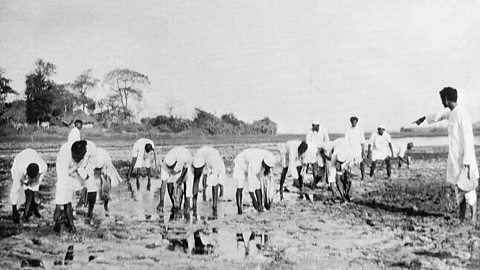
Mahatma Gandhi was a Hindu who was determined to achieve independence for India from the British Empire. But he believed that this could and should be achieved through non-violent protest, which he called satyagraha.
The main way he asked people to do this was through A form of peaceful protest in which someone refuses to obey certain laws because they believe they are unjust.
Non-violence is more powerful than all the armaments in the world. Non-violence is not passivity in any shape or form. It is the most active form in the world. In non-violence the masses have a weapon which enables a child, a woman, or even a decrepit old man to resist the mightiest government successfully.”
Mahatma Gandhi
The Salt March
The British had been taxing salt in India for decades, but this hurt the poorest people most.
To show the world the injustice of British rule, Gandhi and 78 other leaders marched 240 miles from the Sabarmati Ashram to Dandi. They were joined by thousands of people who wanted to protest by symbolically collecting salt from the sea without paying any tax to the British. This tax made it difficult for poorer Indians to afford British salt, and it was also illegal for them to produce their own salt. Anyone found to be making their own salt could be imprisoned for up to six months.
After this protest, around 60,000 people were arrested, including Gandhi himself. But the British government accepted that they had to consider some of Gandhi’s requests and invited him to London.
This peaceful protest was a significant turning point, because it showed that the British government was starting to seriously consider Indian independence.
GCSE exam-style question
Give two religious beliefs about the importance of peacekeeping.
In your answer you must refer to a source of wisdom and authority.
Answers could include:
Hindus believe that, as there is a part of Brahman within every human life, then it is not right to harm and be violent towards anyone and they should seek to be at peace with everyone.
Working for peace is seen as part of ahimsa, the belief that all life should be respected and will be rewarded by good karma.
Useful quotes about peace and conflict from Hinduism
1 of 5
Forgiveness and reconciliation
Video
Watch the video below to compare Hindu, Buddhist and Jewish attitudes towards whether religious people should always forgive.
Buddhist presenter: Hello, I'm a Buddhist.
Hindu presenter: I'm a Hindu.
Jewish presenter: And I'm Jewish.
Buddhist presenter: And today we're talking about forgiveness
Hindu presenter: And how hard it can be to forgive other people when you've been treated unfairly.
Jewish presenter: But should we as religious people always forgive?
Buddhist presenter: One of the most important Buddhist teachings is 'Ahimsa', which means 'non harming'. It's all about living a non-violent life and avoiding anything that might lead us to violence. Forgiveness is a big part of that. We're taught to let go of the need for revenge and other feelings that might lead us to harm someone.
Hindu presenter: The principle of Ahimsa originally comes from Hinduism. It's one of the 'yamas', the good qualities we should try to develop. And another is “kshama”, which means forgiveness.
Jewish presenter: Jews also believe that non-violence is the ideal and that forgiveness is important, so important, we have a special day devoted to it every year called 'Yom Kippur', which is Hebrew for, 'the Day of Atonement'. We fast and ask God to forgive us for all the things we've done wrong. But during the ten days before Yom Kippur, we should go and ask for forgiveness from any people we think we've wronged.
Buddhist presenter: The Buddha's advice was to forgive and move on. He described how some people dwell on their grudges, 'He abused me. He struck me. He overcame me. He robbed me. In those who do not harbour such thoughts, hatred will cease.' Instead, the Buddha taught that we should try to develop 'metta', loving kindnessand 'Karuna', compassion for other people, even people who've hurt us.
Hindu presenter: But forgiveness is difficult. Mahatma Gandhi was a Hindu who used non-violent protest to campaign for an end of British rule in India. He said, 'The weak can never forgive. Forgiveness is an attribute of the strong.'
Jewish presenter: And there are examples of people showing incredible forgiveness,even in the most unthinkable situations. Eva Mozes Kor was a survivor of the Holocaust. Both her parents and two of her sisters were murdered at Auschwitz.Eva later spoke about the healing power of forgiveness. 'I believe forgiveness issuch a powerful thing', she said. 'It's free, it works, it has no side effects, and this is what our world needs besides punishment'.
Buddhist presenter: But should we always forgive whatever the situation?
Hindu presenter: Is that fair?
Jewish presenter: It means letting go with feelings that, you could argue, are totally justified.
Buddhist presenter: Don't we need to feel that justice has been done before we can forgive?
Hindu presenter: But forgiveness isn't about justice. It's a personal thing. I was hurt by a friend that I trusted. I was upset and angry with them. I didn't want to talk to them. I just wanted them out of my life. But that didn't make me feel good either. I realised my anger was just eating me up. I thought for a long time and decided to forgive them. Not because I didn't feel wronged, I did, but to make me feel better, to release my anger and to restore some balance in my life.
Jewish presenter: So we all agree that forgiveness on a personal level is what our religions teach us.
Buddhist presenter: And that can sometimes feel like a really hard thing to do.
Hindu presenter: But forgiveness allows us to let go of painful feelings that only do harm to ourselves.
Jewish presenter: And even if I've chosen to forgive someone, it doesn't necessarily mean they won't face justice for what they've done.
Buddhist presenter: They might even learn something from being forgiven. But what do you think?
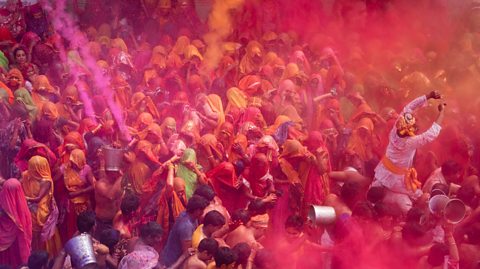
Forgiveness is an important teaching in Hinduism. The festival of Holi is a day that marks the importance of forgiveness and righting any wrongs between people. Hindus believe that both the A person who carries out a harmful, illegal, or immoral act. and the victim of injustice must find peace with the situation.
Forgiveness is the one supreme peace.”
Mahabharata 5:33
The story of Rama and Sita from the illustrates the importance of forgiveness, when Sita forgives those who have harmed her. Hindus believe that they should follow Sita’s example.
Forgiveness is also seen as a divine quality. In Hinduism, it is divided into two forms - the Goddess Lakshmi forgives even when the perpetrator does not care, and the God Vishnu will forgive when forgiveness is asked for. As the forgiveness of Lakshmi is seen as more honourable, many Hindus will try to forgive those who have wronged them even if that forgiveness has not been sought or asked for.
…by forgiveness is it that the whole universe is held together.”
Mahabharata 3
Reconciliation
Reconciliation is about making up and rebuilding relationships between two sides after a conflict has taken place. It is more than just apologising, as it is moving on from the situation and actively working towards peace.
Having forgiven someone, many Hindus believe that it is important to be reconciled with the person they have been hurt by, so that the world continues to be peaceful and harmonious. Hindus also believe that there needs to be inner reconciliation with one’s true self, which can be reached through Showing compassion to one’s self, releasing anger, guilt and pain that might be carried, reaching a sense of peace and learning from the previous errors. and The fulfilment of ones’ life’s aim and gaining total understanding of one’s soul (atman).
Religion as a cause of war and violence - holy war
A holy war is a war that is authorised by a legitimate religious authority.
Non violence should always be aspired to in Hinduism but there are times when conflicts can only be resolved by fighting, particularly when justice is being sought.
It is the duty of Hindus to know and understand from religious texts when it is right to fight for their faith. For example, the Bhagavad Gita tells the story of Arjuna seeking advice from the God known as Krishna, when the Kaurava and Pandava were both claiming the same kingdom. Arjuna knew that there were members of his family on both sides and so it was possible that he might kill a member of his own family if he went to war. Krishna authorised the war by explaining to Arjuna that there was nothing to fear in killing in war, as the soul is immortal and when the body dies, then the soul will be born again.
…atman is not killed when the body is killed… certain is death for the born and certain is birth for the dead, so you need not grieve.”
Bhagavad Gita 2
Arjuna was told as he had been born into the warrior caste, then he had the duty of his varna to fight as a warrior and if he chose not to do so because of cowardice then it would be seen as dishonourable.
Hinduism scripture quiz
More on Hinduism
Find out more by working through a topic
- count1 of 2