Overview of Mrs Midas by Carol Ann Duffy
Mrs Midas is a poem by Carol Ann Duffy written from the viewpoint of the wife of the mythological King Midas, from the Roman poet Ovid’s Metamorphoses.
King Midas was granted a wish by the god Dionysus whereby everything he touched would turn to gold.
With comical undertones, a wide range of emotions are expressed through the persona of Mrs Midas.
- She speaks out against her husband's foolish actions and gradually separates herself from him.
- She leaves him to waste away in isolation.
- She laments the loss of their physical relationship and the chance to have a baby together to fulfil their dreams.
The poem deals with themes of greed and isolation.
Looking for some quick revision? Try an interactive quiz for National 5 English.
You can read Mrs Midas by Carol Ann Duffy on the Scottish Poetry Library website.
Context
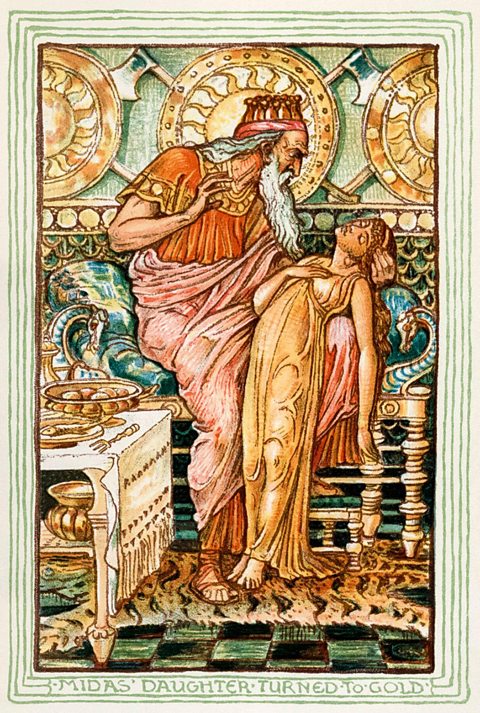
Mrs Midas is written from the viewpoint of the wife of King Midas.
Who was King Midas?
There are many legends about the ancient King Midas, the ruler of Phrygia. The most well-known version of the story is that one day, he met a A creature from Greek mythology with the upper body of a man and the legs of a goat. in need of assistance. When Midas helped the satyr, he was granted any wish he wanted by the god Dionysus.
However, Midas' greed got the better of him and he wished for everything he touched to turn to gold. It turned out to be a foolish wish. All of his food and drink, his home, and even his daughter were turned to gold. Realising the consequences of his greedy ways, he begged Dionysus to reverse the wish.
The phrase 'Midas touch' comes from this legend, and usually refers to someone who can make money from any endeavour.
More about Midas: If you would like to hear more about the legend of King Midas, listen to this audio story about King Midas and his love of all things gold, read by Crawford Logan in Scots: Stories in Scots: King Midas
Form and structure of Mrs Midas
Mrs Midas is written in the form of a When a character speaks for an extended period of time, revealing thoughts, feelings, and motivations to another character or the audience. from a female perspective.This is similar to the other poems in Carol Ann Duffy's The World's Wife collection, in which well-known male characters from myths or history are presented from the viewpoint of the forgotten or disregarded women in their lives.
Duffy focuses on an aspect of this well-known character King Midas and presents an imaginary response from his wife's viewpoint, providing fresh, thought-provoking and comical insight into their lives.
- Mrs Midas is made up of eleven stanzas of irregular line length.
- Stanzas are made up of six lines.
- Lines vary in length between nine and seventeen syllables.
This irregularity reflects how unpredictable and chaotic life has become for this couple - at any second, with a simple touch, Mrs Midas could be turned to gold.
The tone is conversational. Duffy frequently uses The use of run on sentences with no punctuation at the end of lines or across stanzas., keeping the poem flowing as if the speaker is telling her story to friends.
Stanzas one to six deal with the discovery of King Midas' granted wish, and the sheer panic at the realisation of the tremendous power he has been given.
At the same time, a comic tone is maintained throughout, as Mrs Midas catalogues everyday items being turned to gold.
Stanzas seven to eleven reveal Mrs Midas's heartfelt response to the harsh implications of Midas' gift. This highlights the damage it has done to the couple's relationship and their future together.
The final line in the poem sums up Mrs Midas' regret at the loss of physical contact with her isolated husband.
Stanzas one to three
In the first stanza, Carol Ann Duffy sets the scene. It is an evening in late September - both the time of day and time of year suggest things turning golden - the sunset, autumn leaves.
Duffy presents Mrs Midas in a typical domestic scene. She pours a glass of wine and begins to "unwind" as she cooks the evening meal
The kitchen / filled with the smell of itself, relaxed

With its "steamy breath", the kitchen is A type of imagery in which non-human objects, animals or ideas are given human characteristics., suggesting the living, breathing heart of the home. This contrasts with the life-sapping events that are taking place in the garden.
Our first image of Midas has him separate and at a distance from his wife. Midas stands under a pear tree and snaps a twig which then miraculously turns to gold.
Putting this down to poor visibility, Mrs Midas has to look again and this time sees her husband plucking a pear from a branch and describes the way:
…it sat in his palm, like a light-bulb. On.
This A simile is a word or phrase used to make a comparison for dramatic effect, using 'like' or 'as'. effectively conveys both the shape of the pear and the brightness emanating from it. The full stops add a comedic effect, highlighting Mrs Midas’ shock, disbelief and sudden dawning of awareness of what she has just witnessed.
This whimsical, light and humorous imagery is continued and contrasts with the seriousness of what has just happened. Mrs Midas' incredulity is evident when she questions whether he is just:
putting fairy lights in the tree?
Stanza three relays Midas' return journey through the house as he turns the doorknobs and blinds into gleaming gold making his wife think back to a school history lesson about:
the Field of the Cloth of Gold
This was the site of a meeting, near Calais in France, between the kings of England and France in 1520.
The aim of the meeting was to improve relations between the two countries. Both monarchs built lavish temporary palaces, embellished with golden cloth to reflect their wealth and power. The meeting had little impact and, soon after, relationships between the countries deteriorated. The reference suggests that gold is all for display but that this is ultimately short lived and pointless. It also foreshadows the breakdown of the couple's relationship.
Mrs Midas goes on to describe the "strange, wild, vain" face of her husband as he realises that he has been given a tremendous power, motivated by greed. As the exasperated wife, Mrs Midas utters a typical expression:
What in the name of God is going on?
Her perplexed reaction causes her husband to laugh. We get the idea of difference between the two - that at this moment Midas's gift is something he has not shared with his wife.
Stanzas four to six

In stanza four, Mrs Midas attempts to instil a sense of normality by her matter-of-fact tone in serving up dinner:
For starters, corn on the cob.
Learn more about identifying and revising tone:What is tone?
This comedic effect is maintained as Midas ends up
…spitting out the teeth of the rich.
This line clearly demonstrates the negative effects of such a gift as Midas can no longer enjoy the simple pleasures of food, while emphasising that gold teeth are usually only seen in the mouths of the wealthy.
Along with the catalogue of food utensils that have also been turned to gold, Mrs Midas' anxiety about what is happening is revealed in the way she pours wine with "a shaking hand".
The repetition of the same sounds or consonants in two more words nearby each other. is used to highlight the seriousness and reality of the situation when she witnesses the transformation of a glass into a "golden chalice". As he drinks she observes the transformation from:
the glass, goblet, golden chalice
The blend of the vowels with the letter 'l' links to the golden luxury of the item, while the harsh alliterative 'g' sound drives home the seriousness of this so-called gift.
The sinking in of reality is further echoed in the first line of stanza five when Mrs Midas starts to scream while her husband sinks to his knees.
As both come to terms with his new power, Mrs Midas finishes off the wine and forces her husband to sit
on the other side of the room and keep his hands to himself.
Even after becoming aware of the consequences, this humorous line reveals that while Midas still seeks to enjoy a physical relationship with his wife, his new gift means that he will be deprived of this pleasure.
The stanza ends with Mrs Midas relaying the precautions she takes to protect the cat by locking it in the cellar and then moving the phone, but allowing the toilet to be changed into gold.
Duffy then inserts a deliberate pause to imitate the speaker's incredulity upon hearing how her husband has been "granted" a wish.
The word 'granted' is a pun which is repeated to convey her opinion that, in general, people can and do make wishes but if they are going to be given, then of course her "fool" of a husband had to be the one to have his wish come true.
She is truly aggrieved by this and goes on to explain the futility of such a wish since gold "feeds no one". In doing so she exposes the inherent uselessness of gold and that it therefore has no real value.
Even so, humour is injected to contrast with this harsh fact as Mrs Midas considers, on a more positive note, how the situation will mean that at least Midas will
…be able to give up smoking for good.
Stanzas seven to nine
The remainder of Mrs Midas continues to highlight the damage Midas' gift has done to their relationship with the beginning of stanza seven summarising the full effect in the single statement:
Separate beds.
Mrs Midas' terror of her husband touching her is continued and emphasised as she reveals how she even puts a chair against the door at night because she is "near petrified". Petrified reveals the strength of her fear but its true meaning (to be turned to stone) suggests the very real threat of Mrs Midas being transformed into dead matter. The reality of her situation is that should her husband attempt any physical contact she would be turned to gold.
Humour again, offers a bit of light relief as she relays how the spare room has been transformed into the impressive "tomb of Tutankhamun". This suggests a place of pointless luxury - what use is all that gold to someone who is, essentially, dead? This symbolises that their relationship and dreams are effectively dead.
The separateness of the couple is further highlighted as she focuses on the physical suffering they must now endure, in contrast to the fulfilling relationship they enjoyed before Midas was granted his wish.
These were "halcyon days" days of joy when they were "passionate" and
unwrapping each other, rapidly, like presents, fast food.
However, she now rightly fears Midas' "honeyed embrace" since it would be deadly to her.
In stanza eight, Mrs Midas expresses her sadness now of being deprived of the opportunity to have a real baby.
She begs the question:
Who…can live with a heart of gold?
Usually, this expression has positive A word used to describe the ideas or feelings that a word might suggest. For example, a skull conjures up thoughts of fear, mortality and death. and is associated with kindness and empathy. Here, this familiar Describing something by saying it is something else. While a simile compares things using 'like' or 'as', a metaphor creates a direct comparison is ironically inverted as the literal meaning is implied, inferring that it would be impossible to survive as a living being with such a heart.
A superficial, initially attractive description of the baby she dreamt about, a literal golden child, is presented with its "perfect ore limbs" and "amber eyes". But this descends into a disturbing image as these flame-coloured eyes are deemed to be
holding their pupils like flies.
The suggestion is of unseeing eyes, and the introduction of flies suggests eyes that are dead. Sadly, her milk will remain only a "dream" too as her breasts can never bear any milk as long as her husband has this gift.
Waking to the "streaming sun", again, poignantly reminds us that each day she will awake to a world in which gold dominates every waking moment.
In stanza nine, the consequences of the myth and the effect on their lives continues to destroy their relationship as Mrs Midas bluntly informs us:
So he had to move out.
She then conveys how she had to drive him to live in their isolated caravan "under the cover of dark" and how she returns alone as: "the woman who married the fool", clearly blaming her husband for stupidly wishing for gold. There is a hint of her awareness of being watched or talked about, as she tries to keep the situation hidden.
She tells of how at first she visited at odd times, always parking the car a safe distance away in case she was affected by his gift.
Stanzas ten to eleven
Stanza ten of Mrs Midas continues to present images of this solitary, distanced, detached separate lifestyle as she describes the single golden items she discovers on her walk from the parked car to her husband: "Golden trout" and "a hare hung from a larch".
She describes him in a sorrowful state as
thin, delirious; hearing, he said, the music of Pan.
This associates him to another Greek god, this time the isolated figure of Pan, who was the god of shepherds and flocks, and we note the irony that a gift so equated with wealth and prosperity should result in such emotional poverty.
The final stanza stresses Mrs Midas' anger at her husband's "pure selfishness" in making a wish that has not only affected him but also deprived them both of any physical relationship and his wife of a chance to have her dream baby.
In the end, the poet is reminding us that the myth of Midas, normally only viewed in connection with how it affected Midas and his life, also affected his poor wife who, even after all her anger has been unleashed, is still left alone with nothing but a wistful, regretful sense of loss for the man she married.
In a poignant line, she remembers fondly their once full, physical relationship and mourns its passing:
even now, his hands, his warm hands on my skin, his touch.
The repetition of the words "hands" emphasises too that his touch, once a potent symbol of their intimacy is now lost forever and reminds us that, unlike human skin to skin contact, gold is cold and hard.
What are the themes of Mrs Midas?
Greed
Greed is certainly a recurring theme as this is what motivated Midas to make his wish in the first place. Like any good fable, the moral of the story reveals itself - even with all the wealth they could ever want, both Mr and Mrs Midas are unhappy and must face the consequences of their choice. Duffy invites us to consider how something so precious like gold can easily become destructive.
Isolation
The choice Midas makes is a disaster, and drives a wedge between him and his wife. They lose their normal life, and any hope of having a family together. Loneliness is all that is left in the end for either character. Mrs Midas at the end misses her husband’s touch, and appears to have the realisation that some things are more valuable than gold and riches.
Comparing Mrs Midas to other Carol Ann Duffy poems
Mrs Midas and Medusa share obvious similarities in the otherworldly powers based on classic mythology. Together with Havisham, these poems are told from the perspective of hurt women, relating the emotional damage of a failed relationship, and fondly remembering happier times.
While Medusa and Havisham share a sharp, vengeful tone, Mrs Midas is more humorous and feels more like a woman telling her story to some old friends that an emotional outpouring.
Like Originally, Mrs Midas deals with a sudden change that has happened to the speaker as a result of someone else's actions. Both express a sense of loss and isolation, and a yearning for what once was. But each, in their own way, suggests moving on, with Mrs Midas matter of fact removal of her husband from her life, and the speaker in Originally shedding their old accent and memories.
Revise Mrs Midas by Carol Ann Duffy
Test your knowledge of Mrs Midas and other poems by Carol Ann Duffy with these interactive National 5 English quizzes.
Quizzes - Carol Ann Duffy quiz
Revise the set texts by Carol Ann Duffy with these interactive quizzes in preparation for your National 5 English exam.

More on Carol Ann Duffy
Find out more by working through a topic
- count6 of 7

- count7 of 7

- count1 of 7

- count2 of 7