Three, two, one…blast off!
Wow, blasting off used five eighths of your fuel. If you used five eighths of your fuel to take off, and another two eighths to get this far, how much fuel have you used?
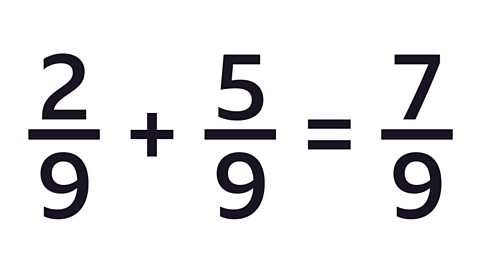
To add fractions that have the same denominators, you add together the numerators. And if you started with eight eighths and you’ve used seven eights, how much fuel do you have left to get home?
Ah! Wait a minute, isn’t there a spare tank of fuel?
For each fraction we need to find an equivalent fraction, where the denominators are the same. The denominator of a new fraction should be a multiple of both eight and 12.
Like…yes! 24. So now they have the same denominator, you can add them together by adding the numerators.
You have enough to go home!
Now, how much oxygen do you have left?
Adding and subtracting fractions
Common denominators
It's easy to add and subtract fractions when the numbers on the bottom are the same.
These are called the denominators.
Equivalent fractions
However, sometimes the denominators are different.
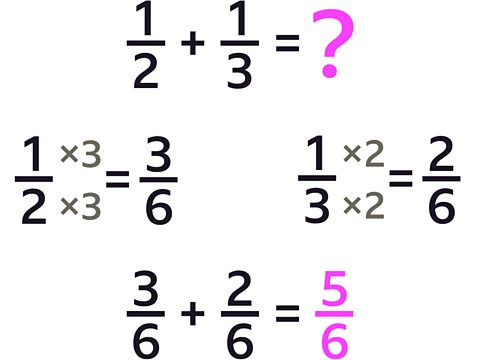
You use equivalent fractions to make them the same.
A common multiple of 2 and 3 is 6.
So, for each fraction we need an equivalent fraction with a denominator of 6.
Now you can add these together.
Play Bitesize games
Level up now! Take on the latest primary games on Bitesize.

More on Fractions and decimals
Find out more by working through a topic
- count6 of 16

- count7 of 16

- count8 of 16

- count9 of 16