Key points about religious celebrations and festivals

Used to describe nouns and must agree with the nouns they are describing. are useful for giving more information on opinions.
Adjectives must agree with the The name of a thing such as an object, a place or a person. Nouns are often described as naming words. they describe.
Use Generally used to describe a verb, or actions to add more detail about how something is being done (and when, where or how often something takes place). of frequency to describe how often religious celebrations and festivals occur.
Vocabulary – Talking about religious celebrations
Religious celebrations
| Spanish | English |
|---|---|
| Navidad | Christmas |
| Nochebuena | Christmas Eve |
| el Día de Reye | Epiphany, 6 January |
| Reyes Magos | the Three Kings, the Three Wise Men |
| Semana Santa | Easter Week (Holy Week) |
| Pascua | Easter |
| Eid | Eid |
| Janucá | Hanukkah |
| El Festival de la Luz | Diwali / The Festival of Light |
| Día de Muertos | Day of the Dead (Mexican celebration) |

Did you know?
The Spanish word for 'Easter' is Pascua, but it's more common to see Easter referred to as Semana Santa (Holy Week). This is a time when many festivals take place across Spain and Latin America.
Faith groups
| Spanish | English |
|---|---|
| budista | Buddhist |
| cristiano/a | Christian |
| católico/a | Catholic |
| hindú | Hindu |
| judio/a | Jewish |
| musulmán/musulmana | Muslim |
| sij | Sikh |
Useful adjectives for describing religious celebrations include:
| Spanish | English |
|---|---|
| religioso/a | religious |
| cultural | cultural |
| especial | special |
| nacional | national |
| animado/a | lively |
Grammar – Adjective agreements
Use adjectives when giving opinions to give more information.
Remember that adjectives need to agree with the noun they describe in Spanish.
For example:
un desfile animado - a lively procession
una fiesta divertida - a fun festival
The endings of the adjectives animado and divertida have changed to match the Nouns in Spanish are classified into two groups: masculine or feminine. Each noun therefore has a gender. of the nouns before them.
When the noun is plural, the adjective describing it ends in s. For example:
los desfiles animados – the lively processions
las costumbres católicas – the Catholic customs
Adjectives which do not end in o do not change according to gender, but add es when the noun they describe is More than one of an item..
For example:
el disfraz tradicional – the traditional costume
los disfraces tradicionales – the traditional costumes
las celebraciones especiales – the special celebrations
Adjective agreements – Mini quiz

Complete the following sentences in Spanish.
El defile _______ .
The religious procession.
El desfile religioso.
The noun desfile is masculine and religioso ends in o to agree with it.
La fiesta _______ .
The lively festival.
La fiesta animada.
The noun fiesta is feminine and animada ends in a to agree with it.
Las celebraciones _________ .
The Christian celebrations.
Las celebraciones cristianas.
The noun celebraciones is feminine plural and cristianas ends in as to agree with it.
Los desfiles _________ .
The traditional processions.
Los desfiles tradicionales.
The noun desfiles is plural and tradicionales ends in es to agree with it.
Tradicional is an adjectives that adds es when plural.
Find out more about adjective agreements in the Adjectives in Spanish guide.
Reading practice
Read the descriptions below and work out which festival is being described. There is one option too many.
| A | Navidad |
| B | Pascua |
| C | Semana Santa |
| D | Eid |
Question 1
Es mi fiesta favorita porque me encanta comer chocolate. Además, para mí es el final del invierno y el comienzo de la primavera.
The answer is B – Pascua - Easter.
Translation
It’s my favourite festival because I love eating chocolate. Also, for me, it’s the end of winter and the beginning of spring.
Question 2
Me gusta esta fiesta porque toda la familia la celebra junta y comemos mucho. Damos dinero a los pobres.
The answer is D – Eid.
Translation
I like this festival because the whole family celebrates together and we eat a lot. We give money to the poor.
Question 3
El día antes se llama Nochebuena y cenamos con los abuelos porque hay una fiesta en su casa.
The answer is A – Navidad – Christmas.
Translation
The day before is called Christmas Eve and we have dinner with the grandparents because there is a party at their house.
Vocabulary - Talking about celebrations
Useful nouns to describe religious celebrations include:
| Spanish | English |
|---|---|
| Check your connection, refresh the page and try again. | saint, saint’s day |
| Check your connection, refresh the page and try again. | church |
| Check your connection, refresh the page and try again. | mosque |
| Check your connection, refresh the page and try again. | synagogue |
| Check your connection, refresh the page and try again. | temple |

Other useful nouns include:
| Spanish | English |
|---|---|
| Check your connection, refresh the page and try again. | custom, habit, tradition |
| Check your connection, refresh the page and try again. | procession, parade |
| Check your connection, refresh the page and try again. / Check your connection, refresh the page and try again. | costume(s), fancy dress |
| Check your connection, refresh the page and try again. | show, spectacle |
| Check your connection, refresh the page and try again. | party, festival |
| Check your connection, refresh the page and try again. | tradition |
| Check your connection, refresh the page and try again. | present, gift |
Useful verbs include:
| Spanish | English |
|---|---|
| Check your connection, refresh the page and try again. | to dance |
| Check your connection, refresh the page and try again. | to celebrate |
| Check your connection, refresh the page and try again. | to sing |
| Check your connection, refresh the page and try again. / Check your connection, refresh the page and try again. | to amuse, to entertain, amusing, entertaining; to enjoy oneself, have a good time, enjoying oneself, having a good time |
For example:
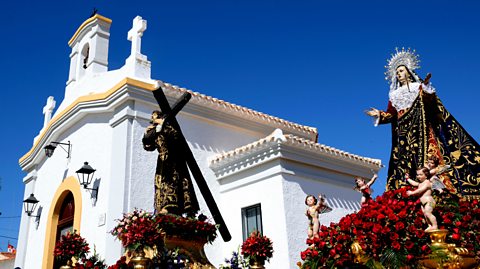
Semana Santa es una celebración católica cuando hay desfiles religiosos. - Semana Santa is a Catholic celebration when there are religious processions.
Se viste en disfraces tradicionales. - One dresses up in traditional costumes.
Navidad es una fiesta cristiana que celebra el nacimiento de Jesucristo. - Christmas is a Christian festival which celebrates the birth of Jesus Christ.
Mucha gente va a la iglesia y canta para celebrar su vida. - Lots of people go to church and sing to celebrate his life.
Eid es una fiesta musulmana cuando las familias celebran el fin de Ramadán y comen juntos. - Eid is a Muslim festival when families celebrate the end of Ramadan and they eat together.
All vocabulary listed in this guide can be found on the vocabulary sheet below.
Grammar – Adverbs of frequency
Common Spanish adverbs of frequency include:
| Spanish | English | Spanish | English |
|---|---|---|---|
| siempre | always | cada semana | every week |
| casi siempre | almost always | cada mes | every month |
| a menudo | often | de vez en cuando | from time to time |
| frecuentemente / con frecuencia | frequently | cada año | every year |
| anualmente | annually | regularmente | regularly |
| nunca | never | mucho / muchas veces | often, a lot, many times |
| casi nunca | almost never | todos los días / cada día | every day |
Position of adverbs of frequency
The position of the adverb of frequency can vary. They can go:
after the verb they modify
at the beginning of the sentence
after the verb
as the last word of the sentence
The position of the adverb of frequency depends on where the emphasis is in the sentence.
For example:
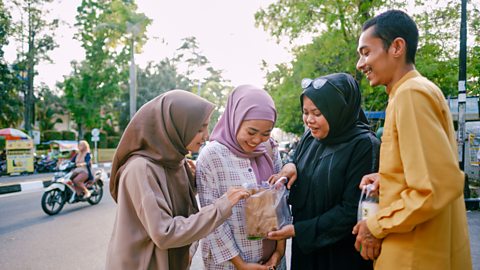
Siempre damos regalos a la familia durante Eid. – We always give presents to the family during Eid.
Durante Semana Santa a menudo vemos los desfiles. – During Semana Santa (Easter Week) we often watch the processions.
Se celebra la Navidad cada año. – One celebrates Christmas every year.
The position of nunca and casi nunca
If nunca or casi nunca are not placed before the verb, you need to add no.
For example:
María nunca va a la iglesia en Nochebuena. – Maria never goes to church on Christmas Eve.
Daniel no celebra la Navidad nunca. – Daniel never celebrates Christmas.
Adverbs of frequency – Mini quiz
Complete the following sentences with the correct adverb of frequency.
Doy los regalos ____________a Navidad.
I always give presents at Christmas.
Doy los regalos siempre a Navidad.
Siempre = always
Celebramos Pascua ________ .
We celebrate Easter every year.
Celebramos Pascua cada año/anualmente.
Cada año and anualmente both mean every year or annually.
No como ______ durante el día durante Ramadán.
I never eat during the day in Ramadan.
No como nunca durante el día durante Ramadán.
Add no before the verb como. Nunca means never.
Listening practice
Listen to the description of Semana Santa (Easter Week) in Mexico and complete the activity below.
- The most celebrated festival in Mexico is…
| A | Day of the dead |
| B | Christmas |
| C | Holy Week |
The answer is B
Después de la Navidad, la Semana Santa es la fiesta más celebrada en México. - After Christmas, Holy Week is the most celebrated festival in Mexico.
- What percentage of Mexicans identify as Catholic?
| A | 83 |
| B | 86 |
| C | 85 |
The answer is A
…el 83 por ciento se identifica como católica. - … 83 percent identify as Catholic.
- How long do children usually have as a holiday?
| A | A week |
| B | 10 days |
| C | Two weeks |
The answer is C.
Muchos mexicanos no trabajan para por lo menos una semana y los niños tienen frecentamente dos semanas de vacaciones. - Many Mexicans do not work for at least a week and children often have two weeks of holiday.
- The extract says that many people…
| A | dress up |
| B | go on holiday |
| C | go to church |
The answer is C.
… mucha gente va a la iglesia el Viernes Santo… - …many people go to church on Good Friday…
- The food that is mentioned that people eat is…
| A | fish |
| B | meat |
| C | burritos |
The answer is A.
Se come mucha comida en la calle como pescado, pan con queso y fruta. - A lot of street food is eaten such as fish, bread with cheese and fruit.
Click or tap on Show more to read the transcript and a translation.
Transcript
Después de la Navidad, la Semana Santa es la fiesta más celebrada en México. En México, casi toda la población es cristiana: el 83 por ciento se identifica como católica. Como resultado, existe una rica cultura de tradiciones y celebraciones de Pascua.
Muchos mexicanos no trabajan durante por lo menos una semana y los niños tienen frecuentemente dos semanas de vacaciones.
Hay desfiles y mucha gente va a la iglesia el Viernes Santo, el día que marca la muerte de Cristo.
Se come mucha comida en la calle como pescado, pan con queso y fruta.
Translation
After Christmas, Easter Week is the most celebrated festival in Mexico. In Mexico, almost the entire population is Christian: 83 percent identify as Catholic. As a result, there is a rich culture of Easter traditions and celebrations.
Many Mexicans do not work for at least a week and children often have two weeks of holiday.
There are parades and many people go to church on Good Friday, the day that marks the death of Christ.
A lot of street food is eaten such as fish, bread with cheese and fruit.
Vocabulary sheet
Click or tap on the image below for a list of useful vocabulary to use when describing religious celebrations and festivals.

Now you have revised the important vocabulary and key grammar points for talking about religious celebrations and festivals, why not have a look at the Describing free time activities in Spanish guide?
Careers advice and tips from BBC Bitesize
Future careers, further studies and the world of work - we're here to help with advice from experts and from young people who've found their path.

More on Customs, festivals and celebrations
Find out more by working through a topic
- count3 of 3