Weak and strong vibrations
Sounds are vibrations that travel as waves of energy into our ears.
The volume of a sound is how loud or quiet the sound is.
A nail hit hard with a hammer will have a lot of energy so will cause a strong vibration. This means the sound waves will be tall, which means it will make a loud sound.
A nail hit softly with a hammer will have little energy so will cause a small vibration. This means the sound waves will be short, which means it will make a quiet sound.
Sounds lose their energy as they travel, which is why sounds become quieter the further away you are from the source.
A sound that makes a strong vibration will have more energy and will travel further than a sound that make a weak vibration.
Watch: Volume of souund
Fran: Every sound creates a wave, and we receive that in our ears to hear it.
And the volume of a sound is how loud or quiet a sound is.
The sound waves are bigger for a loud sound, like this!
And they are smaller for a quiet sound, like this.
Over to one of my investigators to see what they've found out about the volume of sound.
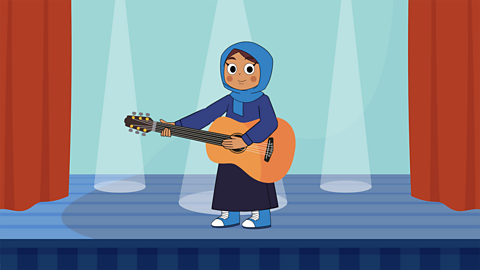
Child: So, that is what the sound of a guitar looks like
If I play the guitar softly and lightly, let's see what happens to the wave.
Yeah, it's quite small.
Shall I make it bigger?
Oh yeah, that's a lot bigger.
To make the sound louder, I strummed the guitar harder.
Fran: By changing the strength of the strumming, you changed the strength of the vibrations of the sound wave.
And we can see how that works with this speaker and this sound metre.
So, if I turn up the volume… then the vibrations get bigger and the sound gets louder, which we can not only hear, but we can see in thissound metre.
And then, if I turn the volume down, the vibrations get smaller and the sound quieter, which we can see because the numbers go down.
Now, sounds are vibrations that travel through the air as waves.
The vibrations - or waves - weaken as we get further from the sound source.
If our ears receive those waves when they are strong, so, near the source, we'll hear the sound as loud.
But if we move away and receive the sound waves, we will hear the sound as quieter.
So, next time you're listening to music, remember you can control the volume by controlling the strength of the sound vibrations.
Fascinating facts

Fascinating facts about the volume of sound!
When sounds bounce off a surface, the vibrations are reflected and you can hear them again, this is what creates an echo.
Sound can travel around four times faster in water than in air.
During a thunderstorm you can hear thunder and see lightning. Light travels much faster than sound. Light travels at 186,000 miles per second, whilst sound travels at 770 miles per hour. That is why you will often see lightning before you hear the thunder.
The study of sounds is called acoustics.
Sound waves require a medium, such as air, water or gas, to travel through. In space, where there is no air, their is no sound.
Volume is measured in decibels (dB), named after Alexander Graham Bell, a Scottish scientist who invented the first working telephone.
Watch: How to amplify your voice
You can amplify your voice in different ways. You can:
- Shout! Shouting can make your voice louder
- Use a microphone and speaker. You can use a microphone and speaker or a megaphone to amplify your voice to make it louder
Here's what you need to know about making noises louder.
Narrator: Making loud noises If you were talking to a big crowd or someone far away you’d have to make your voice really loud, so everyone can hear you.
Boy : Hello
Boy 2: We can’t hear you.
Narrator: You could try using a megaphone to make your voice louder. The secrets of a megaphone is its cone shape. This helps make your voice louder or amplifies your voice and the cone shaped directs your voice towards the target.
Boy 1: Hello
Boy 2: We can hear you.
Cones work by preventing the sound waves from spreading out, channelling all the sound energy into just one direction instead.

Did you know?
If you are trying to keep sound out (soundproofing), then even the tiniest gap around a door or window can let in an amazing 50% of external sound energy.
Important words

Amplify – To expand, make bigger or larger.
Echo – The repetition of a sound due to reflection off another object.
Loud – Something that has a high volume.
Quiet – Something that has a low volume
Sound waves – A sound wave is a vibration that travels through a solid, liquid (such as water) or gas (such as air).
Sound energy – Energy which can be heard by living things.
Vibration – When an object moves back and forth very quickly.
Volume – The volume of a sound is how loud or quiet the sound is.
Activities
Activity 1 – Quiz
Activity 2 – Recording noises
Which objects around you are able to make a noise?
Record an object making a noise with either a phone, laptop or tablet.
If your recording device shows the sound waves, take a look and write down what they look like. If not, describe the vibration that is making the sound.
Activity 3 – Tune booster
Discover how to investigate volume with this practical activity from the Science Museum Group.
Tune Booster. document
Boost the volume of your tunes with this tune booster activity from the Science Museum Group.

Activity 4 – Guided reading
New game! Horrible Science: Stinky Space. game
Join Pipette on her epic mission and learn some revolting facts about space along the way.

More on Sound
Find out more by working through a topic
- count3 of 4
- count4 of 4
- count1 of 4