Why were lots of Ancient Egyptians farmers?
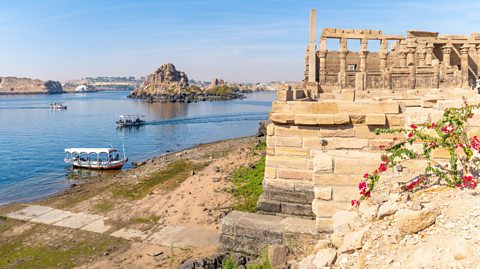
Lots of Ancient Egyptians lived in settlements next to the River Nile, because the river was an important water source, providing freshwater for drinking, cooking and washing.
It was also important for transport and trade.
This enabled them to build a wealthy empire.
The Ancient Egyptians were amongst the first civilisations to farm on a large scale and many other civilisations learnt from them.
Important words
Important words on why farming was important for the Ancient Egyptians.
| Keyword | Definition |
|---|---|
| Basins | Flat areas of land surrounded by small walls to hold water. |
| Fertile soil | Soil that is good for growing plants and crops. |
| Harvest | The time when farmers collect the crops they have grown. |
| Irrigation | Bringing water to crops to help them grow. |
| Shaduf | A tool the Ancient Egyptians invented to move water from rivers and lakes onto land. |
Watch: Ancient Egyptian farming
Watch the video to learn more about Ancient Egyptian farming.
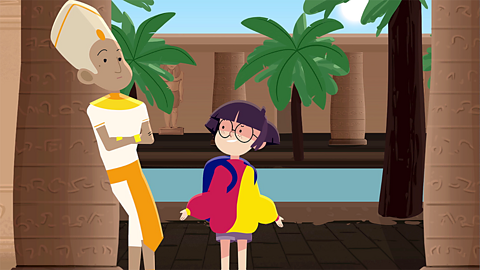
Child: A quern for grinding grain to make flour.
Wow! That must have been really hard work.
These tools are so basic. It’s all so primitive!
Ancient Egyptian person: I beg your pardon. Did you say primitive?
Child: What I meant to say was…
Ancient Egyptian person: This is the cutting edge of farming technology!
Child: More ‘grinding’ really.
Ancient Egyptian person: And I suppose you think it’s easy growing wheat and barley in heat like this?
Child: Well no, but…
Ancient Egyptian person: Well it’s not! We need to know exactly when the river will flood, so that we plant our crops at the right time.
That way, we can take advantage of all the nutrients left behind by the floodwater.
We even measure the level of the River Nile to see how much flooding we can expect.
We have three seasons: Akhet, the flooding season, Peret, the growing season and Shemu, the harvesting season.
During growing season, the fields are ploughed, either by hand, or with oxen.
And we set up a complex network of water channels, for irrigating the crops, otherwise they would dry out.
Child: Wow, that’s really clever!
Ancient Egyptian person: The grain is held in big stores to keep it preserved. We exchange it for other goods like cloth or bread.
So the stores are a bit like banks, where we can keep our grain, or take it out when we need it.
Child: Cool! So what re you grinding in your quern?
Ancient Egyptian person: We’re making flour for baking bread.
Child: Ow! There’s some stone from your quern in my bread.
Ancient Egyptian person: Ok, we’re good at farming, but we’re not perfect.
How did the three farming seasons work?
The Ancient Egyptians based their farming around the annual flooding of the River Nile.
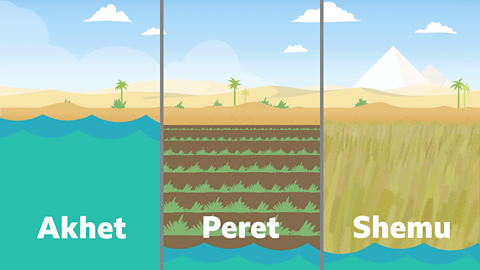
There were three seasons in the Egyptian calendar:
| Akhet | Also called the Season of the Inundation. Heavy summer rain in the highlands of Ethiopia each year would cause the Nile to flood as it flowed through Egypt. Farmland could be covered by up to two metres of water. |
| Peret | Also called the Season of the Emergence. As the floodwaters went down, the land beside the Nile was left covered in thick dark mud which was very fertile (soil that is good for growing plants and crops). Farmers used this season to plant grain, barley and other fruits and vegetables. |
| Shemu | Also called the Season of the Harvest. Egyptians harvested (the time when farmers collect the crops they have grown) the food they had planted, collected seeds to plant the following year and stored grain in large silos. |
What techniques did farmers use?
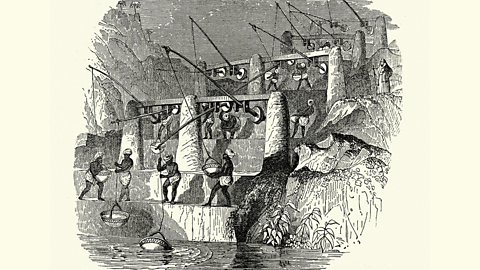
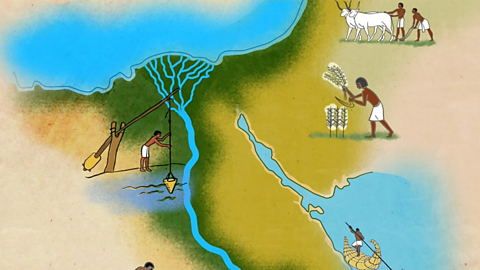
To make the most of the annual rising and falling of the River Nile, the Egyptians dug channels and walls to divert flood water away from cities and towards fields for farming.
This was called basin irrigation (bringing water to crops to help them grow).
They also invented tools like the shaduf. A shaduf is a long pole with a bucket attached to the end, which people could use to raise and move water from rivers or lakes onto land.
Why was farming important?
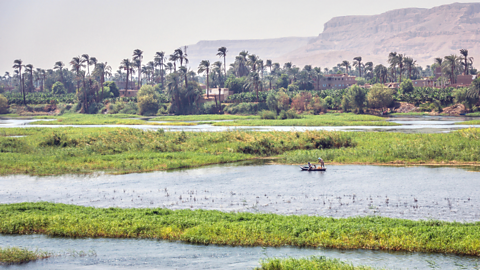
Farming was the basis for the entire Ancient Egyptian civilisation.
The flooding of the River Nile left behind a rich, black silt which was very fertile and meant the Ancient Egyptians could grow lots of their own crops, including barley, fruit, vegetables and wheat.
Reeds and flax plants were also essential for Ancient Egyptians.
They used the reeds to make papyrus, which was used as paper.
Flax plants were used to make linen cloth for clothes.
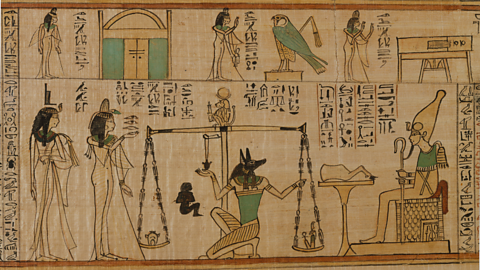
They Ancient Egyptians were amongst the first civilisations to farm on such a large scale, growing crops on a regular basis allowed them to generate their wealth.
Think like a historian

Have a look at the thinking points below and think about your answer to the questions. You could even write it down on a piece of paper or discuss it with somebody else if you want to.
Why was farming such an important achievement for the Ancient Egyptians?
How is farming in Ancient Egypt different from farming today?
Did you think about how farming provided a steady supply of food for the Ancient Egyptians? Farming allowed people to settle in one place and build communities. Water from the River Nile created fertile soil, and techniques like irrigation and the shaduf helped them grow crops on a large scale. Without farming, Ancient Egypt would not have been able to support a large population, powerful pharaohs or build temples and pyramids.
Did you think about how farmers in Ancient Egypt relied on the flooding of the River Nile to make their soil fertile, while farmers today use technology? Ancient Egyptian farmers didn't rely on the rain to water their crops. They used simple tools like shadufs, while today farmers use machines, tractors and technology to grow and harvest crops much faster. Ancient Egyptians mostly grew wheat, barley and fruit and vegetables such as onions, cabbage, figs and melons. Today, modern farming can produce a wider variety of crops to feed people all over the world.
Activities
Activity 1: The farming seasons
Can you name the farming seasons?
Activity 2: Quiz – Ancient Egyptian farming
Activity 3: History Explorer game
Play this game to test your knowledge and learn even more facts about Ancient Egypt.
History Explorer: Secrets through time
History Explorer: Secrets through time: KS2 History
Grown-ups corner
Are you a parent, carer or teacher?
Take a look at some of the links below on KS2 History which are packed full of knowledge, videos, quizzes and activities.
KS2 History: Ancient Egypt
BBC Bitesize for Teachers
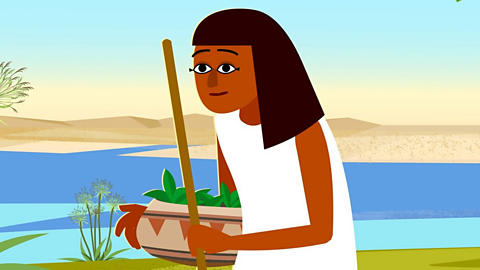
KS2 History: Ancient Egypt - Nanu - The Farm Girl
BBC Bitesize for Teachers
KS2 Music: Ancient Egypt. Song: 'Living, living River Nile'
BBC Bitesize School Radio
Horrible Histories: Raid and Trade game! game
Play Horrible Histories: Raid and Trade KS2 History
More on Ancient Egypt
Find out more by working through a topic
- count6 of 18
- count7 of 18
- count8 of 18
- count9 of 18