When an item is measured in maths, we are attempting to provide a number to show the size or amount of something.
This could be a measurement of its weight, volume, capacity, length, time or temperature, and there are standard units of measurement agreed upon and used all around the world. These standard units can be divided into two separate groups: imperial and metric. Depending on where you live, you might be more familiar with one than the other.
In the past, people in the UK and Ireland would traditionally have used the imperial system of measurement. Despite being seen as quite old fashioned now, a lot of the measures listed below (and their abbreviations) are still commonly used today and are still the main system for America.
| Weight | Volume | Length |
|---|---|---|
| ounces (oz) | teaspoon (tsp) | inches (in or ') |
| pounds (lbs) | cups | feet (ft or ") |
| tonnes (tn) | pints (pt) | yards (yd) |
| gallons (gl) | miles (ml) |
More recently, many countries around the world have moved towards the metric system which was developed to be easier to follow as it relies on counting in tens, hundreds and thousands. These units of measure will probably be more familiar to you.
| Weight | Volume | Length |
|---|---|---|
| grams (g) | millilitres (ml) | millimetres (mm) |
| kilograms (kg) | litres (l) | centimetres (cm) |
| metres (m) | ||
| kilometres (km) |
It is very important to think carefully about the most appropriate size of unit for the task you are carrying out; the smaller the unit, the more accurate you can be. You can also combine a number of units of measure to help achieve this, for example: giving an answer in meters and centimetres, rather than just metres, when measuring the length of your classroom. The relationship between each unit listed below should help:
Weight: 1kg = 1000g
Volume: 1l = 1000ml
Length: 1cm = 10mm, 1m = 100cm and 1km = 1000m
Whether you choose to use imperial or metric units of measure will depend on your task, and it is also possible to make comparisons between both systems by converting from one to the other, using a conversation table. For example:
| Weight | Volume | Length |
|---|---|---|
| 30g = 1oz | 5ml = 1tsp | 1cm = 0.39 in |
| 1kg = 500lbs | 1l = 1 ¾ pts | 1km = 0.62mi |
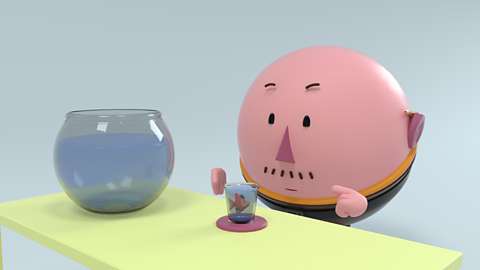
In the video below Trig uses his powers of conversion to change the water in his fishes bowl.
Narrator: With the correct calculations, anything is possible in the natural world of mathematics.
Here, we witness Trig our curious measuring creature.
When not busy measuring angles and making things, Trig is looking after his friend, Fish.
Today he’s changing the water in Fish’s fishbowl.
There is exactly one litre in the jug. But it takes 1250 millilitres of water to change the fishbowl.
How much water does Trig need to add to the jug?
This is a metric issue. Metric is an interesting system of measurement.
1 litre of water is exactly 1000 millilitres.
1 litre also weights exactly 1 kilogram, or 1000 grams. If one litre was turned into a cube, it would take up a volume of 10 centimetres, by 10 centimetres, by 10 centimetres, or 1000 centimetres cubed.
So, if Trig needs 1250 millilitres of water for Fish. That’s the same as 1.25 litres.
He already has 1 litre which is 1000 millilitres.
So, if we take 1250 millilitres and subtract 1000 millilitres, he needs 250 millilitres more for the fishbowl.
Perfect fit and ready for the big splash. Sometimes there’s nothing better than a freshly made bed.
More on Weight and mass
Find out more by working through a topic
- count1 of 2