Addition and subtraction methods

You can add or subtract numbers in lots of different ways.
You can use number lines, number bonds, fact families, 10 squares and counters, or even just writing the numbers down.
Sometimes it is faster and easier to do calculations in your head. This is called mental calculation.
Activity: Addition and subtraction methods
Complete this interactive activity to explore some different methods for addition and subtraction. Then put your knowledge to the test.
Making calculations simpler
It can be quicker and easier to do some calculations in your head.
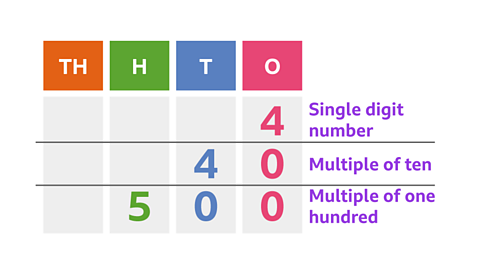
An easy number to work with could be a single digit number, or a multiple of 10, or a multiple of 100.
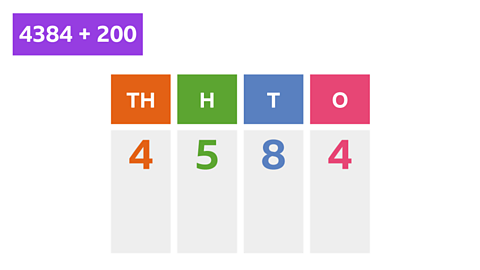
This is what these types of numbers look like in a place value chart.
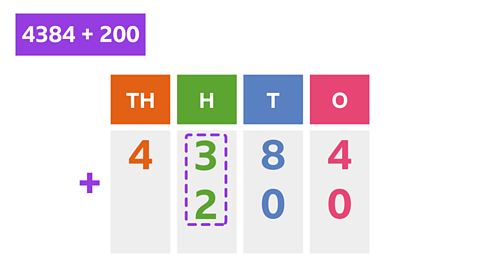
Take a look at this slideshow to see how you can use your knowledge of place value to quickly do this calculation:
4384 + 200 = ?
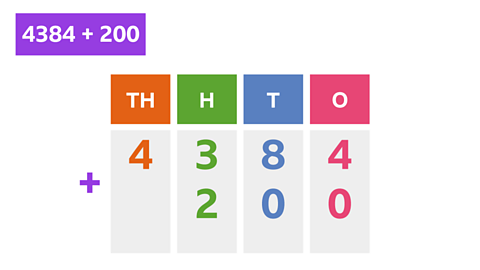
Image caption, To solve this problem which place value column will you need to add?
1 of 3
Using the compensation method
Another way to calculate is to use a compensation method. This method helps if a number is close to a multiple of 10 or 100.
Look at this calculation:
4384 + 190 = ?
It would be easier to add 200 to 4384 than 190.
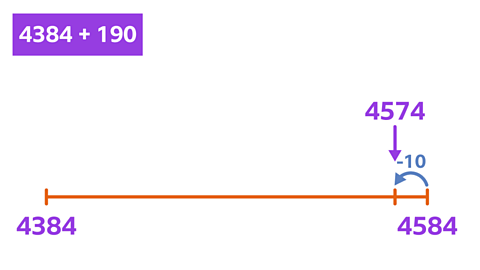
But if you add 200, you need to compensate by taking 10 away at the end.
The calculations to find the answer would look like this:
4384 + 200 = 4584
4584 - 10 = 4574
This tells you that:
4384 + 190 = 4574
This is what the calculation looks like on a number line:
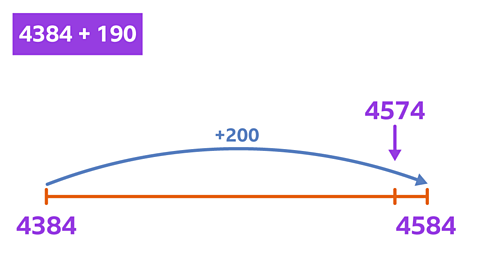
Image caption, It is easier to add 200 to a number than it is to add 190.
1 of 2
Counting up to solve subtraction problems
Counting up is a useful method, if you are subtracting two numbers that are close in value to each other.
Look at this calculation:
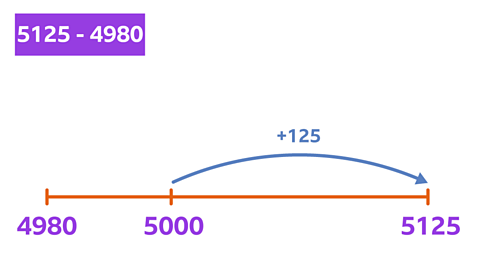
5125 - 4980 = ?
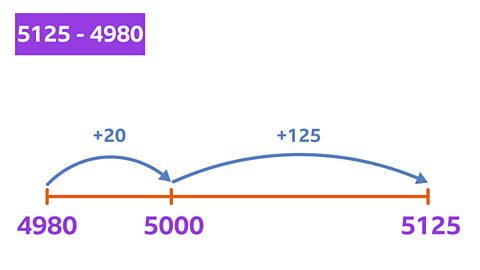
To solve this you can count up from 4980 to 5000 (which is 20).
Then you can count on from 5000 to 5125 (which is 125).
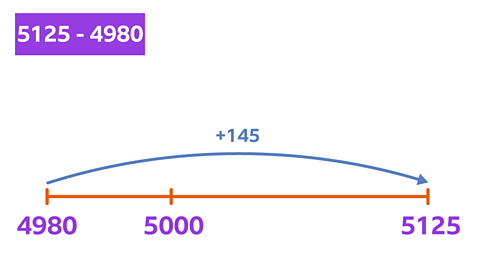
In total, you will have have counted up 145.
So:
5125 - 4980 = 145
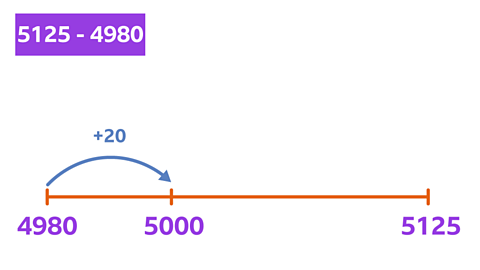
Image caption, You can count up from 4980 to 5000 (which is 20).
1 of 4
Example 1

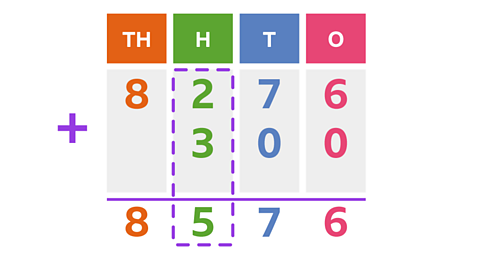
To find out the answer to this calculation you can just add the hundreds, the other values will not change.
What is 8276 + 300?
✓8276 + 300 = 8576
To find the answer you just need to add the 300 and not change the other columns.
Example 2
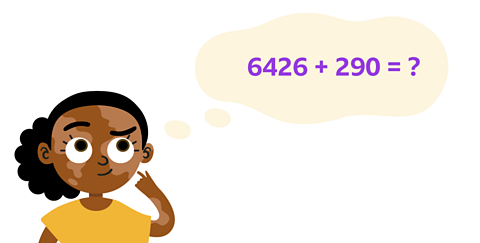
In this example you could use a compensation strategy to find the answer.
Which number could you compensate to make it easier?
✓ A good strategy here is to add 300 first.
This number line shows the result if you add 300:
As 300 is 10 too many, you need to subtract 10 at the end.
This is what that calculation looks like on a number line:
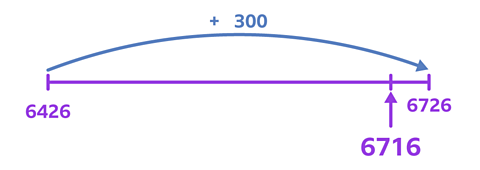
The calculations are:
6426 + 300 = 6726
6726 - 10 = 6716
So the answer is 6716.
Example 3
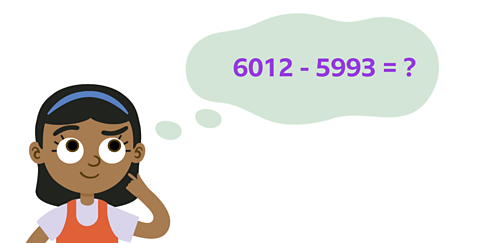
The two numbers in this calculation are close together.
What strategy could you use to find the answer?
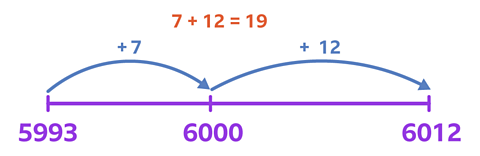
✓ You could count up from 5993 to 6012.
First, jump from 5993 to 6000. This is a jump of 7.
Next, jump from 6000 to 6012. This is a jump of 12.
Adding those jumps of 7 and 12 together gives you 19.
So:
6012 - 5993 = 19
Play our fun maths game Guardians: Defenders of Mathematica. game
Use your times tables and more maths skills to defeat monsters and reclaim the Kingdom of Mathematica

More on Adding and subtracting
Find out more by working through a topic
- count2 of 4
- count3 of 4
- count4 of 4