Did you know?
The term ‘text’ comes from Latin and French. It means to weave a tissue of many threads.
Introduction to examining different text types
Key learning points
Non-fiction texts are everywhere – from class textbooks to diary entries, from newspapers to social media posts, from instruction manuals to film reviews.
It is useful to know how these texts are put together, to think about their different purposes and to notice how they are designed to appeal to different readers.
Different types of texts use rules or The normal or standard ways of doing something. of form, layout, structure and language to get their meaning across.
What is text?
Historically, ‘text’ referred to the printed words on a page and the actual words of a speaker or writer.
As technology developed, the term ‘text’ widened to include words and content on websites and social media as well as text messages. People now even refer to film, art, photographs and symbols (such as Pictographs – pictures used to symbolise what is described, felt or said 😊.) as texts even though they use images rather than words to convey meaning.
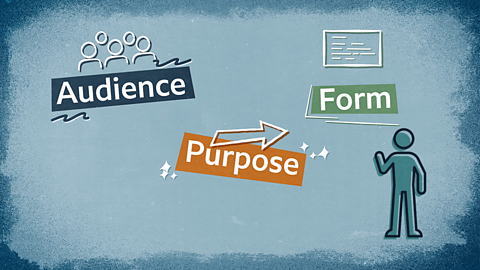
Non-fiction texts tend to have specific purposes, for example to inform, instruct, entertain or persuade. They are often created for specific readers or audiences, for example, adults or teenagers, experts or beginners, local or international readers. A text aimed at children is likely to be different in both language and layout to a text aimed at adults.
Find out more about writing to persuade.
Different types of texts
Each type of text has its own writing conventions and language which shapes its length, The shape of the text, how it looks and the rules it follows., The attitude that a writer expresses towards a subject and how it makes the reader feel. and . Look at the following three types of non-fiction texts, and think how they might differ to suit their intended audience and purpose.
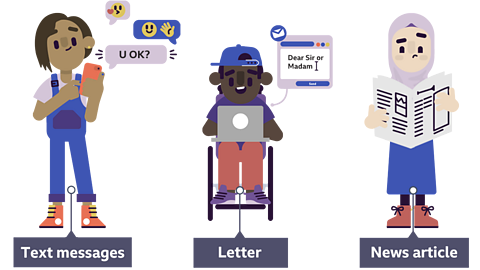
Text messages use informal language because they are sent by friends that know each other well. The messages are communicated using Language typically used in text messages. It might include abbreviations and images such as emojis. that both parties understand.
A letter can be either formal or informal and while the tone of language may change, both formal or informal letters will a have similar layout.
A news article follows the normal rules of grammar and punctuation, whereas text messages do not.
Text messages are a conversation using short, quick phrases. News articles and letters use sentences of a more standard sentence length in short paragraphs.
Understanding form
The How and where the text will appear, eg an email, a blog, a recipe, a leaflet, an article. of a text determines the structural layout, the order, content and even size of text.
The form of a text serves many purposes such as:
- It can reflect the purpose of a text.
For example, if the aim is to allow the reader to understand something very quickly and easily, the text might use shorter sentences or paragraphs. It might use headings to summarise the information or sub-headings to help the reader find the information quickly on the page.
- It can reflect the intended audience.
For example, if you are writing for a young child, you would probably use much less text, space it out and use simpler, age-appropriate language.
- It can help us to recognise the type of text.
For example, a newspaper article is recognisable by its large font headline; an instruction manual might use a numbered list.
Layout conventions
The layout is an outline of the conventional rules that a text should follow. Most of these conventions are practical. For example, a letter needs a name and address; a tweet is limited to a certain amount of characters; a headline in a newspaper is designed to catch the eye.
Examples of different conventions
Newspaper articles use a headline, subheadline, byline, a lead paragraph, followed by explanatory and additional information paragraphs. Sometimes columns, pull-out quotations, and images are used to structure and present the text.
An instruction leaflet uses headings and bullet points or numbers to make each instruction clear. It has a small amount of information in each step and uses language that is precise and to the point.
A review has a title and sub-title that reflects the reviewer’s opinion, paragraphs and a rating or recommendation. For example: I rate this film ★★★★☆ 4 out of 5 stars.
The limited space and word count of text messages compel users to shorten words, often breaking the rules of conventional spelling, grammar and punctuation. Additional information, can come from hashtags, emojis and other shortcut strategies.
Differences between text types
When you read a non-fiction text, first consider what text type it is, what the purpose of the text is and who the target audience is.
Some text types are always formal, like a job application, a text about an important topic like health or safety, or any occasion when you need to be taken seriously by the reader. These examples can change depending on the audience though.
You could, for example, write a formal or informal letter depending on whether you were writing to a friend (informal) or your headteacher (formal). Although the layout would be similar, your language would change including key details like using the appropriate greeting or sign off.
Some non-fiction texts are closer to fiction. Examples of literary non-fiction texts would be Writing about your life, key events and things that have influenced you., Writing about real events from history. and Writing about different places and the experiences you have had in those places, based on true experiences.. These are usually written as longer articles or full-length books.
Language in texts
Language shapes how readers engage with a text.
If a text uses language that is too formal or technical for the reader then fewer people will understand and appreciate the content that has been written.
Equally, if a text is too simple or informal for the form or content then readers underestimate the value of the text and the writer.
The writer must choose their words carefully, thinking about what they are trying to achieve with their text and who is going to be reading it.
For example, if you were giving a speech to your headteacher and called them ‘dear’ this would not be appropriate. However, using ‘Dear’ at the start of a letter would be appropriate – it is a conventional opening that letter writers commonly use.
Test your knowledge
Solve the Story!
An exciting new series from the Other Side of the Story, designed to help young people strengthen their media literacy skills.

More on Critical reading
Find out more by working through a topic
- count2 of 5
- count5 of 5