Who were Rebecca and her daughters?
Rebecca and her daughters were a group of men who attacked A building on a turnpike road where the toll is collected. in south-west Wales between 1839 and 1843. They were protesting against the expensive Fee charged for using roads or crossing a bridge. imposed on people travelling along A main road on which tolls were charged for travelling..
There were many Companies that collected tolls on roads and made profit. in the area. This meant that people had to pay tolls to several different trusts when they travelled from one place to another. There wasn’t such competition between different trusts in England.
There was no way for farmers to avoid these roads, as they had to drive their cattle along them and travel back and forth to the market to buy A natural material used by farmers to help to fertilise the land. to improve the soil. Therefore, this was a very expensive system for them.
Having become fed up with the regime, a group of farmers came together to Violent action against an individual or organisation. against the system. In order to hide their identities, the men wore women’s clothing and blackened their faces. This was very similar to what happened with the Ceffyl Pren, a form of community punishment that was a tradition in rural Wales.
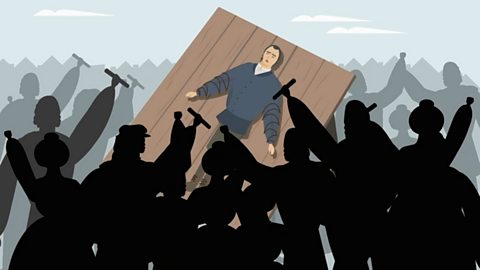
Ceffyl Pren
The Ceffyl Pren was a form of physical punishment carried out in rural areas of Wales. It was a tradition in these areas for local people to punish members of the community themselves.
A crowd of people would paint their faces black and carry a wooden frame or ladder to the door of an offender’s home. The offender would be carried around the village tied to the frame or ladder in order to shame them.
The Rebecca rioters are thought to have used the Ceffyl Pren on tollgate keepers and anyone who disagreed with their actions.
Video - The Rebecca Riots
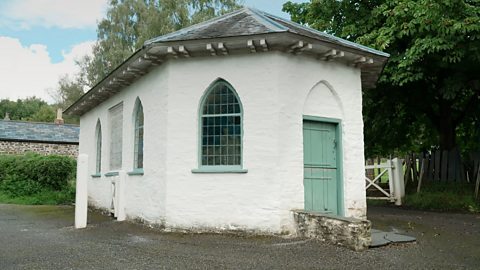
This isn’t really my style and I don’t usually hang around near toll gates like this one in St Fagans, but, I wanted to have an idea of what people like Twm Carnabwth and John Hughes were doing back in the late 1830s, at the time of the Rebecca Riots.
The population of rural Wales had doubled in the 18th century. As life was tough, many moved to industrial areas, some even emigrating to places like America to make a better living for themselves.
Farming was very labour intensive, as most things were done by hand. It was all work with no enjoyment and very little profit. To add insult to injury they had to pay rent to wealthy landlords. Farmers had to pay tithes to the Anglican church, which caused frustration as most attended the chapel. The whole country was experiencing bad harvests due to lack of rainfall. Landowners started raising tolls on important roads.
All this made people unhappy. They felt hard done by because food was scarce and their standard of living was poor. Farmers like Twm Carnabwth and John Hughes decided to do something about it. So they and other farmers put on women’s clothes and attacked the toll gates.
Why did farmers dress like this and why were they called Rebecca and her daughters? Basically, they needed to disguise themselves. That’s when the skirts and the blouses came in handy, and they also blackened their faces with coal. Dressed as women, they felt they were symbolising the values of the Welsh Mam - looking after their community rather than breaking the law. They called themselves ‘Rebecca and her daughters’, after a passage from the book of Genesis, in the Bible. People at that time knew the Bible very well.
And what did Rebecca and her daughters achieve? The protesters had drawn attention to the unfairness they had suffered. Sending in soldiers to stop the protests didn't work so in the end the government made the toll gate system and the poor laws fairer - and gradually things improved for the people in the rural areas of Wales.
Rebecca Riots
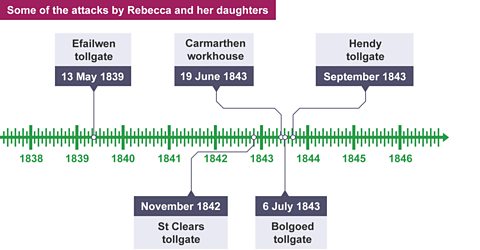
Rebecca and her daughters’ first attack happened on 13 May 1839 on the Efailwen tollgate in Carmarthenshire.
This was the first in a series of 500 attacks in south-west Wales between 1839 and 1843.
Efailwen
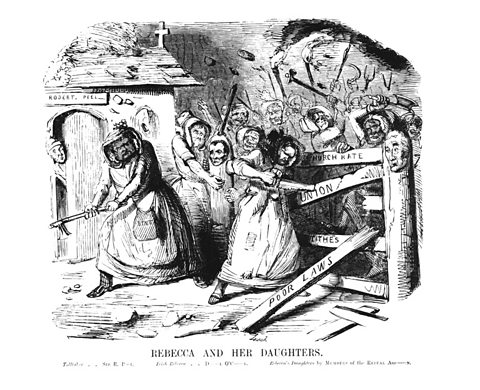
There were 12 tollgates on the roads around the town of Carmarthen alone, which led to discontent among local farmers. A new tollgate was built in 1839 in the village of Efailwen and this was the final straw for the farmers. They had been using this road to avoid paying tolls on other roads in the area and they had to use this road to cart their lime.
According to local accounts, a man named Thomas Rees, or Twm Carnabwth, was responsible for arranging the first attack. He was a religious man and also a renowned boxer at local fairs. On the night of 13 May 1839, a crowd of men dressed as women and with blackened faces headed to the Efailwen tollgate and destroyed it. Some say that up to 300 local farmers were in attendance that night.
A new gate was erected shortly afterwards, but on 6 June of the same year Rebecca and her daughters attacked it again on. On 17 July, they burnt down the toll-house and gate.
Further riots
Following the attack at Efailwen, the Rebecca Riots spread across south-west Wales. The worst year was 1843, when Rebecca and her daughters attacked many important tollgates. Between January 1843 and the spring, over a hundred tollgates across south-west Wales were destroyed.
In May 1843, Carmarthen’s Water Street tollgate was destroyed by about 300 Rebecca rioters. In June a crowd of 2,000 attempted to burn down the local Government building where poor people could go for food and accommodation if they were in work.. The military had to be called as the movement became more violent. In the same month, a crowd of 4,000 gathered near the Plough and Harrow pub outside the town to march and call for People being treated fairly, reasonably and without bias according to the law..
On 6 July 1843, around 200 Rebecca rioters attacked a tollgate in Pontarddulais.
In August, there were <glossaryterm id"zc4xv9q">riots in Glamorgan and Llanelli for the first time and there were attacks on toll-gates in Llangyfelach.
In October, during an attack at Hendy near Swansea, the toll-house keeper, a young woman named Sarah Williams, was killed.
Serious attacks also occurred in Cardigan, Haverfordwest, Tumble and Kidwelly.
Why the name ‘Rebecca’?
Some say the name came from a woman named Beca Fawr (Big Rebecca) from the The smallest unit of local government in rural areas in the care of a priest. of Llangolman. When Twm Carnabwth organised the first atack, it was difficult to find women’s clothing to fit such a large man, so he borrowed clothes from Beca Fawr.
It is more widely believed that Rebecca was an imaginary leader. The name is said to come from the Book of Genesis, chapter 24, verse 60:
“…and they blessed Rebekah and said unto her, “Thou art our sister, be thou the mother of thousands of millions, and let thy seed possess the gate of those which hate them.”
The verse refers to the possession of the gate of enemies. This was the exact aim of Rebecca and her daughters in destroying the tollgates.
Other reasons for the riots
It was a very difficult period for farmers in south-west Wales, so there were many reasons for the riots as well as opposition to the tollgates, eg:
- a reduction in the price of corn that meant farmers didn’t make enough profit from its sale
- an agricultural recession that began in 1836 (and ended roughly when the riots ended) and poor A process or period of gathering crops.
- a recession in the industrial areas of the south-east, the farmers’ main market for the sale of their produce
- a huge wealth gap between poor farmers and the rich landowners who charged high taxes and rents
- the unpopularity of a tax called the poor rate which paid for the new poorhouses
The result of the Rebecca Riots
The destruction of tollgates was just one aspect of Rebecca and her daughters’ actions. In reality, the movement was protesting against other social grievances, as well as the expensive tollgate charges.
A large meeting was held in the Gwendraeth Valley on 25 August 1842 and another near Llyn Llech Owain in September, which led to a An agreement between two sides..
In these meetings, it was decided to send a petition to Queen Victoria. As a result of this:
- a new law was passed the following year to merge Carmarthenshire turnpike trusts with the wider system, more in line with England
- the toll on lime was halved
- the payment system was simplified
Quiz - The Rebecca Riots
More on Revolution
Find out more by working through a topic
- count1 of 3

- count2 of 3