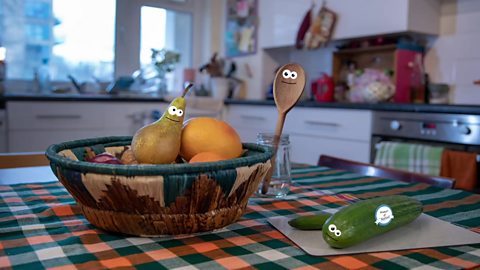
What is a food journey?
All food makes a journey from its source to you the consumer. We buy food from a variety of shops and online deliveries straight to our door.
Different foods are prepared and packaged in different ways for our convenience.
In this article you can learn:
- what a food journey is
- where milk comes from
- how bread is made
- what food miles are
This resource is suitable for Health and Wellbeing for primary school learners.
Video - Farm to plate
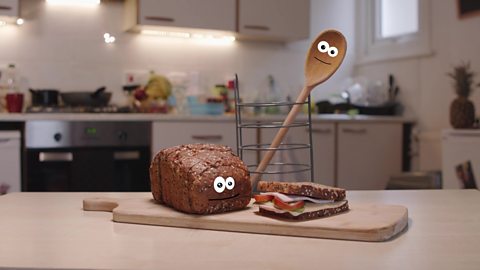
In this video, we learn about food journeys as the Great Spoon explains where milk and bread come from.
Find out where milk and bread come from.
MILK What is this place? Where am I?
BREAD Nae idea. I’m as confused as you.
MILK Who am I? Why am I?
THE GREAT SPOON Everything is fine, milk.
MILK Who are you calling meeeeelkk?
THE GREAT SPOON You. You are milk!
MILK What?
THE GREAT SPOON I am the Great Spoon. Don’t you remember how you got here?
MILK Oh…Oh! Oh!!! No…
THE GREAT SPOON Don’t you remember the supermarket? The delivery van? The dairy factory? The cow?
MILK Cow?! Where? Hide!
THE GREAT SPOON Let's go back to the start…In the beginning, there was grass.
MILK Ooh, that's nice… Relaxing.
THE GREAT SPOON The grass was eaten by a cow.
MILK GASPS
THE GREAT SPOON Inside the cow, that grass was turned into milk. A farmer milked that cow using sucking machines and then collected the milk in a big, cold tank called a vat. After that milk was…pasteurized.
MILK Pasteur-what?
THE GREAT SPOON Pasteurised. You were heated to kill off any nasty bacteria and then cooled down to keep you fresh. It’s nothing to worry about!
MILK Aah…
CHEESE I went through it and honestly, it wasn’t that bad. At least you weren’t curdled with acid, drained of your liquid and turned into cheese…
MILK GASPS
THE GREAT SPOON Actually, the journey of milk is really quite fun - you go on this cool ride that spins you round and round to separate the cream.
CHEESE Then you slide into a bottle… Wheeeeeeee! Ride in a van to the supermarket…
THE GREAT SPOON And then someone special picks you up and takes you home.
MILK Ooh! I remember now.
BREAD Um. Excuse me, the Great Spoon? What about me?
THE GREAT SPOON You are bread. Just like milk, bread starts in a farmer’s field. In the beginning, there was wheat…
MILK Is there a cow?
THE GREAT SPOON No cow.
MILK Oh, phew!
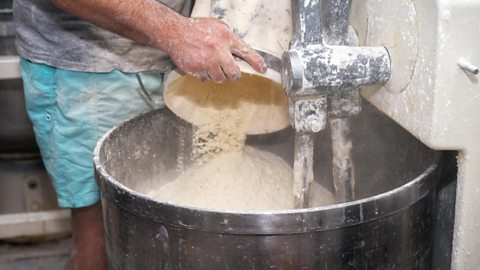
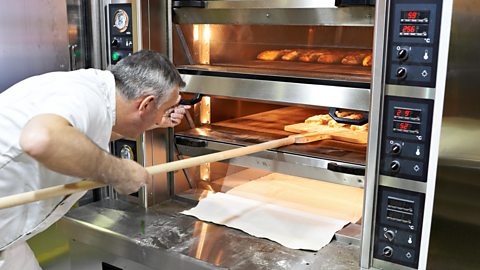
THE GREAT SPOON Wheat grain was harvested then taken to a factory and ground up into flour. Then the flour was taken to a bakery, mixed with yeast, water and other tasty ingredients to become a gloopy mixture called dough. Then you were baked in an oven, packaged, driven to the supermarket, bought and brought here.
BREAD Amazing!
MILK We’ve had incredible journeys.
BREAD I can’t believe it’s all over.
THE GREAT SPOON It’s not all over.
BREAD No?
THE GREAT SPOON Pals… you're breakfast.
ALL CHEER
Where does milk come from?
Lots of us enjoy drinking milk and it is often added to other drinks and foods. But where does milk come from?
- Mother cows make milk to feed their calves. When grass in a farmer’s field is eaten by a cow, the cow’s body uses All the contents of food and drink that our bodies need to grow and be healthy. from the grass to produce milk for their babies.
- The farmer then milks the cows using a machine attached to their udders.
- The milk is put into a vat and The process of heating it at a high temperature to kill any harmful bacteria. .
- Milk is then chilled to keep it fresh.
- Another machine separates the cream from the milk. This is called Separating a mixture by spinning..
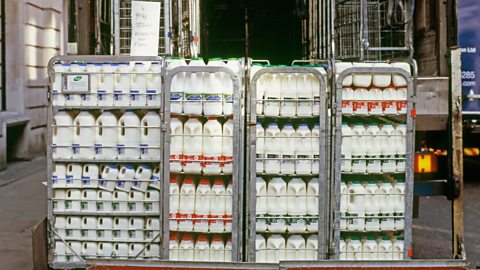
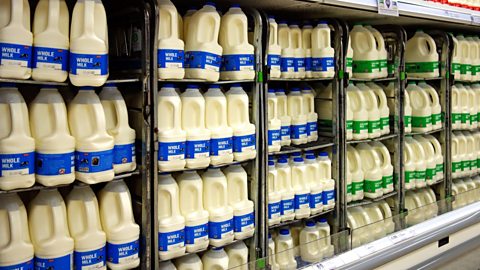
- The milk is then ready for the last step of its journey, being bottled ready for transportation by lorry to the supermarket, shop or even straight to your door.
This slideshow shows the different steps in bread's food journey from farm to plate.
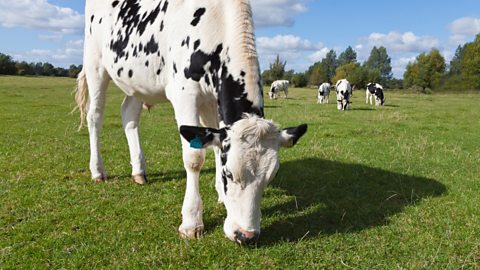
Image caption, Mother cows make milk to feed their calves. When grass in a farmer’s field is eaten by a cow, the cow’s body uses nutrition from the grass to produce milk for their babies. (Ian Merton / Alamy Stock Photo)
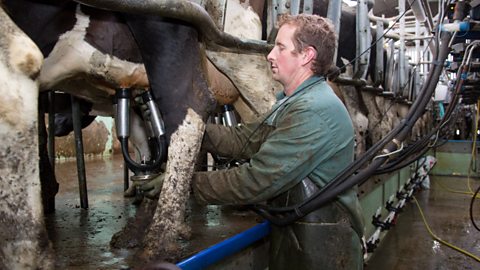
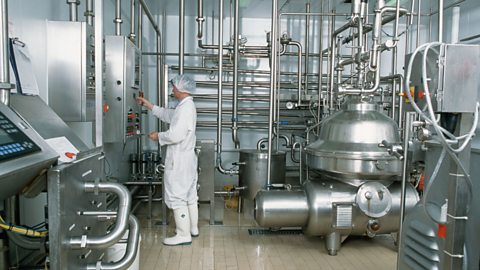
1 of 5
Did you know?
Grass is difficult to digest. Cows have a stomach with four separate compartments to process the grass they eat.
Find out how cows, and other animals, digest their food on Bitesize 2nd level Science.
How is bread made?
Many of us like to eat bread - from toast to sandwiches. But where does bread come from? How does it get from wheat in a field to our plates?
- Bread starts its journey as wheat grown in a farmer’s field.
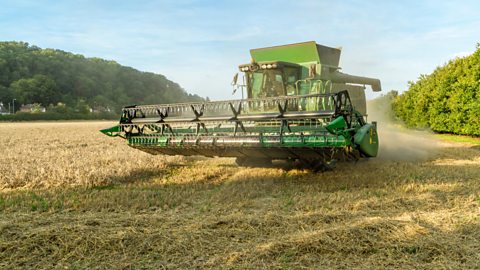
- Wheat is gathered using a machine called a combine harvester.
- The wheat is now ready to be transported to a factory that will grind it into a smooth flour.
- Flour is then mixed with water and yeast. These are the ingredients to make the dough for bread.
- The dough is shaped and baked in the oven.
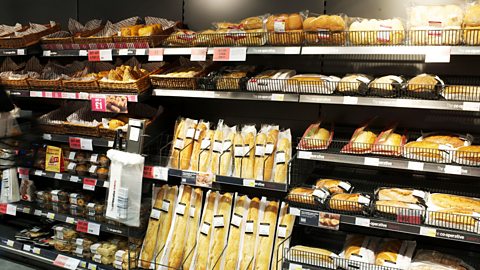
- The bread is packaged and transported to the supermarket to be sold.
This slideshow shows the different steps in bread's food journey from farm to plate.
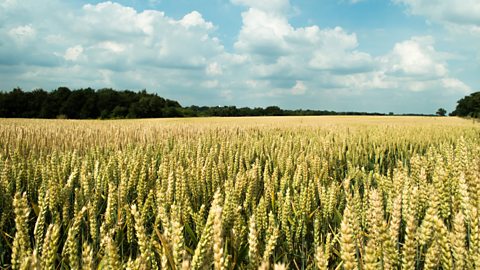
Image caption, Bread starts it journey as wheat grown in a farmer’s field. (Gianfranco Coppola / Alamy Stock Photo)
1 of 5
Did you know?
Some people can't eat normal bread because it contains A protein which can be found in grains like wheat and rye. and some people are allergic to gluten. They can have gluten-free bread instead, which is made using different grains.
What are food miles?
- Each of the steps above can be calculated to work out milk or bread's food miles.
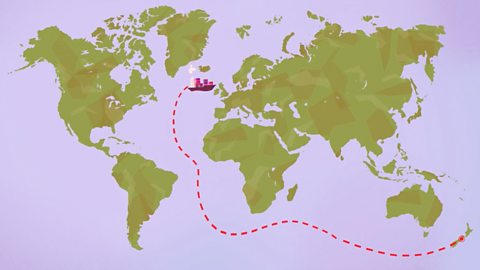
- Food miles measure the distance a food has travelled to get to your plate using transport that produces The release of carbon into the Earth’s atmosphere. This contributes to climate change..
- Some food travels from the farm it is grown on to a shop to be sold. Other foods travel to a factory first and then to a supermarket or shop.
- Food that is grown and produced locally is a more Using something in a way that does not destroy it completely. option for our environment.
Learn more about food miles: Sustainable food
Test your knowledge
Quiz - Food journeys
Try this short true-or-false quiz to test your knowledge on food journeys.
Challenge - Map out a food journey
In this article, we've learned where milk and bread come from but all foods take their own journey to get to our plates and lunchboxes.
Look at the food in your fridge, lunchbox, school canteen or think of your favourite meal. Can you find out where it was made?
Try figuring out its food journey or calculating its food miles. Can you map this out?
These guides can help you learn about and calculate food miles.
Food miles. revision-guide
Find out more about food miles in this article
Food and sustainability. revision-guide
Learn about the impact of food choices on the environment.
Climate change food calculator. activity
Use this climate change food calculator to discover more about food miles and carbon emissions.
More on Food and health
Find out more by working through a topic
- count7 of 10
- count8 of 10
- count9 of 10
- count10 of 10