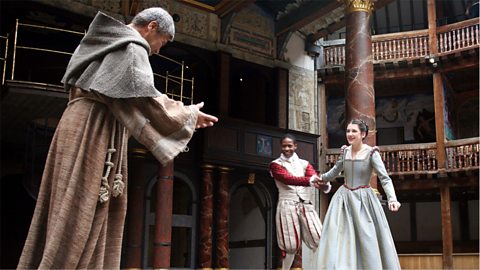
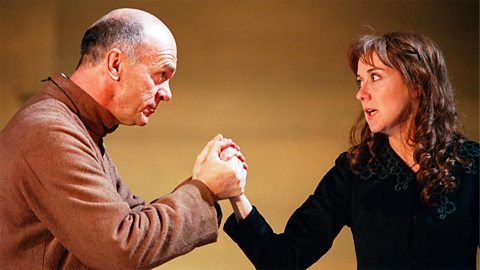
Key points
Juliet is one of the main characters from Romeo and Juliet, a tragedy by English playwright William Shakespeare.
Juliet meets Romeo and they fall in love.
Their families are enemies, so the couple marry in secret, but their relationship ends in tragedy.
Did you know?
In Shakespeare’s time, it was common for parents to choose who their children married. However, in the play, Juliet is determined to choose her own husband.
Plot summary
A plot summary of Romeo and Juliet:
Juliet’s key moments
Click through the slideshow to see Juliet’s key moments in the play
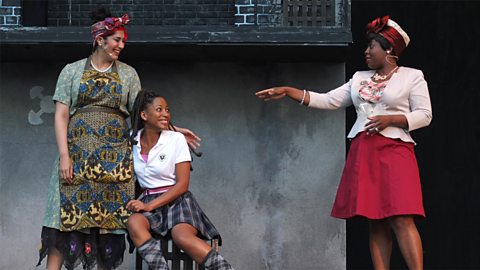
Image caption, These images are taken from a 2014 production of Romeo and Juliet set in Harlem, New York. The Nurse (left) and Lady Capulet (right) encourage Juliet (centre) to consider marrying Paris, telling her that he will be at the Capulet party.

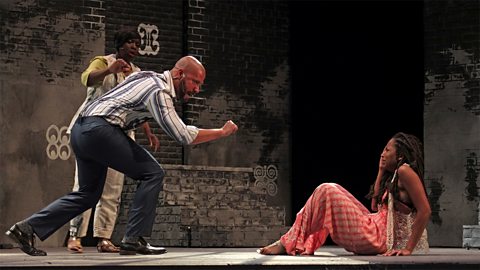

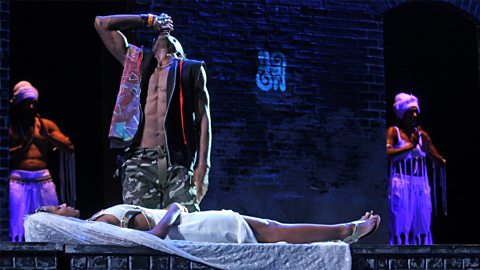
1 of 5
Character traits
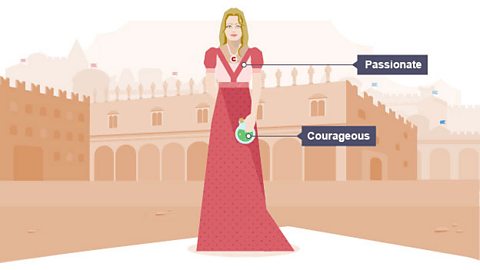
Passionate
When Juliet meets Romeo, she shows a Someone who has strong feelings or beliefs. side to her character. Juliet proposes marriage to Romeo and her language shows the strength of her feelings.
Courageous
By agreeing to Friar Lawrence’s plan, Juliet shows she is courageous and brave. She also shows determination when she stands up to her father and refuses to marry Paris.
How does Juliet’s language show the strength of her character?
When Romeo and Juliet first meet, Juliet shows she can match Romeo’s playful language and they share a sonnet, a 14-line poem typically about love. Romeo starts by addressing Juliet in rhymed lines and she continues the sonnet rhyming pattern in her response. Their ability to share these rhymed lines and continue each other’s imagery shows how in tune with each other they are and how true their love is.
During the scene in which Romeo and Juliet decide to marry, Juliet talks more than Romeo and takes control of the conversation. Later in the play, she feels alone and scared – first when her cousin Tybalt is killed and Romeo is ordered to leave Verona, and later when she decides to take the potion to make her appear dead. Despite this, she expresses herself in a poetic, but also clear and reasoned way.
Relationships
Juliet quickly develops an intense romantic relationship with Romeo. They meet at a party and then get married the next day. They only spend one night together after their marriage.
Juliet has a close relationship with her Nurse and trusts her to arrange her secret marriage. Juliet also trusts Friar Lawrence and agrees to his risky plan to fake her own death.
Juliet does not seem as close to her parents and does not share her true feelings with them. They want her to marry someone she doesn’t love and they are angry with her when she refuses.
Why does Juliet get married at such a young age?
Juliet is 13 years old when she gets married to Romeo. In Shakespeare’s day, it was possible for girls to get married at this age, although most women got married in their late teens or their early twenties.
Changes in character
At the start of the play, Juliet appears to follow the wishes of her parents. Later she is more Someone who does not do what they are told to do, especially when they disobey someone who has power over them. and marries Romeo in secret. She also stands up to her father and refuses to marry Paris.
At the start of the play, Juliet trusts the Nurse with her plans and involves her in her secret romance with Romeo. When Romeo kills Tybalt, the Nurse says that Romeo has shamed himself and encourages Juliet to forget him and marry Paris. Juliet then keeps her plan to drink the fake poison a secret from the Nurse.
Video - the tomb
Watch this video to learn more about how a director might stage the tomb scene.
Presenter: Hello and welcome to The Big Scene. We’re in the tomb at the end of Romeo and Juliet and it’s about as cheerful as the last time I saw my in-laws, Christmas ’96. Thanks for asking.
The young lad Romeo has killed himself believing Juliet to be dead by poison and she has awoke to find him dead and killed herself with his dagger. It’s a veritable bloodbath and there’s not a dry eye in the house. But only if the director does his job right.
Remember, the audience has been building up to this moment for the past few hours so it’s got to be dramatically satisfying. Otherwise, you could have a riot on your hands.
Juliet: Yea, noise? Then I’ll be brief.
Oh happy dagger!
Presenter: Ah the wooden dagger. A tactic as old as my hairstyle but they both get the job done.
Alright, alright it’s clearly a prop but come on guys, it’s a play, she’s not actually gonna die. Suspend your flipping disbelieve will you?
Textbook approach. It’s the kind of move that Shakespeare himself might have gone for and she, oh she finishes it off with a hanky representing the blood. That is lovely. No need for fancy pants special effects and…
Oh dear, oh no, that is just disappointing.
Director: Is that your doing? Get out.
Presenter: And he’s off. Well, what did you expect from that kind of behaviour? Unbelievable.
Oh well this is child’s play if you ask me and Juliet clearly agrees.
Passerby: Argh! Argh!
Presenter: Oh he’s been a touch unlucky there.
They need a moment of inspiration to bring this death to life. You know what I mean.
Well, well, well, this is modern. I’ve checked the text guys and Juliet specifically calls it a dagger. You start bringing guns into the equation, mimed or otherwise, and you’re gonna have to deal with that line. And me!
Juliet: Ooh there rust and… let me die!
Presenter: Oh and an inspired touch! I don’t think anybody saw that shot coming! Super special effects skill from the director there. Well played my son!
Director: That’s great. I really liked the way you did that. It is quite out there. And I just slightly worry that we might be alienating the audience too much so, if it’s alright with you I’d like to just try something else.
Presenter: Oh dear. What a pity! Shameful scenes of descent at the end there. And that is a sure fire way of getting yourself recast.
No surprise she’s off, straight to the dressing room. Let’s see what the substitute can do.
Substitute Juliet: There rust and let me die.
Presenter: Oh and what a finish! Stunning, powerful!
We don’t have to see it. We know what’s happened. And the audience’s imagination will be running riot. Hold on! How am I supposed to see where… very funny guys. Stop mucking around. Ooh. Aw… Turn the ruddy lights on.
What do these key quotations mean?
My only love sprung from my only hate.
Juliet
Act 1, scene 5
After meeting Romeo, Juliet discovers he is a Montague - her family’s enemy. Despite this knowledge, Juliet cannot change her feelings of love for Romeo. She calls him her “love” and refers to the feud between the Capulets and Montagues as her “only hate”.
What’s in a name? That which we call a rose
By any other word would smell as sweet;
Juliet
Act 2, scene 2
Juliet is thinking about Romeo’s family name – which is a barrier to their love. She argues that names are not important.
O God, I have an ill-divining soul!
Methinks I see thee now, thou art so low,
As one dead in the bottom of a tomb.
Juliet
Act 3, scene 5
In this scene, Juliet’s words seem to predict their fate at the end of the play. As Romeo climbs down from her room, she imagines she sees him dead in a tomb. Tragedy hangs over their relationship.
Listen to a scene
In Act 3, scene 2 Juliet learns from the Nurse that Romeo has killed Tybalt. Listen to her reaction in this audio.
Juliet: O serpent heart, hid with a flow’ring face!
Did ever dragon keep so fair a cave?
Beautiful tyrant, fiend angelical!
Dove-feathered raven, wolvish-ravening lamb!
Despised substance of divinest show!
Just opposite to what thou justly seem'st,
A damned saint, an honourable villain!
O nature, what hadst thou to do in hell
When thou didst bower the spirit of a fiend
In mortal paradise of such sweet flesh?
Was ever book containing such vile matter
So fairly bound? O that deceit should dwell
In such a gorgeous palace!
Nurse: There's no trust,
No faith, no honesty in men, all perjured,
All forsworn, all naught, all dissemblers.
Ah, where's my man? Give me some aqua-vitae;
These griefs, these woes, these sorrows make me old.
Shame come to Romeo!
Juliet: Blistered be thy tongue
For such a wish! he was not born to shame:
Upon his brow shame is ashamed to sit;
For 'tis a throne where honour may be crowned
Sole monarch of the universal earth.
O, what a beast was I to chide at him!
Nurse: Will you speak well of him that killed your cousin?
Juliet: Shall I speak ill of him that is my husband?
How does Juliet react to the Nurse’s criticism of Romeo?
Juliet is angry that the Nurse is critical of Romeo. When the Nurse suggests that shame has come to him, Juliet says “Blistered be thy tongue/ For such a wish!”
Test your knowledge
Solve the Story!
An exciting new series from the Other Side of the Story, designed to help young people strengthen their media literacy skills.

More on Romeo and Juliet
Find out more by working through a topic
- count5 of 6

- count1 of 6

- count2 of 6