Algebra
Algebra is the part of mathematics in which letters and other symbols are used to represent numbers in expressions, formulas, equations, and inequalities.
The plural of formula is sometimes written as formulae.
Terms and expressions
An algebraic expression is made up of two or more terms.
For example, \(3a² -7b - c+ 6\) is an expression.
It is made with 4 terms: \(3a²\), \(-7b \), \(-c \) and \(+6 \)
Formulas and equations
Formula
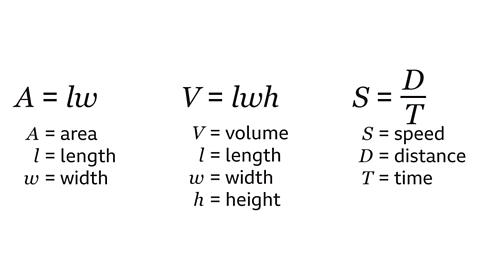
A formula is a rule which is expressed algebraically. Formulas are used to find one quantity, given one or more other quantities.
For example, \(A = ½ b \times h\) is the formula, or rule, for finding the area of a triangle: area equals half base times height.
We can use this formula to find the area of any triangle if we know the base and the height.
Equation
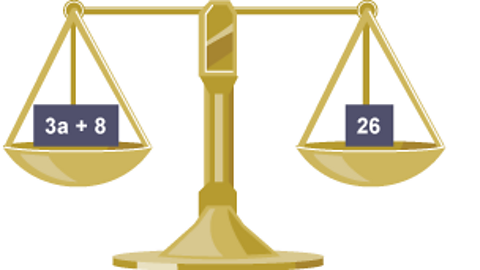
An equation is a statement showing that two expressions are equal. Often equations can be ‘solved’ by finding values which make the statement true.
For example, the equation \(2x + 3 = 11\) is true when \(x = 4\), because both sides of the equation are equal to 11.
Remember that equations and formulas have an ‘=’ symbol but expressions do not.
Inequalities
In algebra, just as in number, the symbols, <, >, ≤ and ≥ can be used in a mathematical statement.
They are used to show when a term or expression is greater or less than another term or expression.
Examples:
\(5x + 7 < 19\) 5x + 7 is less than 19
\(2m ≤ 5q\) 2m is less than or equal to 5q
\(10t – 4 > 15 – t\) 10t – 4 is greater than 15 – t
\(0 ≥ 4p – 16\) zero is greater than or equal to 4p – 16
Question
Which of the following are not inequalities?
a) \(-4 + 5m≤ 7\)
b) \(12v = 3v - 315\)
c) \(12h >\)
d) \(9 - 18k ≥ 2j\)
Answer
b) & c)
b) is an equation not an inequality.
c) is not an inequality as there are no terms to the right of the inequality sign.
Question
Look at the inequality below:
\(6k – 7 j > 12 – k\)
Which of the following statements are true? There is more than one!
a) \(6k - 7j\) is greater than or equal to \(12 – k\)
b) \(6k – 7 j\) is less than \(12 – k\)
c) \(6k - 7j\) is greater than \(12 – k\)
d) \(12 – k\) is less than \(6k – 7j\)
Answer
Statement c) is true
Statement d) is also true as the two statements:
\(6k – 7 j > 12 – k\) and \(12 – k < 6k – 7j\) are giving us the same information.
Remember that the symbol > or < always points towards the smaller side of the inequality.
Test yourself
More on M1: Algebra
Find out more by working through a topic
- count3 of 7