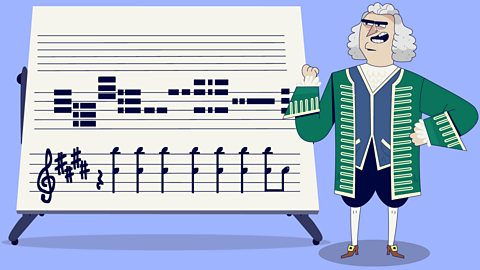
How is music written down?
The musical symbols used when writing music down. is used to write down music.
It's one way to remember what you have To write your own music..
It's also great in helping other musicians read your music and play it for themselves.
If you can read and write music yourself, then you'll be able to play the music that other people have written too.
Watch: Understanding notation with Bach
Music notation allows musicians to read the A pattern of sounds of different durations. and How high or low a musical sound is. of the notes they are supposed to play.
It contains many different forms. See if you can spot three different types of notation Bach introduces to Lightning Jelly.
Izzy: Whoops! How does this bit go again?
Hasan: How can you forget? It’s easy… Oh hang on, I’ve forgotten it too.
Ed: Er, me too…
Ruby: Yeah, we’re more forgetful than Mr… Umm…
Asha: Maybe we’d remember if f I wrote it down! There’s the quick bit, then the squiggly bit, then the badaboom badabing bit… See?
Ruby: Let’s take five.
Izzy: Woah! A BACH music game!
Ed: YOU’RE really good Ruby!
BACH: STOP IT! Don’t give up on your song! You just need to write it down with some NOTATION. Come with me if you want to not forget!
BACH: LEVEL ONE: RHYTHM
Ed: Oh I get it! The dot is a short note, and the dash is a long one.
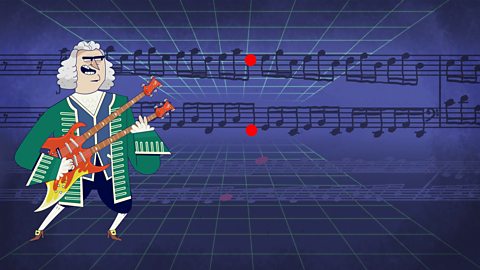
BACH: QUICK. Get to the guitar!
BACH: LEVEL TWO: PITCH
Hasan: Woah! The height of the notes show the pitch.
Ruby: Yeah, the low notes down here.
Izzy: And the high notes up here!
BACH: Come on! Faster!
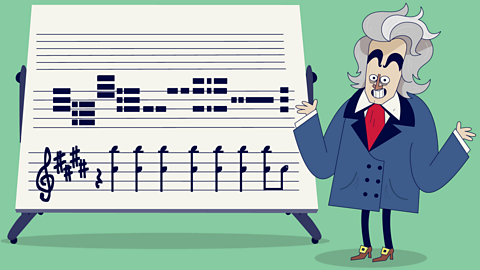
BACH: LEVEL THREE: WESTERN NOTATION.
BACH: This is how I write my music down. The space between the notes shows the duration, and the height shows the pitch. Ha-ha!
Ed: What about guitar tabs?
BACH: Yes! You got it! That is another way of writing music down. Writing music down allows other people to play and helps you forgetful folk remember it. So do it. Come on! Do it now!
Asha: No problemo!
BACH: You guys are gonna make great composers! But I’ll be Bach!
Did you spot the three different types of notation in the video?
They were:
- Western notation
- guitar tabs
- rhythm notation
You might recognise the piece that Bach was playing on his guitar.
Learn more as James May introduces a more traditional performance of Bach's most famous piece, Tocatta and Fugue in D minor with BBC Ten Pieces.
What are notes?
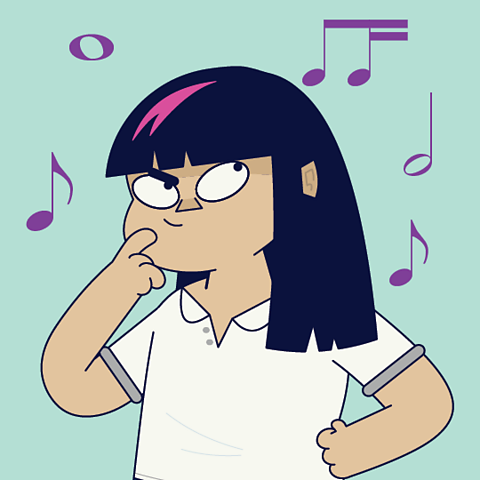
Rhythms are made up of notes with different The length of time each note is played for..
Each note can be represented by a different symbol.
All of the notes have different names.
For example, a one beat note is called a crochet, a two beat note is called a minim.
Watch: What are the main notes?
You can use animal names to help you learn each of the main notes.
This is great fun and helps you to hear the different durations of each note too.
Naomi: OK, first question. What is notation?
Clogs: Notation is a way to write down music using symbols called notes.
Naomi: Right. So are there any notes that I need to be aware of for my first lesson?
Clogs: Yes. They are called semibreve, minim, crotchet and quaver.
Naomi: Well, it sounds a bit like you're talking in a different language.
Clogs: I am not although I can explain further in a different language, if you would prefer, activating Dutch language mode.
Naomi: No, no, no, wait.
Clogs: [In dutch] A semibreve is always four beats long.
Naomi: OK, now I'm really lost. Mrs Thomas, I need help.
Mrs Thomas: Oh, don't worry, Naomi. I've got just the thing to help you understand simple rhythm notation. I give you the tree of rhythm.
Naomi: Oooh exciting, but I'm still confused.
Mrs Thomas: Can you remember what a rhythm is?
Naomi: Yes. A rhythm is a pattern of sounds of different lengths.
Mrs Thomas: Yes, Well done. Each of these symbols is a musical note that sounds for a different length of time.
Naomi: So does that mean if we mix them up, we could create a rhythm?
Mrs Thomas: Oh, yes, it does, indeed. But before we get on to that, we need to learn how many beats each note is played for.
Naomi: All right, so a beat. That's the steady pulse running through music.
Mrs Thomas: Yes, correct. Let's start at the top of the tree and work our way down.
The first note is called a semibreve.
Naomi: Now that's the open circle. How long is that played for?
Mrs Thomas: Well, let's see if you can work it out. I like to remember note durations using my favourite animals. And first up the bear.
Naomi: Oh, I didn't think bears would be involved in this lesson.
Mrs Thomas: Well, a semibreve is played for this length of time B-air-air-air
Naomi: That's a very long bear.
Mrs Thomas: Yeah, you're right.
It should probably look more like this.
Can you guess how many beats are in a semibreve?
Naomi: Oh, OK, I think it was probably four.B-air-air-air.1234.
Mrs Thomas: That's right.
Next up, the minim.
Naomi: The minimum looks like the semi brief, but it's got a line sticking out of it.
Mrs Thomas: Yeah, Good observation.
Minim sounds like this c- ow, c-ow
Naomi: C-ow, c-ow. Ah, the minimum cow sound half as long as the semibreve bear.
Mrs Thomas: How many beats does that make a minimum?
Naomi: OK, I think it's two beats for each note.C-ow, c-ow, 1212.
Mrs Thomas: Oh, Well done. Moo-ving on.We have the Crotchet and another new animal.
Cat. Cat, Cat, Cat.
Naomi: Cat, Cat, Cat, Cat! They're one beat each.
Mrs Thomas: Fantastic. And finally we have the quaver.
Naomi: Oh, they've all got fun little tails.
Mrs Thomas: Yeah, they do.When you have two quavers next to each other, they are paired and their tails join together to form a beam.
And the animal I use for a pair of quavers is the monkey.
mon-key, mon-key, mon-key, mon-key
Naomi: Mon-key, mon-key, mon-key, mon-key So each quaver is half a beat mon and key.
But when grouped together, a pair of quavers is a whole beat monkey.
Mrs Thomas: Exactly. Let's see if you can remember the duration of all the notes.Can you make your way down our rhythm tree all by yourself?
Naomi: I think so. You can join in as well. I'll count us in ready?
1234B- air -air - air
c-ow, c-ow
Cat, cat, cat, cat.
Monkey, monkey, monkey, monkey!
Mrs Thomas: Well done. The last thing you'll need to know is how to do a rest.
Naomi: Ooh yes, don't mind if I do. Night night, Mrs Thomas.
Mrs Thomas: Oh, no, no, no, not that kind of rest. A rest is a gap or silence in the music where you don't play and this is the symbol for a one beat rest and to show a rest we're going to do this sssh.
Naomi: OK? Sssh.
Mrs Thomas: Brilliant. Now we know the different notes.
We can mix them up to make rhythms. Try and read this.
Naomi: All right, join in as well.1234.Cat, cat, sssh, cat.
Mrs Thomas: Well done.
Naomi: I did it! I read rhythm notation. Thanks, Mrs Thomas. I'm gonna go and tell Clogs he is gonna be so proud.
Watch: What is Western notation?
In Western notation, the different rhythm notes are drawn on a When music is written down on five horizontal lines and four spaces that represent different pitch or instruments. which is a set of five lines.
The notes can sit on the line, or in the spaces between the lines.
All Western musical instruments and the players in a Western orchestra, will use this type of notation to read which note to play and how long for.
Katie: What on earth are all these lines Clogs?
Clogs: Oh, I am glad you asked Katie.
Now that you are learning the skills and knowledge to be a musician, it is important to understand musical notation.
Katie: Notation?
Clogs: Notation is simply writing music down. We can show different pitches in music by drawing them on a stave.
Katie: A stave?
Clogs: A stave like the one on the screen is five parallel lines onto which we put musical notes.
Katie: Oh, OK, So what happens if we put a note low down on the stave?
Clogs: That means it is a lower pitched note.
Katie: So I guess if we put a note higher up on the stave, it means it's a higher pitched note.
Clogs: Exactly. And when we put notes of different pitches together, we create a melody, which is the tune it looks and sounds like this.
[Twinkle twinkle little star melody]
Katie: OK, that makes sense. How else is a stave helpful to musicians?
Clogs: Putting the notes on a stave not only helps musicians know the pitch of a note, it also tells them the duration of each note, which is how long or short the note is played for.
Katie: Well, I like the sound of the this clogs and when you have notes one after another on different durations, that creates a rhythm.
So the stave is essential then if you want to play the music without having to remember it all or have other musicians play it.
Thanks, Clogs.
It's all starting to make sense now.
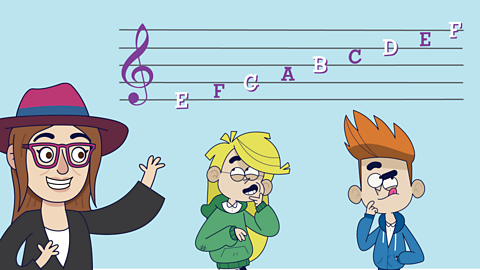
Remember, the pitch of the note is how high or low it is.
Most instruments (like the violin, flute or trumpet) read notes from what is called the A symbol that is used when writing music to show the pitch of the notes on a stave..
Simple rhymes can help you remember the name of the note pitches. For the notes on the lines, some people say:
Every
Green
Bus
Drives
Fast
The notes that sit in the spaces between the lines, spell out the word FACE.
If you need to write the notes above or below the stave, you can add additional lines (called ledger lines).
Activities
Quiz
Play BBC Bitesize educational games! game
Fun, interactive games for children aged 4-11, with maths, English, science, history and many more subjects.

More on Sounds and Symbols
Find out more by working through a topic
- count4 of 4
- count1 of 4
- count2 of 4