What are the key learning points?
An object has gravitational potential energy \(E_{p}\) because of its position above the ground.
The equation \(E_{p}\) = mgh is used to calculate the potential energy in joules, where m is the mass in kilograms, h is the vertical height in metres and g is 10 N/kg.
Kinetic energy \(E_{k}\) is the energy possessed by a moving object.
The equation \(E_{k}\) = \(\frac{1}{2}\) mv2 is used to calculate kinetic energy in joules, where m is the The amount of matter an object contains. Mass is measured in kilograms (kg) or grams (g). of the object in kg and v is the speed of the object in m/s.
What is kinetic energy?
All moving objects have kinetic energy, \(E_{k}\).
KE is a scalar quantity as it does not have a direction.
The KE of an object depends on its:
- mass;
- how fast the object is moving i.e. its speed (or The rate of change of displacement. The distance travelled in one second in a specified direction. Measured in m/s.).
What would have more kinetic energy - a bird or an aeroplane?
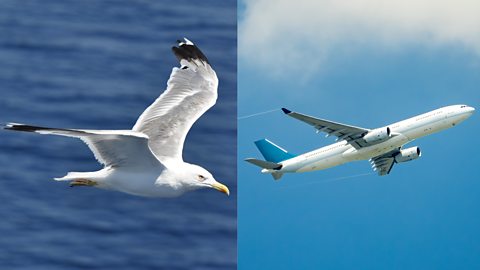
The aeroplane above would typically have more kinetic energy than the bird for two reasons:
It has more mass.
It has a greater speed.
Another example is space junk.
A small bolt in orbit could be dangerous because even though it has a small mass, it has a huge speed, therefore a huge amount of kinetic energy.
How to calculate kinetic energy
The kinetic energy of a moving object can be calculated using the equation:
Kinetic energy = \(\frac{1}{2}\) x mass x (speed)2
Kinetic energy = \(\frac{1}{2}\) mv2
or
\(E_{k}\) = \(\frac{1}{2}\) mv2
where:
\(E_{k}\) = kinetic energy in joules, J
m = mass in kg
v = speed in m/s
Question
What is the kinetic energy of a 1000 kg car travelling at 5 m/s?
Answer
\(E_{k}\) = \(\frac{1}{2}\) mv2
m = 1000 kg
v = 5 m/s
\(E_{k}\) = \(\frac{1}{2}\) 1000 kg x (5 m/s)2
\(E_{k}\) = 12,500 J
The car has 12,500 J of kinetic energy
Question
A car of mass 1200 kg, travelling at a steady speed, has a kinetic energy of 175 kJ. What is the speed of the car?
Answer
\(E_{k}\) = \(\frac{1}{2}\) mv2
The car has 175 kJ of kinetic energy. This must be converted into J to use in the equation for kinetic energy.
175 kJ = 175,000 J
\(E_{k}\) = 175,000 J
m = 1200 kg
175,000 = \(\frac{1}{2}\) x 1200 kg x v2
175,000 = 600 kg x v2
v2 = \(\frac{175,000 J}{600 kg}\)
v2 = 291.67
v = \(\sqrt{291.67}\)
v = 17.1 m/s
The car has a speed of 17.1 m/s.
Question
A 60g tennis ball is travelling at 70 m/s after a player’s serve.
What is kinetic energy of the tennis ball?
Answer
m = 60g = 0.06 kg
v = 70 m/s
KE = \(\frac{1}{2}{mv^2}\)
KE = \(\frac{1}{2}\times{0.6}\times{70^2}\)
KE = 147 J
What is the relationship between kinetic energy and work done?
A moving object has kinetic energy because work has been done on it.
When work is done, energy in one form is transferred to the kinetic energy of the moving object.
To stop the object again, the same amount of work would have to be done to bring it back to rest.
If an object travelling at a certain speed has 2000 J of kinetic energy, we can say that:
2000 J of work has been done in getting the object to travel at that speed from rest.
And 2000 J of work would have to be done to bring it back to rest.
Key fact
- Kinetic energy = work done
Question
A car travelling along a straight road has kinetic energy of 150000 J.
The breaks are applied, and it is brought to rest over a distance of 65 m.
Calculate the average force of the car breaks.
Answer
The car has 150000 J of kinetic energy.
This means that 150000 J of work will have to be done on the car to bring it to rest.
i.e. Kinetic energy = work done = 150000 J
Work done = Fd
Work done = 150000 J
Distance d = 65 m
150,000 = F x 65 m
F = \(\frac{150000 J}{65 m}\)
F = 2308 N
The average force of the car breaks is 2308 N.
What is gravitational potential energy?
Any object lifted above the ground has gravitational potential energy (or GPE).
The amount of gravitational potential energy an object has on Earth depends on its:
- mass;
- height above the ground.
In the diagram:
- All the books on a shelf have GPE.
- Books A and B have more GPE than book C because they are higher.
- Book B has more GPE than book A because it has a greater mass.
Gravitational potential energy is a scalar quantity as it has no direction.
How to calculate gravitational potential energy
The gravitational potential energy of an object raised above the surface of the Earth can be calculated using the equation:
Gravitational potential energy = mass x gravitational field strength x vertical height raised
gravitational potential energy = mgh
or
\(E_{p}\) = mgh
where:
\(E_{p}\) is the gravitational potential energy in joules, J
\(m\) is the mass in kilograms, kg
\(g\) is the gravitational field strength in newtons per kilogram, N/kg
\(h\) is the change in height in metres, m
Question
A book with a mass of 0.25 kg is lifted 2 m onto a bookshelf. If g is 10 N/kg, how much gravitational potential energy does it gain?
Answer
\(E_{p}\) = mgh
m = 0.25 kg
g = 10 N/kg
h = 2 m
\(E_{p}\) = 0.25 kg x 10 N/kg x 2 m
\(E_{p}\) = 5 J
The gravitational potential energy gained by the book is 5 J.
Question
A book of mass 600 g has 12 J of gravitational potential energy. How high is it above the Earth’s surface? (g = 10 N/kg)?
Answer
The book has mass 600 g.
This must be converted into kg to use in the equation for gravitational potential energy.
600 g = \(\frac{600~kg}{1000}\) = 0.6 kg
\(E_{p}\) = mgh
\(E_{p}\) = 12 J
m = 0.6 kg
g = 10 N/kg
12 J = 0.6 kg x 10 N/kg x h
h = \(\frac {12~J}{{0.6~kg} \times {10~N/kg}}\)
h = 2 m
The book is 2 m above the surface of the Earth.
Gravitational potential energy and work done
If an object is lifted, work is done against the force of gravity.
When work is done energy is transferred to the object and it gains gravitational potential energy.
If the object falls from that height, the same amount of work would have to be done by the force of gravity to bring it back to the Earth’s surface.
If an object at a certain height has 2000 J of gravitational potential energy, we can say that:
2000 J of work has been done in getting the object to that height from the ground and 2000 J of work would have to be done to bring it back to the ground.
Key fact
Change in gravitational potential energy = work done
Kinetic energy, gravitational potential energy and conservation of energy
If an object, such as a ball is lifted above the ground it has gravitational potential energy.
If the ball is then dropped from rest it will fall back to the ground.
The gravitational potential energy is converted to kinetic energy.
Due to the Principle of Conservation of Energy we can say that:
Gravitational potential energy at the top = kinetic energy at the bottom
GPEtop = KEbottom
This is assuming that air resistance is ignored i.e. no energy is converted to heat or sound on the way down.
Question
A ball of mass 0.4 kg is lifted to a height of 2.5 m.
It is then dropped, from rest.
What is the speed of the ball as it hits the ground (g = 10 N/kg)
Answer
GPEtop = KEbottom
m = 0.4 kg
g = 10 N/kg
h = 2.5 m
(mgh)top = (\(\frac{1}{2}\) mv2)bottom
0.4 kg x 10 N/kg x 2.5 m = \(\frac{1}{2}\) x 0.4 kg x v2
10 = 0.2 v2
v2 = \(\frac{10}{0.2}\)
v2 = 50
v = \(\sqrt{50}\)
v = 7.1 m/s
The ball returns to the ground with a speed of 7.1 m/s.
Question
- A mass of 25 kg is dropped from the top of a tower 20 m high. What is the speed of the mass as it hits the ground?
- A mass of 50 kg is then dropped from the same height. What is its speed as it hits the ground?
Answer
- GPEtop = Kebottom
m = 25 kg
g = 10 N/kg
h = 20 m
(mgh)top = (\(\frac{1}{2}\)mv2)bottom
25 kg x 10 N/kg x 20 m = \(\frac {1}{2}\) x 25 kg x v2
5000 = 12.5 v2
v2 = \(\frac{5000}{12.5}\)
v2 = 400
v = \(\sqrt{400}\)
v = 20 m/s
The 25 kg mass returns to the ground with a speed of 20 m/s.
- GPEtop = Kebottom
m = 50 kg
g = 10 N/kg
h = 20 m
(mgh)top = (\(\frac{1}{2}\)mv2)bottom
50 kg x 10 N/kg x 20 m = \(\frac {1}{2}\) x 50 kg x v2
10 000 = 25 v2
v2 = \(\frac{10,000}{25}\)
v2 = 400
v = \(\sqrt{400}\)
v = 20 m/s
The 50 kg mass returns to the ground with a speed of 20 m/s, which is exactly the same as the speed of the 25 kg mass.
If there was no air resistance or drag, the 25 kg mass and the 50 kg would fall at the same rate of 10 m/s2.
Dropped from the same height, they both hit the ground at the same speed and after the same period of time.
This is true of all objects regardless of their mass - in the absence of air resistance (friction) they fall at the same rate.
What is strain energy?
A force acting on an object may cause the shape of an object to change.
Elastic objects can store strain energy if they are stretched or squashed.
For example, this happens when a catapult is used or a spring is stretched.
Objects can also store strain energy when they are squashed.
For example, this happens when a squash ball is dropped onto a hard surface or a stress ball is squeezed.
Work is done on an object when its shape changes.
When work is done, energy is transferred, and this energy is stored as strain energy.
When the object returns to its original shape, the stored strain energy is released.
Test your knowledge
More on Unit 1: Energy
Find out more by working through a topic
- count5 of 5
- count1 of 5

- count2 of 5
- count3 of 5