Air raids

Britain was attacked from the sky for the first time, early in 1915.
No one expected air raids, so when German airships first flew over Britain, people weren't ready.
As the war went on, whistles would sound the alarm and people learnt to run for cover in London Underground stations or at home in cellars.
Watch: A London air raid
Watch and listen to one boy’s account of a London air raid in 1916 during World War One.
NARRATOR: On the night of 2 September 1916, German airships attacked London.
Williams Leefe Robinson, a young lieutenant in the Royal Flying Corps, took to the air in his single engine biplane to defend the city.
On the ground a young boy, Patrick Blundstone, watched the night’s events unfold.
Afterwards he wrote a letter to his father describing what happened.
PATRICK BLUNDSTONE: Dear Daddy, I hope you’re not alarmed.
You shouldn’t be, unless you know where one of the Zepps went.
I had heard that it raided London, up The Strand, and caused heavy causalities.
This I know because I saw, and so did everyone else in the house.
Here is my story…
I heard the clock strike 11 o’clock. I was in bed and just going to sleep.
Between 2 o’clock and 2.30 o’clock, we saw flashes and then heard bangs and pops.
Suddenly a bright yellow light appeared and died down again.
“Oh! It’s alright,” said the Poolman. “It’s only a star shell.”
That light appeared again. We rushed to the window and looked out and there right above us was the Zepp!
It had broken in half and was in flames, roaring and crackling.
It went slightly to the right and crashed down into a field.
It was about a hundred yards away from the house and directly opposite us.
It nearly burnt itself out but it was finished by the fire brigade.
I would rather not describe the condition of the crew, of course. They were dead. Burnt to death.
The Zepp was bombed from an aeroplane above with an incendiary bomb, by a Lieutenant Leefe Robinson.
We have some relics, some wire and wood framework.
The weather is beastly. I hope you’re all well.
Your loving son, Patrick.
P.S. Please don’t be alarmed, all is well that ends well, as this did for us. We are all quite safe.
NARRATOR: The burning airship lit up the sky for miles around.
Thousands of people watched as the wreckage plummeted into a field, in the village of Cuffley.
It was the first time a Zeppelin had been shot down in Britain.
The next morning 10,000 people gathered at the crash site to collect a souvenir.
The day became known as Zepp Sunday.
The pilot who shot down the airship became an overnight hero.
Two days later, William Leefe Robinson was awarded the Victory Cross, the highest award for gallantry.
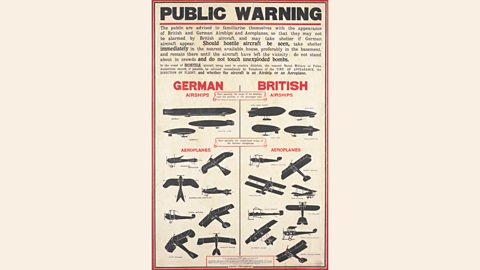
German airships and aeroplanes
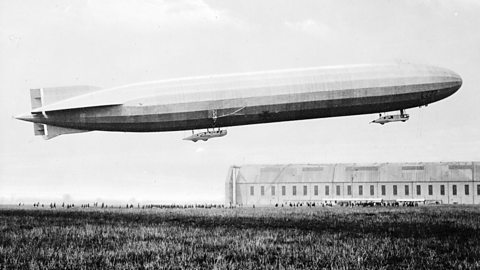
German airships were called Zeppelins. Large bags filled with hydrogen gas enabled them to float.
The crew controlled the engines from a compartment underneath. They dropped bombs on factories and military bases.
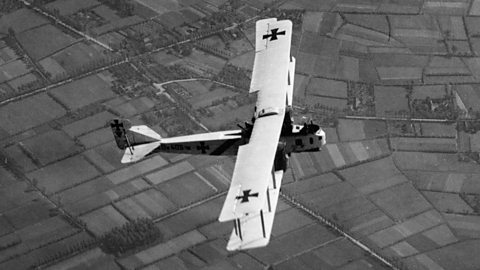
The Gotha bomber could travel a long way and fly higher than British aircrafts. Gotha attacks were devastating.
Later Germany developed an even bigger, more dangerous bomber called The Giant.
German air raids were was one of the reasons the Royal Air Force was formed in April 1918.
Watch: Attacks by sea
Watch our video to learn what happened to a small British town when it was attacked by Germany from the sea.
[SNARE DRUMS]
LILY’S GREAT-GREAT-GRANDDAUGHTER: At the start of World War One Britain was protected by the largest navy in the world.
There hadn’t been a war in Britain for over 150 years.
So in 1914 my great-great-grandmother Lily felt safe.
This her, she lived by the sea in Hartlepool.
But one morning in December 1914 something terrible happened in Hartlepool.
Afterwards, in school, Lily wrote all about it.
LILY: I was walking to meet my friends when suddenly I saw flashes out at sea and through the fog I saw the shape of ships.
There was a big booming sound, like thunder but louder.
Then there was an explosion.
Now I knew that the ships I had seen were firing at us.
At first I hid behind a wall.
I could see the shells flying through the air, they made a swishing, whizzing sound.
I started to run as fast as I could. I was very frightened.
I found my mum and she was crying when she saw me.
My brother and I thought the Germans were invading.
People on the street started rushing everywhere.
My mum held our hands very tight and we went through the town, trying to get inland, away from the sea.
I thought that the battleships must be able to see us all running.
They hit the gasworks near where my dad was working, I really wanted to see him.
Then the booming and the firing stopped. The ships had sailed away.
When we got back to our street my dad was waiting for us.
Half the front of our house had fallen down. My bed was hanging over the street!
My mum was very quiet and she was upset but I was happy that we had got away.
In the street I saw pieces of broken metal. They were shrapnel, bits of exploded bombs.
The shrapnel was still warm, I put it in my pocket.
Later that week, at school, our teacher told us that the Germans had not wanted to invade.
They wanted to attack places that were important to the British war effort.
The Germans also fired at people in Scarborough and Whitby that day.
Over 100 people had been killed in our three towns.
Soon, like lots of men, my dad decided to join the army. He couldn’t forget what happened.
I didn’t want to forget either so I kept the shrapnel in my pocket.
LILY’S GREAT-GREAT-GRANDAUGHTER: And now I have the shrapnel that my great-great-grandmother picked up, so I will always remember what happened to her on that day too.
How did people stay safe?

Streetlights were dimmed so enemy pilots would struggle to see their targets.
Whistles blew to raise the alarm.
Searchlights helped gunners to spot airships or planes, and shoot them when they were close.
Policemen shouted warnings as they cycled round the streets wearing a sign saying "take cover".
In London, thousands gathered on Underground platforms, under bridges and railway arches, or even under the stairs at home.
What happened after the air raids?
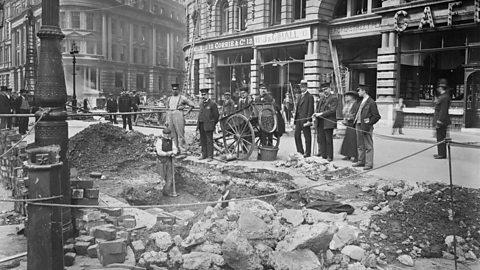
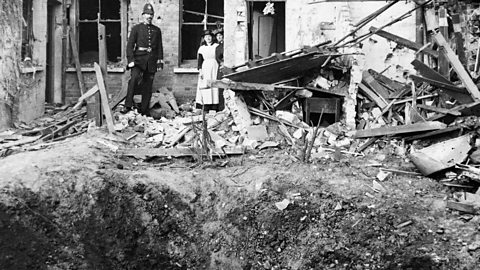
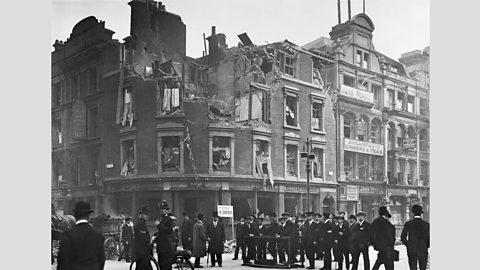
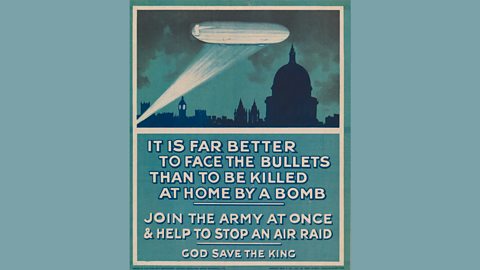
Image caption, Everyone was shocked when the Germans attacked from the air
Before the war, wealthy people could fly between cities by airship. People in Britain had seen pictures of airships but no one imagined they might be used to drop bombs.
1 of 5
By the end of the war, almost 1,500 British citizens had been killed in air raids, and over 3,400 had been injured.
Activities
Activity 1: Quiz – Air raids during World War One
Activity 2: History Explorer game
Play this game to test your knowledge and learn even more facts about World War One.
History Explorer: Secrets through time
History Explorer: Secrets through time: KS2 History

Horrible Histories: Raid and Trade game! game
Play Horrible Histories: Raid and Trade KS2 History

More on World War One
Find out more by working through a topic
- count15 of 20
- count16 of 20
- count17 of 20
- count18 of 20