Let's learn about vibrations and sound.
Watch and learn
Watch this video to find out how vibrations and sounds are related.
Video
How do vibrations help us hear sound?
The scientists are experimenting with different sounds.
Title: Vibrations
Sound is actually a vibration. A vibration is when an object moves backwards and forwards very, very quickly – like this guitar string. The movement causes the air to vibrate out in all directions in a wave. We call this a sound wave.
Sound waves are all around us. They are unique vibrations from lots of different things.
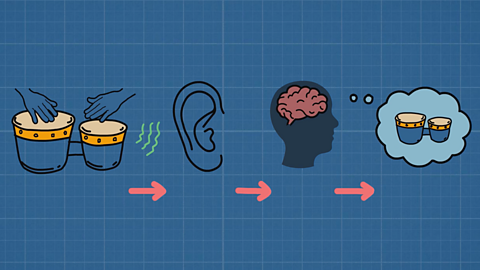
In our experiment, the bongo drum makes a noise by vibrating the skin that is stretched over the drum. That causes vibrations in the air that travel as a wave. It reaches our ears, then our brains make sense of it as a sound.
We can change the sounds we hear by changing the way we make vibrations. If the guitar player keeps the string long, the vibration is slow. This means the sound wave is long and spread out. We can say the sound has a low pitch.
But if he makes the string shorter by holding it down with a finger, when he plucks it, then the vibrations are quicker and closer together. The sound will be higher. When the shorter string is plucked it has a higher pitch.
When we speak, sing, or make sounds we vibrate our vocal cords. There are muscles inside our body. Touch your neck while singing or speaking and you’ll feel the vibrations in these muscles.
Try it, we can all sing a little bit. Or maybe not.
What are vibrations?

Check your connection, refresh the page and try again. are tiny shaking movements that go back and forth in a material.
Tip: Think of a mobile phone vibrating when receiving a phone call! Even if the phone is on silent, the vibrations still make a sound.
Vibrations can be produced in lots of different ways.
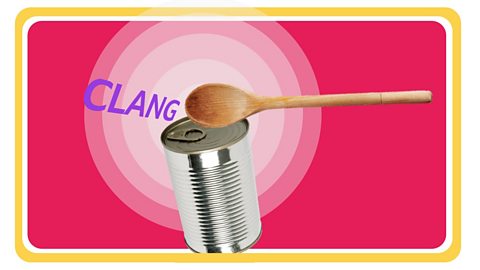
Examples:
hitting two objects together
plucking a tightly stretched wire or string
pushing air through a tight space
rubbing certain objects together
Are sounds vibrations?
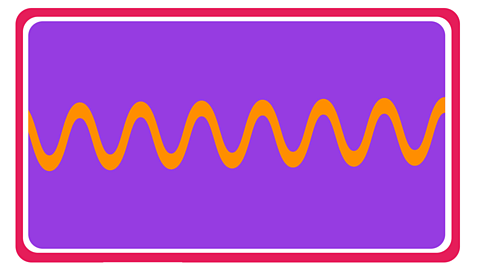
Yes!
Sounds are vibrations.
They travel out from a source as waves.
The vibrations from the source make the molecules around them vibrate (shake and wobble) too.
Vibrations can travel through different things (solids, liquids and gases) to our ears👂
Our brains 🧠 then make sense of what we are listening to.
Did you know?
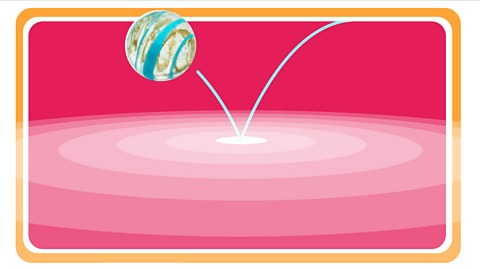
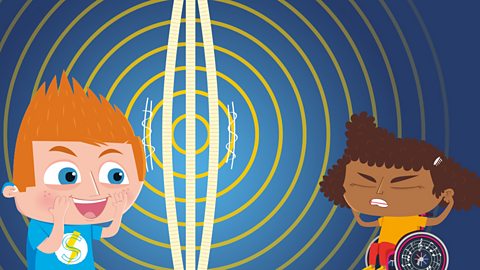
Sound waves spread out in all directions from the source, just like ripples from a stone thrown into a pond. That’s why you can hear someone banging a drum wherever you are in the room.
The sound waves get weaker as you get further away from the source and so the sound gets quieter.

A drum is an excellent sound-making object. The skin of the drum is stretched very tightly over the body of the drum. When the skin is hit, it vibrates and produces sound.
Hitting the drum harder, with more energy, makes a louder sound. The sound waves are larger and spread out further, carrying the sound a greater distance.
Sound
Sound is defined by:
- Check your connection, refresh the page and try again.: how loud or quiet the sound is
and
- Check your connection, refresh the page and try again.: how high or low the sound is
These two things are not connected. A high-pitched sound can be loud or quiet, as can a low-pitched sound.
Pitch
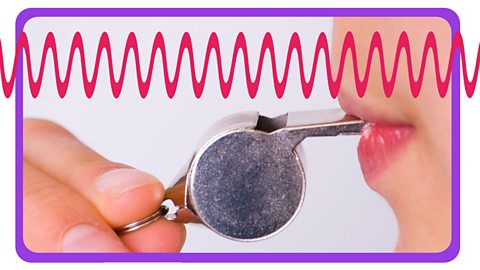
The pitch of a sound is determined by the speed of its vibration.
It is measured in Check your connection, refresh the page and try again.. This tells you how many vibrations happen in one second.

Image caption, A roar: a low-pitch sound
A slow vibration such as a lion roar (between 40 – 200Hz) produces a low-pitched sound.
1 of 2
Try this

Rest your hand on your windpipe.
Hum a tune.
Can you feel the vibrations? As you change the pitch of your humming you will feel the vibrations change speed.
( Humans make sounds by pushing air out of our lungs through a pair of vocal folds in our windpipe. The vocal folds cause the air to start vibrating and the sound is shaped by the mouth into recognisable sounds such as speech! )
Activity

Make an elastic band guitar!
You will need:
a show box or plastic food container
elastic bands of different lengths and widths
protective glasses
Watch the video below for instructions
Video

Check your connection, refresh the page and try again. – Tiny movements back and forth in a material.
Check your connection, refresh the page and try again.(Hz) – The units of measurement of pitch. 100Hz means 100 waves per second.
Check your connection, refresh the page and try again. – How loud or quiet a sound is. Measured in decibels.
Check your connection, refresh the page and try again. – How high or low a sound is. A whistle is high pitched and thunder is low pitched.
Quiz
More on Light and sound
Find out more by working through a topic
- count2 of 3
- count3 of 3